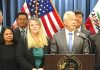
California Democrats have begun discussing changes to the state’s primary election rules as concerns grow that the party could fail to advance a candidate to next year’s gubernatorial general election.
The proposal would replace California’s current “top-two” primary system, in which the two candidates with the most votes advance to the November general election regardless of party, with a system that would allow each political party’s top vote-getter to move on to the general election.
Democratic political strategist Steven Maviglio submitted a proposed California constitutional amendment to state officials on May 8 to repeal the top-two primary system. The initiative would restore partisan primaries for state and congressional offices if approved by voters.
Maviglio argued that the current system is no longer functioning as intended. In his proposal, he said voters are repeatedly forced to choose between two candidates from the same party in general elections, leaving some voters without a candidate who represents their political views.
California adopted the top-two primary system through Proposition 14 in 2010. Under the system, all candidates appear on the same primary ballot regardless of party affiliation, and only the top two vote-getters advance to the general election. Supporters at the time argued that the system would reduce partisan polarization and encourage candidates to appeal to a broader electorate.
But the system has drawn renewed scrutiny ahead of the 2026 California governor’s race. Recent polling has shown Republican commentator Steve Hilton and Riverside County Sheriff Chad Bianco running near the top of the field, raising the possibility that two Republicans could advance to the November general election while Democrats are left without a nominee.
Maviglio’s proposal is widely seen as a response to Democratic concerns that the party could be shut out of the general election. However, any change would take time. If the initiative qualifies for the ballot, voters could decide on it in 2028, and the revised primary rules would not take effect until the 2030 election cycle at the earliest.
Critics argue that Democrats are seeking to change the rules only because the current electoral landscape could work against them. A coalition called More Choice California has already launched an effort to defend the current nonpartisan primary system, arguing that the repeal push is backed by political operatives from both major parties.