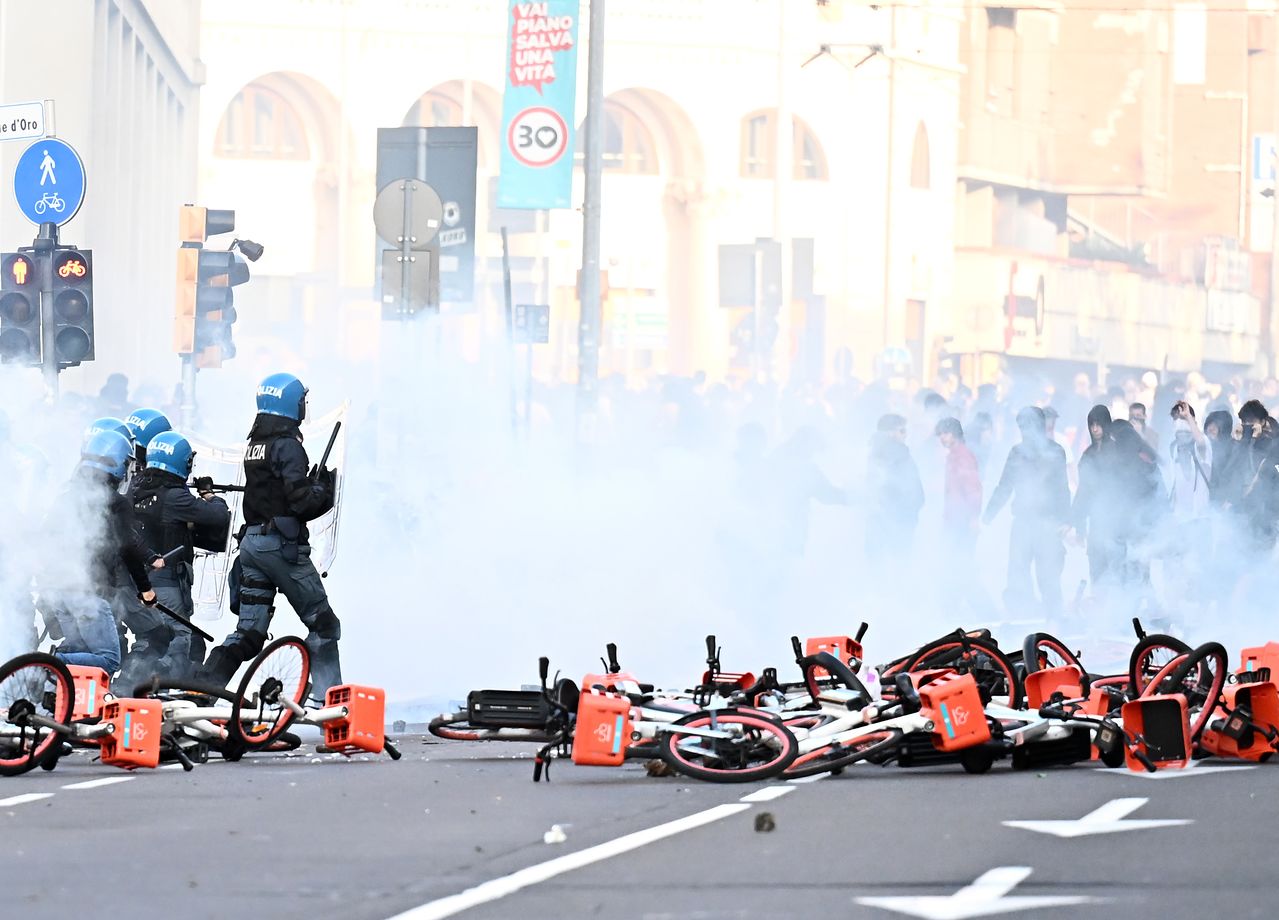
Violent protests and looting fueled by public anger are spreading from France across Europe. As France weighs declaring a state of emergency, similar incidents involving looting, arson, and violence have erupted in Italy, Belgium, and Albania, while tent protests persist in Spain and Portugal over housing issues.
In Milan, Italy, a protest involving 5,000 people on October 17–18 turned chaotic as masked individuals broke into stores to loot merchandise. Euronews reported that clashes in the Duomo Square between protesters throwing stones, fireworks, and petrol bombs and police firing tear gas resembled urban warfare. On October 19, luxury brands in Milan’s Montenapoleone district, including Hermès, cleared their display windows out of fear of looting.
Protests also broke out in Turin, Bologna, and Bergamo. Italian Prime Minister Giorgia Meloni stated that while protesting is a right, burning down cities is not, announcing the deployment of 500 troops to Milan.
In Belgium, protesters demonstrating against education budget cuts and other grievances overturned and burned vehicles, primarily in Brussels and Liège. In Albania, protesters smashed windows at the ruling Socialist Party headquarters and set fire to the entrance of the Ministry of Interior on October 18.
Meanwhile, housing protests continue in Spain and Portugal. Following the October 7 death of 87-year-old Maricarmen Abascal—who died after being forcibly evicted from an apartment in Madrid where she had lived for 70 years—protests demanding affordable housing erupted across roughly 50 cities. Portugal has seen similar housing crisis demonstrations in Lisbon and Porto.
At the root of these simultaneous protests lies a broader European crisis. Citizens struggling with the cost of living are demanding expanded public services and wage increases, yet Europe’s national wealth remains stagnant. The International Monetary Fund (IMF) projects European economic growth at just 1.1% this year. Government debt-to-GDP ratios in Italy (137.1%), France (115.6%), and Belgium (107.9%) far exceed the European Union average of 81.7%. Furthermore, tax burden ratios relative to GDP in France (44%), Italy (43%), and Belgium (43%) all surpass the OECD average of 34%, making further tax hikes difficult.
Adding to these strains, a growing immigrant population is intensifying social tensions. The foreign-born population across the 27 EU member states surged by 46.1%, rising from 44.29 million in 2015 to 64.72 million in 2025. Non-EU-born residents account for 46.7 million people, or 10.4% of the total population. As cities face ongoing housing shortages, the rising demand for rental housing and refugee facilities has triggered public pushback. Some residents also voice concerns that migrant workers are driving down labor standards in low-wage sectors.
This environment is accelerating the rise of hard-right political forces. The Financial Times reported that right-wing politicians, including Marine Le Pen of France’s National Rally (RN), have argued that decades of uncontrolled immigration are the underlying cause driving these demonstrations.