When the ignition of Hyundai’s 25.5-ton hydrogen electric dump truck, the ‘New Xcient,’ was turned on, a faint operating sound unique to hydrogen vehicles echoed through the cabin. The rough engine noise and strong vibrations typically felt in diesel trucks were absent.
During the 10-minute test ride, the experience was as quiet as riding a pure electric vehicle, with almost no shaking during acceleration or braking. A Hyundai official explained, "Hydrogen trucks are quiet and can travel up to 700 km on a single charge. With refilling taking only 30 minutes, they are advantageous for long-distance logistics."
Hyundai Unveils Integrated Hydrogen Solutions at WHE 2026
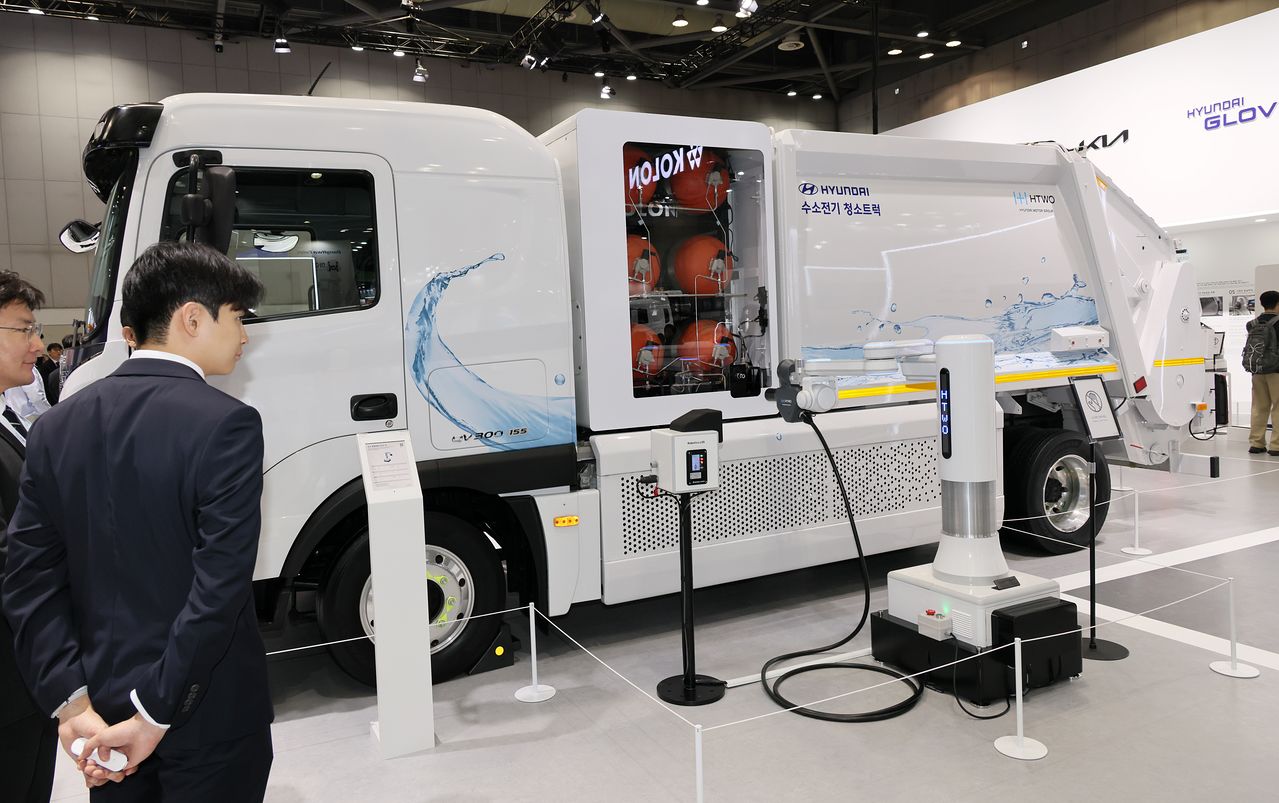
This hydrogen truck is part of the comprehensive hydrogen solution showcased by Hyundai Motor Group on the 4th at the ‘World Hydrogen Expo (WHE) 2026’ held at KINTEX in Goyang, Gyeonggi Province. The group unveiled its vision for hydrogen technology encompassing production infrastructure, mobility, and urban-industrial ecosystems.
In the mobility sector, Hyundai introduced solutions ranging from passenger cars like the ‘Nexo’ to commercial vehicles such as trucks and buses, and even railway locomotives. Notably, they showcased fuel cell systems with enhanced durability suited for long-distance commercial driving, and the ‘Blulink Uptime’ system for real-time remote diagnostics.
Autonomous Robot ACR-H Simplifies Hydrogen Refueling
A demonstration of the hydrogen vehicle autonomous charging robot, Hyundai Hydrogen City technology known as ‘ACR-H,’ was also held. Once charging began, a robotic arm equipped with vision AI autonomously located the vehicle’s charging port, removed the protective cap, and inserted the charger. After refueling, it replaced the cap and returned to its original position.
In the production sector, the ‘Waste-to-Hydrogen (W2H)’ model converting organic waste into biogas and hydrogen drew attention. This technology is currently implemented at ‘HTWO Energy Cheongju,’ a hydrogen production and charging complex. A new polymer electrolyte membrane water electrolysis module was also unveiled for the first time.
Saemangeum AI Valley and Future Outlook
Hyundai Motor Group emphasized applying this hydrogen ecosystem model to the Saemangeum AI Valley, which will be established with an investment of approximately 9 trillion won. The initiative aims to connect hydrogen production, AI data centers, robot manufacturing plants, and urban infrastructure to realize future hydrogen cities tailored to local characteristics.