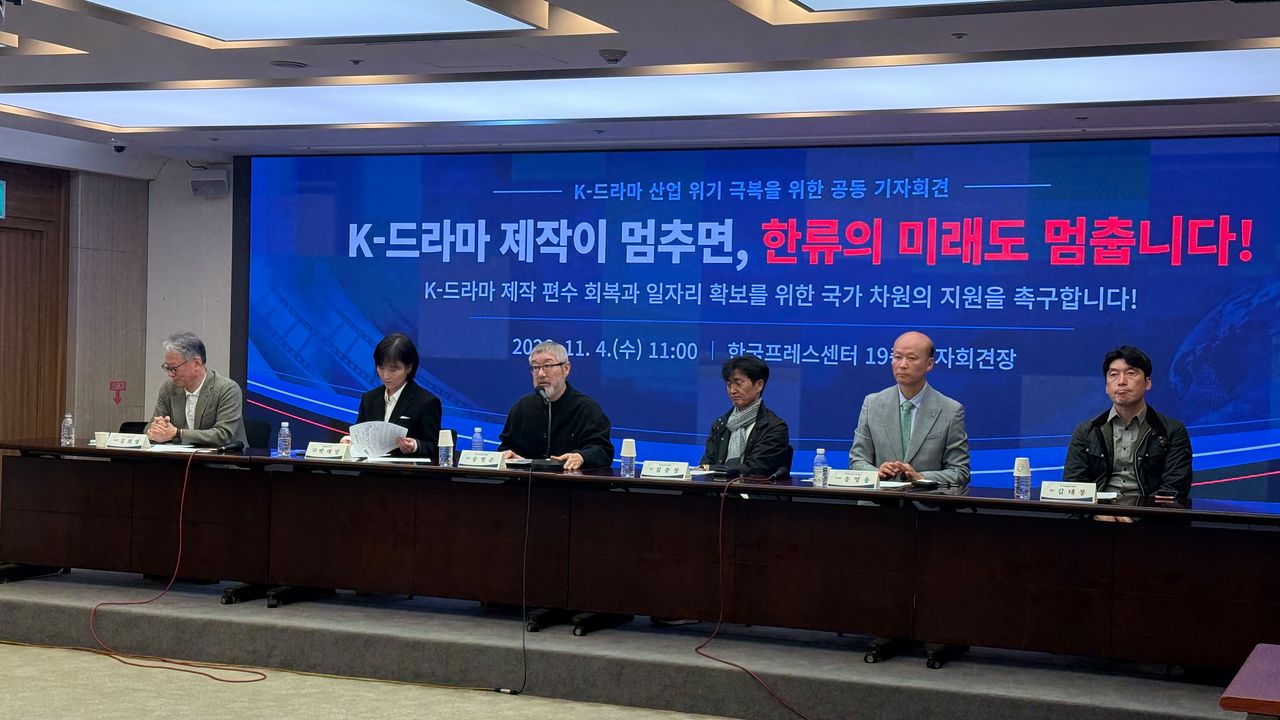
12 associations representing domestic broadcasting creators and staff gathered to declare that the K-drama industry, which leads the Korean Wave, is facing a crisis of survival and urged a pan-governmental response.
On the 4th, 12 related organizations including the Korea Drama Production Association, Korea Drama PD Association, and Korea Television & Radio Writers Association held a press conference at the Korea Press Center in Jung-gu, Seoul. They stated that rising production costs and declining investment capacity have created a structure where investing in dramas leads to losses, which in turn reduces production volume. They called for the establishment of a 1 trillion won scale drama investment and support system.
According to these associations, domestic drama production fell from 141 series in 2022 to about 30% lower two years later. Dramas scheduled by terrestrial broadcasters dropped from 91 series in 2012 to 32 in 2023. The associations diagnosed this as the result of rising production costs coupled with shrinking advertising revenue, pointing to global OTT production methods as the main driver of cost increases.
The organizations emphasized that reviving the foundation of the drama industry is a national task. Last year, total Hallyu-related exports reached $18.975 billion (approx. 25.39 trillion KRW), driven by the expansion of K-dramas. However, they pointed out that government support falls short of this significance. In next year’s Ministry of Culture, Sports and Tourism budget proposal, the broadcasting and video sector budget was cut by 4.5 billion KRW (from 91.8 billion to 87.3 billion KRW), and the Korea Communications Commission’s broadcasting content promotion budget also decreased by 4.4 billion KRW (from 16.8 billion to 12.4 billion KRW).
The associations suggested setting a policy goal to restore annual drama production to the levels seen before relying heavily on global OTT platforms. Furthermore, they urged the creation of a foundation where investment works linked with domestic broadcasters and OTT platforms can be scheduled and distributed using a mid-to-long-term drama investment fund of 1 trillion KRW.