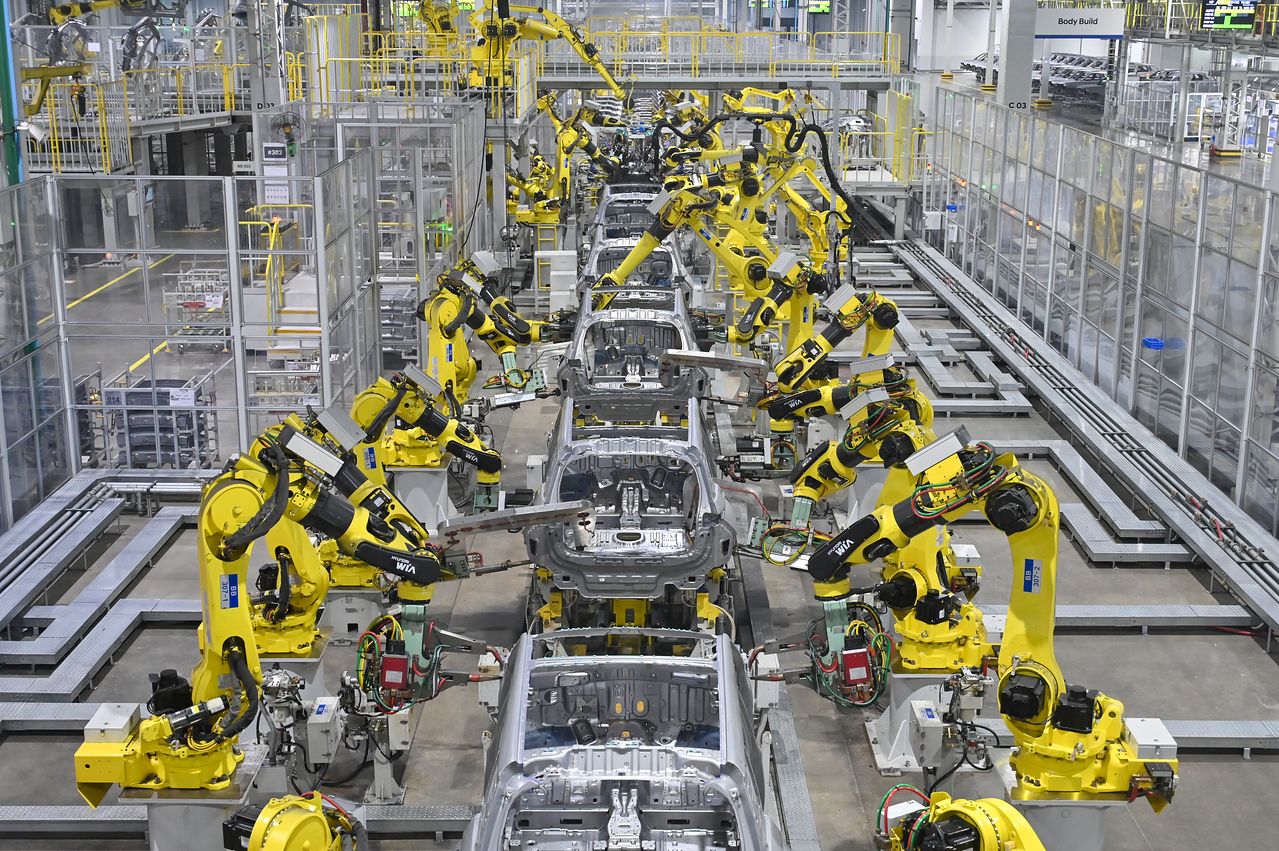
At the Hyundai India plant in Pune, Maharashtra, two yellow robotic arms lift a large steel plate to attach to both sides of a vehicle. Moving dozens of kilograms of steel into position on the car body frame was seamless, raising the total body weight to 360 kg before moving it via conveyor belt without human intervention. Another robotic arm then welded the steel seams, producing a completed body frame every two minutes.
This facility is the former General Motors (GM) plant that halted operations in 2020. Hyundai acquired it in late 2023 and began producing the ‘Venue’ compact SUV in October of last year. While GM utilized only six robots, the facility now operates 204 robots, achieving 100% automation in welding processes. A Hyundai official managing the body shop noted that everything except the building’s structural pillars was replaced.
The body shop assembles and welds stamped steel panels to create the vehicle’s skeleton. Robotic arms standing around two meters tall operate ceaselessly across 86 processes, configured to either transport or weld steel sheets depending on the attached tools.
Automation in welding at this low-labor-cost location is primarily driven by quality control. Transporting the welded body to the painting process takes about three hours. Officials explained that manual welding leads to positional inaccuracies and quality deviations.
Quality verification also relies heavily on automation. 3D coordinate measuring machines (CMM) and laser scanners precisely check the dimensions and shapes of completed car bodies, detecting microscopic errors invisible to the human eye.
Artificial intelligence (AI) manages safety protocols. In the press shop where a 5,400-ton press forms hoods and doors, AI cameras monitor virtual safety boundaries to track workers in real-time, ensuring equipment only operates when the danger zone is clear.
Overhead cranes transporting heavy steel plates feature visual red rectangular warning zones projected onto the floor to prevent worker access. Cameras and vibration sensors are also installed to monitor crane movements continuously.
Hyundai Motor Group plans to continue large-scale investments in factory automation. During the inauguration ceremony at the Pune plant, Hyundai Motor Group Vice Chairman Chang Jae-hoon announced that approximately 60% of the $15.5 billion (approx. 20 trillion KRW) slated for investment in India between 2026 and 2032 will be allocated to upgrading and expanding aging production facilities. The remaining 20% each will target new industries like AI and startups, and research and development (R&D).
Hyundai aims to strengthen its flexible production system to manufacture multiple models on a single line. The company is also establishing a local investment entity, ‘HMG India,’ to expand its business footprint beyond finished vehicles into AI and energy sectors. Expansion at the Pune plant is accelerating, with Vice Chairman Chang stating that production capacity will rapidly scale from the current 170,000 units to 320,000 units annually.