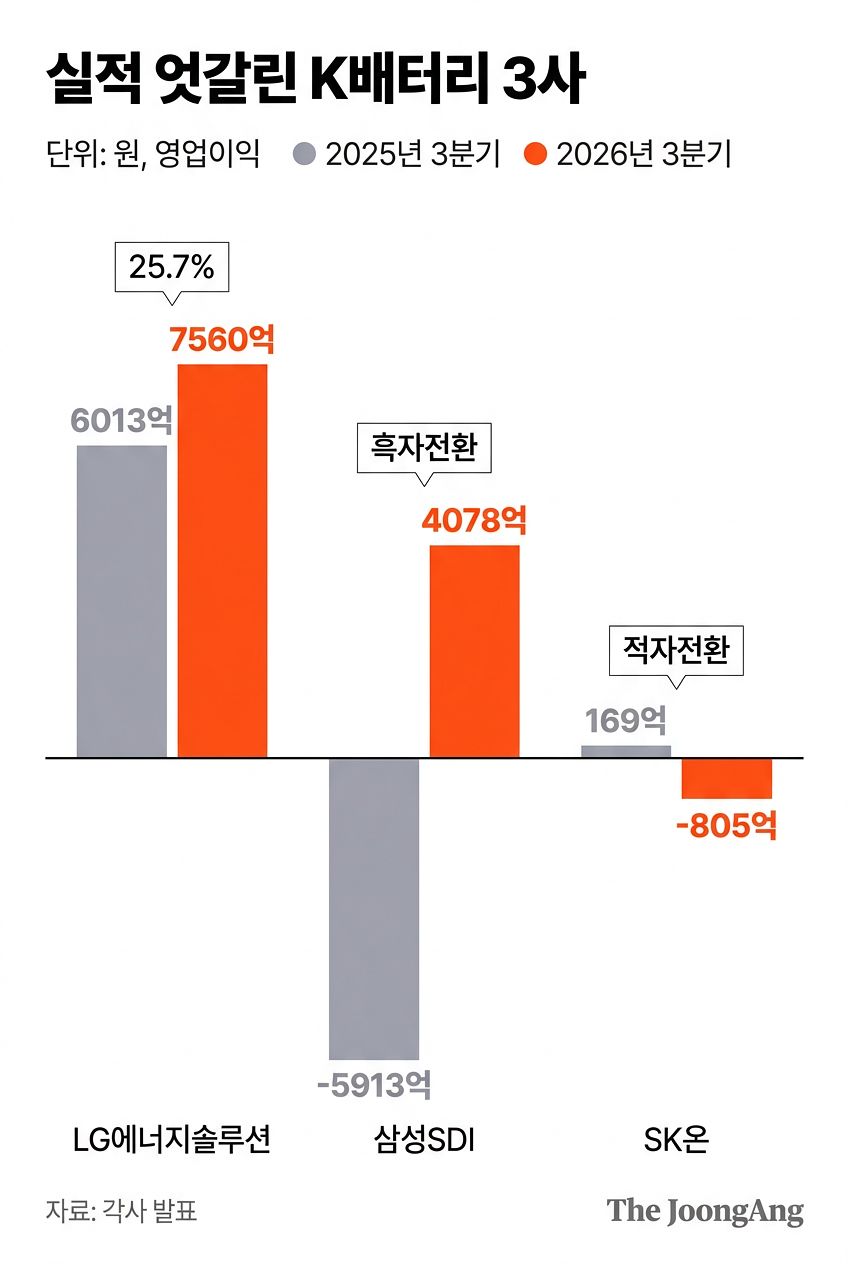
South Korea’s top three battery makers posted divergent earnings reports for the third quarter, as the speed of translating their new growth engine—energy storage system (ESS) batteries—into actual financial performance varied significantly.
Samsung SDI and LG Energy Solution Post Strong Growth
Samsung SDI announced on October 29 that its third-quarter revenue reached 4.6856 trillion KRW, a 52.6% increase compared to the same period last year. The company successfully turned a profit with an operating profit of 407.8 billion KRW, bouncing back from an operating loss of 591.3 billion KRW a year earlier. Samsung SDI attributed the improved performance to surging sales of ESS and battery backup units (BBUs), driven by the expansion of the global artificial intelligence (AI) data center market. ESS units, which store electricity in advance for later use, predominantly utilize lower-cost lithium iron phosphate (LFP) batteries. Domestic battery manufacturers are expanding into ESS batteries to cope with the electric vehicle chasm, or temporary demand stagnation.
Notably, Samsung SDI secured over 60 gigawatt-hours (GWh) of ESS orders in the United States this year alone and began mass production of high-capacity prismatic LFP cells at its StarPlus Energy (SPE) plant in the U.S. this month. Meanwhile, LG Energy Solution, which released its preliminary Q3 results earlier on October 8, also posted solid figures with revenue of 9.6434 trillion KRW and an operating profit of 756 billion KRW, up 59% and 25.7% year-over-year, respectively. LG Energy Solution similarly pointed to increased ESS shipments in the North American region as a key driver of its improved operating profit.
SK On Faces Deficit Amid Delayed ESS Revenue Recognition
In contrast, SK On was the only one among the K-battery earnings trio to record a quarterly loss. The company reported revenue of 1.5263 trillion KRW and an operating loss of 80.5 billion KRW. While SK On achieved a record-high operating profit of 821.8 billion KRW in the previous quarter due to one-time gains such as customer compensation, it has now returned to a deficit. However, the company explained that the scale of the loss has narrowed significantly compared to the 349.2 billion KRW operating loss recorded in the first quarter of this year.
An SK On official explained that while they are steadily securing ESS orders from the United States and elsewhere, most of these orders are scheduled for delivery next year and have not yet been reflected as revenue. The official added that excluding one-time factors, the company is maintaining an improvement trend in its fundamental profitability.