ASD Market Week K-Goods Fair Hosts Press Briefing
Organizers cite K-culture, favorable exchange rates and digital marketing as export opportunities
Businesses call for more overseas trade events and stronger buyer networks
LAS VEGAS — Organizers of the K-Goods Fair, a special exhibition held during ASD Market Week 2026 at the Las Vegas Convention Center, said Korean consumer products are gaining unprecedented opportunities to enter the U.S. market. However, they emphasized that expanding long-term distribution channels and buyer networks will be the key to sustained success.
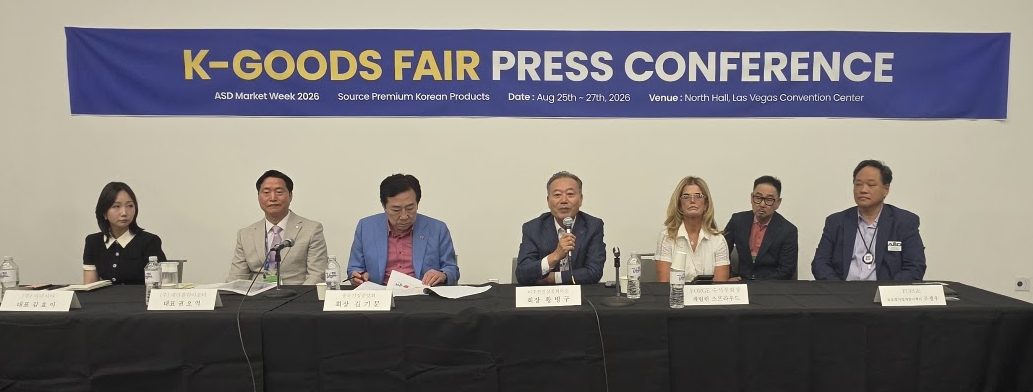
The comments came during a press briefing following the opening of the exhibition, which brought together organizers, trade officials and participating companies to discuss the event’s significance and future prospects.
Among those attending were Kim Ki-moon, chairman of the Korea Federation of SMEs (KBIZ); Hwang Byung-gu, president of the Federation of Korean American Chambers of Commerce USA (FKACCUSA); Carolyn Sprague, vice president of Pojz (formerly Emerald X); Joseph Woo, the company’s global business development director; and representatives from Korean beauty and consumer goods companies.
Kim said Korean small and medium-sized businesses increasingly depend on overseas markets for growth.
“Many innovative Korean SMEs cannot rely solely on the domestic market,” Kim said. “Launching a large-scale Korean pavilion at such a well-established international trade show represents an important new beginning for Korean exports.”
He added that several factors are creating favorable conditions for Korean products abroad, including the continued popularity of Korean culture, the expansion of digital marketing channels and a more favorable exchange rate for exporters.
Sprague, whose company manages the exhibition, said buyer response had been encouraging from the opening day.
“We’ve received very positive feedback on Korean products,” she said. “Our goal is to build a long-term bridge connecting Korean companies with buyers throughout North America.”
She noted that ASD Market Week has spent the past 65 years connecting manufacturers with retailers around the world and described the K-Goods Fair as opening “a new gateway” for Korean products to reach American consumers.
Participating businesses agreed that while government support has helped companies attend overseas exhibitions, expanding access to qualified buyers remains the industry’s biggest challenge.
Kim Hyo-i, CEO of wellness brand Innersia, whose products have ranked among the best sellers at Olive Young in Korea, said many SMEs invest heavily in product development and marketing but still struggle to meet overseas buyers.
“Korean companies are eager for more opportunities to connect directly with international buyers,” she said. “Trade shows like K-Goods Fair provide real business opportunities, and we hope governments, business organizations and private companies will work together to expand these programs.”
Organizers also acknowledged suggestions that broader participation from Korean-American chambers of commerce across the United States could further strengthen future events, saying they would explore long-term improvements.
Responding to questions about whether additional government assistance is needed, Kim said financial support for exhibitors is already substantial.
“The Korean government currently covers roughly 80% of booth costs, which is among the highest levels of support provided by any country,” he said. “The remaining challenge is not booth funding but continuously updating buyer databases and maintaining long-term relationships with potential customers after the exhibition.”
The three-day K-Goods Fair, held alongside ASD Market Week at the Las Vegas Convention Center, concludes Wednesday, with the next event scheduled for March 2027.