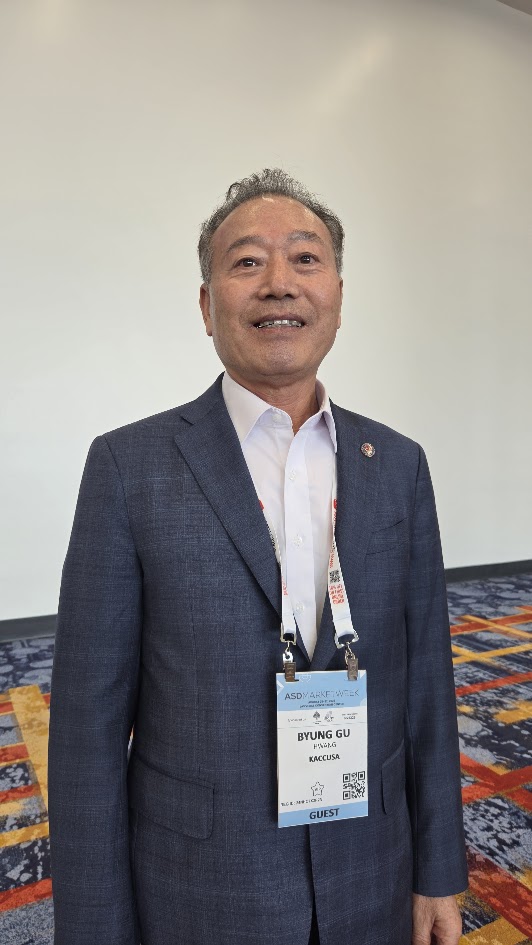
FKACCUSA President Hwang Byung-gu
“Success Doesn’t End When the Trade Show Closes”
Hundreds of Business Cards Mark the Beginning of Long-Term Relationships
LAS VEGAS — “We’ve put everything we have into making this fair a success.”
Those were the first words from Hwang Byung-gu, president of the Federation of Korean American Chambers of Commerce USA (FKACCUSA), when asked about the significance of this year’s K-Goods Fair at ASD Market Week in Las Vegas.
For Hwang, the exhibition represents more than just a three-day trade show. It is an opportunity to build a sustainable pathway for Korean small and medium-sized businesses to enter the U.S. market.
“This isn’t the first time Korean companies have participated in overseas trade exhibitions with government support,” Hwang said. “But after years of experience, we’ve reached a point where we must turn those experiences into lasting results.”
He acknowledged that organizers understood the stakes before the event began.
“From both the government’s and the business community’s perspective, continued investment only makes sense if there are measurable results,” he said. “That’s why our team worked day and night to make this event successful.”
The experience also taught organizers several important lessons.
“No one becomes successful overnight,” Hwang said. “It often takes nearly a decade for an annual trade exhibition to establish itself. More importantly, buyer management doesn’t begin or end during the show. It has to continue throughout the year.”
He noted that while business agreements can develop over many months, many Korean SMEs lose contact with potential buyers after returning home.
“That’s where we see our role,” Hwang said. “The real work begins after the exhibition ends.”
FKACCUSA has previously hired staff to help Korean businesses maintain communication with overseas buyers following other international trade events. Even so, Hwang believes much more remains to be done.
Asked what ultimately determines whether Korean companies successfully enter the U.S. market, Hwang pointed to the stack of business cards collected during the exhibition.
“The hundreds of business cards we’ve gathered over the past few days represent the beginning—not the end—of the process,” he said. “Following up, maintaining communication and building trust with those contacts will determine whether business actually happens.”
He said Korean companies need patience and persistence, adding that FKACCUSA intends to serve as a long-term bridge connecting Korean manufacturers with American buyers.
“We want to be the bridge that helps Korean companies stay connected until those relationships turn into real business opportunities,” he said.
Looking ahead, Hwang said organizers are also considering expanding participation to include larger Korean manufacturers if the event continues to grow.
“Some buyers were interested in placing orders large enough to fill dozens of shipping containers,” he said. “In some cases, participating companies simply didn’t have the production capacity to meet that demand. That tells us we need to broaden the scope of future exhibitions.”
Hwang also emphasized the importance of greater participation from the Korean-American business community.
“A bridge is needed within the Korean-American community as well,” he said. “Many successful first-generation entrepreneurs are approaching retirement. Rather than allowing those businesses to disappear, we hope to help pass them on to the second and third generations so they can continue to grow.”