〈SERIES〉
- Employment, Income & Business Trends
- Housing & Home Equity
- Investment & Retirement Planning
- Inflation & Living Costs
- Korean American Bank Usage
Small-Scale Retail Buyers Drive Broad Expansion in Korean American Investment Participation
Investment participation among Korean Americans has expanded substantially over the past six years, driven by a surge in small-scale retail buyers and broader adoption of equities and individual retirement accounts.
According to the 2026 Korean American Economic Life Survey sponsored by Bank of Hope, respondents holding no investments fell sharply to 15.9 percent, down from 23.5 percent in 2023 and 42.4 percent in 2020. Conversely, entry-level investors holding portfolios of $10,000 or less more than doubled, rising from 7.3 percent in 2020 to 17.3 percent this year to form the single largest capital bracket. Middle-tier portfolios between $20,000 and $50,000 also expanded.
Industry analysts note that broad retail participation, rather than wealth concentration, fueled overall market entry. High-value investment accounts exceeding $500,000 declined from 12.2 percent in 2020 to 7.1 percent this year, indicating that while market participation broadened, capital remained dispersed across modest portfolio sizes.
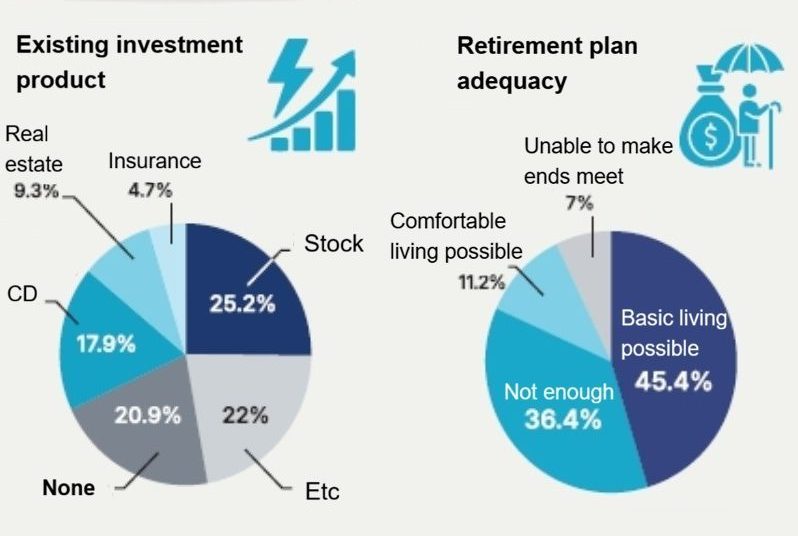
Asset allocation patterns reflected a parallel shift toward public equities. Stock market participation grew steadily from 14.9 percent in 2020 to 20.0 percent in 2023, reaching 25.2 percent this year as markets recovered post-pandemic. Meanwhile, respondents holding no investment products dropped from 32.9 percent to 20.9 percent over the same period. Certificates of deposit and time deposits maintained a solid 17.9 percent share, whereas direct real estate investment holdings fell from 12.4 percent to 9.3 percent.
Capital Preservation Remains Paramount Despite Stock Market Growth
Despite expanding stock ownership, Korean American investors maintained a distinctly conservative risk posture. When choosing investment vehicles, 51.7 percent of respondents prioritized safety and capital preservation, far outpacing the 31.4 percent who prioritized high yields. Preference for capital preservation spiked from 35.8 percent in 2020 to 55.7 percent in 2023, remaining above the majority threshold this year.
Financial planners interpret the concurrent rise in equity participation and capital preservation as a risk-mitigation strategy combining growth assets with defensive positions. High prevailing interest rates also incentivized persistent holdings in certificates of deposit to secure yield without taking on principal loss.
Risk appetite varied significantly across generations. Among respondents in their 30s, the gap between safety at 46.7 percent and return potential at 40.5 percent remained narrow. In contrast, safety preferences widened among older cohorts, reaching 56.9 percent for respondents in their 60s and 55.4 percent for those aged 70 and older, reflecting a shift toward asset preservation as retirement approaches.
Strategic Retirement Planning Expands Amid Ongoing Economic Anxiety
Retirement planning adoption also increased, with 59.2 percent of respondents reporting active retirement preparations compared to 54.1 percent in 2023. Younger demographics led preparation rates, with 70.7 percent of respondents in their 30s and 65.1 percent in their 40s actively preparing for retirement. Preparation rates correlated strongly with employment type, standing at 68.5 percent for professionals and 66.2 percent for corporate employees, but dropping to 44.5 percent for freelancers and 49.8 percent for service-industry workers who lack employer-sponsored plans.
Individual Retirement Accounts emerged as the primary vehicle for retirement savings at 22.6 percent, followed by 401(k) plans at 18.0 percent. The proportion utilizing IRAs grew significantly from 13.7 percent in 2020, while reliance on traditional savings accounts dropped from 16.6 percent to 10.4 percent, and real estate fell from 13.6 percent to 3.9 percent.
Despite higher participation rates, financial anxiety regarding retirement adequacy persists. While 45.4 percent of respondents stated their retirement savings would cover basic living expenses, 36.4 percent deemed their preparations inadequate. Mid-career respondents reported the highest levels of concern, with 44.8 percent of those in their 40s and 42.8 percent in their 50s reporting insufficient savings.
Amid ongoing inflation and broader economic uncertainty, Korean American households are increasingly prioritizing risk reduction and long-term financial resilience over aggressive capital growth.