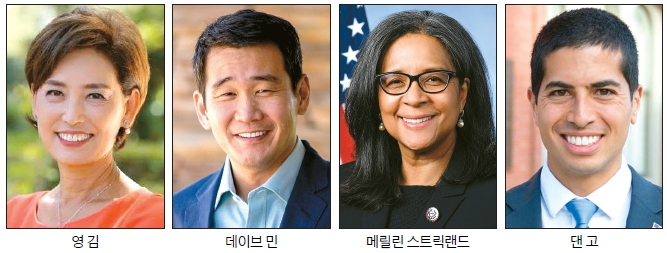
The election prospects of Korean American politicians vary depending on district topography, party inclination, and overall political dynamics. While some candidates continue a stable cruise backed by a solid regional base and overwhelming financial power, others are engaged in fierce battles for public sentiment amid intense competition.
The most fiercely contested battleground is California’s 40th Congressional District, where Republican Representative Young Kim is running. This matchup is evaluated as a prime example of the political fallout caused by gerrymandering, or the redrawing of electoral districts.
Last year, gerrymandering led by the California Democrats forced Rep. Kim into the same district as 17-term veteran Representative Ken Calvert (R-Calif.). With a high-stakes showdown between heavyweights of the same party unfolding in a traditional Republican stronghold, the key to victory ultimately rests with Democratic and independent voters.
According to March figures from CalMatters, the voter registration breakdown by party in this district is 40% Republican, 31% Democrat, and 21% independent.
The overall trend appears to be leaning toward Rep. Kim. In the primary, Rep. Calvert secured 34.9% of the vote, leading Rep. Kim by about 14 percentage points to claim early momentum. However, in an opinion poll conducted last month by Grassroots Targeting, Rep. Kim rebounded with 43% support, overtaking Rep. Calvert, who dropped to 34%. She has also secured an advantage in campaign fundraising, bringing in $8.84 million compared to Rep. Calvert’s $6.14 million.
In contrast, the race for California’s 47th Congressional District by freshman Democratic Representative Dave Min is relatively quiet. The Cook Political Report classified this district as a solid Democratic advantage, favoring Rep. Min. In the June primary, Rep. Min won 45.4% of the vote, defeating Republican challenger Jenny Rae Le Roux by more than 20 percentage points.
As of the end of June, Rep. Min’s fundraising total reached $3.38 million, far outpacing Le Roux’s $376,000 and putting him well on the path to victory.
The campaign of Jane Kim (D), who is running for California Insurance Commissioner as the first Korean American to seek statewide office in the state, is a major focal point of the election. She finished first in the June primary, defeating prominent fellow Democrat State Senator Ben Allen. An opinion poll released on the 6th of last month by Probolsky Research showed Kim leading Allen by 7 percentage points.
However, the ultra-tight race is underscored by the fact that 57% of respondents remain undecided. The large number of undecided voters means the outcome will depend on who can better raise name recognition and absorb support from Republican and independent voters in the remaining time.
Paul Seo (D), Mayor of Rancho Palos Verdes and candidate for California State Assembly District 66, also secured an advantageous position by finishing first in the June primary. Although fellow Democrat Sarah Dean trailed closely by 2 percentage points, mainstream party support leans heavily toward Mayor Seo. Key heavyweights, including incumbent State Assemblyman Al Muratsuchi, U.S. Senators Andy Kim and Adam Schiff, U.S. Representatives Dave Min and Judy Chu, and California Attorney General Rob Bonta, have all endorsed him, demonstrating strong party backing.
In Irvine, former Mayor Sukhee Kang is seeking a political comeback through the City Council District 1 race. He faces a three-way race with incumbent City Councilwoman Melinda Liu and candidate John Park. During the 2024 election, Liu narrowly defeated Park by just 109 votes. The entry of the high-profile former mayor is the biggest variable in shifting voter sentiment. Financially, Kang holds about $120,000, outpacing Liu’s $83,000.
Turning to other states, significant moments in Korean American political history are unfolding. In Washington’s 10th Congressional District, four-term incumbent Representative Marilyn Strickland (D) and Republican Korean American candidate Chris Jung will face off in the general election. This is considered another symbolic matchup in Korean American political history as two candidates representing both major parties compete for a federal congressional seat.
In the top-two primary, Rep. Strickland received 47.3% of the vote and Jung received 31.4%. While Strickland boasts a strong regional base from her time as Tacoma mayor and the advantage of incumbency, Jung drew attention by advancing to the general election without a massive campaign organization or abundant funds. The grass-roots story of a first-generation immigrant pharmacist who has run a pharmacy in Lakewood for over 30 years adds intrigue to how his campaign will resonate in the general election.
Dan Koh (D), running for the U.S. House of Representatives in Massachusetts’ 6th Congressional District, is on a steady trajectory. Bolstered by the district’s traditional Democratic lean and an impressive fundraising total of $4.72 million as of mid-August, he has outpaced Republican challenger Micah Jones, who raised about $450,000, bringing him closer to victory.