A new generation is helping revive the forgotten legacy of Korean independence patriots buried in the United States.
A joint project led by the Korea Daily, Korean National Association Memorial Foundation (a nonprofit preserving Korean independence history), and Hwarang Youth Foundation, with support from Bank of Hope, launched its first event on May 24 at Rosedale Cemetery, near Koreatown, Los Angeles.
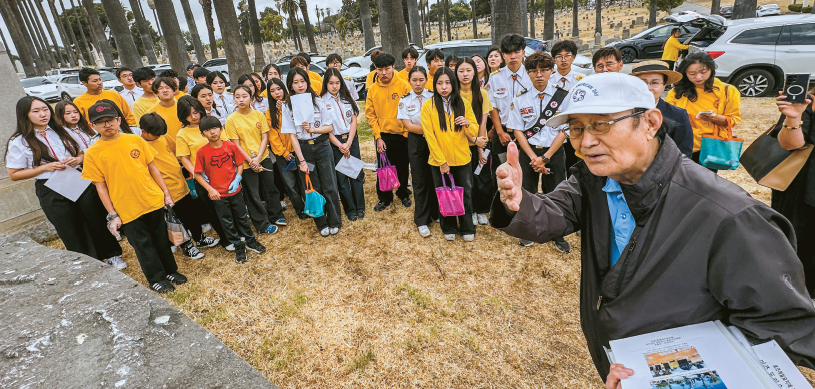
Opened in 1901, Rosedale is one of LA’s oldest cemeteries. According to ongoing research by the Los Angeles Korean American History Museum, 31 Korean independence patriots are buried there.
On the day of the event, 39 students from the Hwarang Youth Foundation located and visited 27 of the graves. The students paid silent tribute, cleaned the headstones by hand, and placed Taegukgi (the Korean national flag) beside each one.
Monthly Maintenance and Deeper Purpose
This initiative marks the beginning of a regular maintenance program. Moving forward, the graves will be cared for monthly in three-person teams formed by student volunteers.
The project goes beyond volunteerism. Organizers emphasized that the activity serves as a powerful educational experience, awakening a deeper understanding of national identity and Korean American history among participants.
Gabriel Kim (18), a student representative, said, “Experiencing history firsthand hit me differently. I felt a sense of duty to remember those who were never repatriated and are buried here in the U.S.”
Angela Lee (16) added, “I could feel the sacrifice of the independence fighters. I’m grateful that we exist today because of them.”
Parental Support and Shared Learning
Many parents joined the students at the cemetery, turning the event into a living history lesson.
Mina Jung, a parent, recalled, “When my child first learned about Dosan Ahn Chang-ho, they asked if ‘Dosan’ was a surname. That’s how little exposure they’ve had to Korean history. Adults need to create these educational opportunities.”
Jamie Lee, who attended with her daughter Alexis Lee, remarked, “Kids who grow up in America don’t have many chances to learn Korean history. This type of experience helps instill a sense of national identity and pride.”
Ongoing Research and Repatriation Goals
The long-term goal of the project is not only the regular care of known graves but also the discovery of additional unknown burial sites and eventual enshrinement at Korea’s National Cemetery.
The Hwarang Youth Foundation continues to investigate unconfirmed graves of independence patriots. They are recording names and locations to build a comprehensive database and prepare for possible repatriation efforts.
Yoonsook Park, president of the Hwarang Youth Foundation, stressed that this is not a one-time event. “This will become a monthly tradition. Through the act of cleaning headstones and placing flags, students learn to carry the pride and identity of their heritage.”
Park also noted a personal shift among students. “Children who used to only sing the U.S. national anthem are now singing the Korean national anthem louder—because they’ve begun to feel its meaning.”
Call for Broader Support
Clara Won, board member of the Korean National Association Memorial Foundation, said, “These graves were abandoned for a long time, with no visitors and no explanations. It’s time for the next generation to take up the responsibility of explaining the meaning of these sites.”
During the event, Pyongyong Min, director of the LA Korean American History Museum, explained the lives of the patriots at each grave to the students. Min has long collected and archived documents on Korean immigration and the independence movement.
Min emphasized urgency: “There are still many patriots whose graves we haven’t identified. Few groups are doing this kind of work, and most are led by the elderly. We urgently need more support from both the Korean American community and the Korean government.”
With each cleaned headstone and newly planted Taegukgi, the forgotten graves began to stir with new life—restored not by monuments, but by memory and care.
BY HANKIL KANG [kang.hankil@koreadaily.com]
AND YEONGCHAE SONG [song.yeongchae@koreadaily.com]