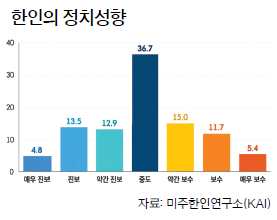
A recent study shows that the Korean American voters population is evenly divided between progressive and conservative ideologies, with the moderate group holding the largest share. In the 2024 presidential election, women showed a clear preference for the Democratic Party, while men split their support almost equally between both major parties.
According to the ‘Current Status and Future Direction of the Korean American Community’ survey by the Korean American Institute (KAI), respondents’ political ideologies were reported as 36.7% moderate, 32.1% conservative, and 31.2% progressive. Although moderates were the largest group, the gap between conservatives and progressives was a mere 0.9 percentage points.
Political leanings also varied by education level. The proportion of moderates was 43.5% among high school graduates or GED holders, but dropped to 35.8% for college graduates and 29.6% for those with graduate degrees or higher.
Conversely, conservative tendencies among post-graduate high-income earners stood at 36.1%, slightly higher than progressives at 34.3%. While moderation decreased among the highly educated, progressive tendencies did not increase unilaterally—a result differing from the general perception that higher education correlates with progressive political views.
Differences were also evident in 2024 presidential candidate support. Among registered voters who participated in the survey, 47.9% responded that they supported Democratic candidate Kamala Harris, which was 14.1 percentage points higher than Republican candidate Donald Trump at 33.8%. Respondents who did not reveal their preferred candidate reached 17.6%.
Gender disparities were particularly pronounced. Harris’s approval rating among women was 52.8%, nearly double that of Trump at 26.9%, with a 25.9 percentage point gap between the two candidates.
In contrast, male voters showed a narrow gap of 2.1 percentage points, with 43.5% supporting Harris and 41.4% supporting Trump. While female voters overwhelmingly supported Harris, male voters demonstrated a virtually neck-and-neck race. Analysts suggest that high support from female respondents contributed significantly to Harris leading in the overall candidate approval ratings.
These survey results indicate that Korean American political orientations and candidate preferences vary by gender and education, suggesting that the Korean American electorate cannot be pigeonholed as a fixed stronghold for any specific political party.
Voter registration rates were also notably high. Among respondents, 70.8% were citizens eligible to vote, and 88.1% of them stated they had completed voter registration. This figure exceeds the estimated overall Asian American voter registration rate of 65.3% for 2024. However, due to potential differences in survey targets and methodologies, and because the results are based on self-reported survey participation, it is difficult to generalize this as the registration rate for all Korean American voters.