As generational shifts take root within the Korean-American community, the educational methods of Korean language schools are also evolving.
In the past, first-generation immigrant parents who were fluent in Korean sent their children to Korean language schools. However, recently, 1.5 and 2nd-generation individuals who are more comfortable with English have established themselves as parents. With the increase in intercultural marriages, more students hardly use Korean at home.
Korean language schools, which used to teach reading and writing to children who grew up hearing Korean at home, now face a situation where they must teach speaking and listening first.
This change is also evident in southern California Korean schools examined around Hangul Day.
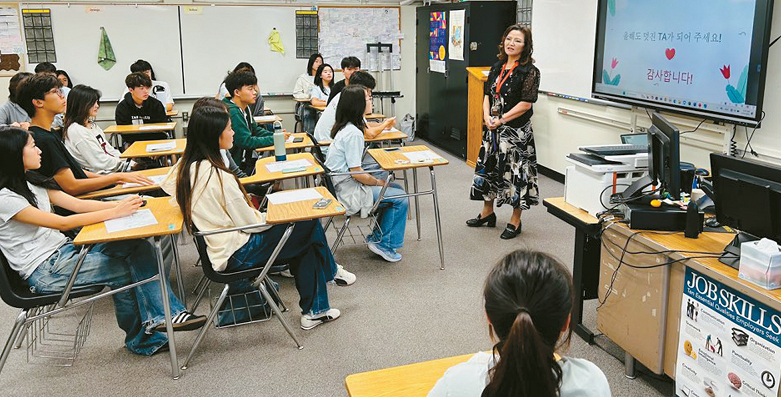
At Fullerton Korean School, the largest among the 11 Korean schools under the Korean Education Foundation of Southern California, 10 to 15 percent of the 400 enrolled students are children of 1.5 and 2nd-generation parents.
Shin Choon-sang, superintendent of the Korean Education Foundation of Southern California who also serves as the principal of Fullerton Korean School, said that students whose parents could not help them with Korean homework often stopped studying after one semester to a year. To support these students, the school created the ‘Homework Club,’ which assists with Korean homework for an hour after class. The number of participating students, initially five, has grown to 40. Teaching assistants (TAs) who are fluent in both Korean and English are also placed in classrooms to explain lesson contents in English and help students understand.
This change is even more pronounced in Atlanta, where the Korean population is relatively small. At the Atlanta Korean School, which has a history of over 40 years, there is an increasing number of students not only with 1.5 and 2nd-generation parents who are clumsy in Korean, but also students directly brought by their grandparents instead of parents.
Go Eun-yang, principal of the Atlanta Korean School, said that they now need to teach speaking and listening, not just reading and writing as before, adding that people must now think of it as second language instruction.
Expectations for Korean language education have also changed. Going beyond simply reading and writing Hangeul, it is expanding into a process of understanding South Korea’s history, holidays, and daily lifestyle, and finding one’s roots. The popularity of South Korean culture, such as K-pop and K-food, is also a factor increasing students’ interest.
Cha Dong-heon and So-hyun, a 1.5-generation couple living in Whittier, prioritized Korean school classes even when their children’s Boy Scouts or athletic schedules overlapped. This was because the father’s regret for not learning Korean sufficiently during his childhood was significant.
All three sons attended Fullerton Korean School, and two sons skipped grades and graduated in the 9th grade. The eldest son Jin-seo, attending UC Davis, teaches friends who want to learn Korean for free at university, and the second son In-seo explains the meaning of Korean lyrics to friends who like K-pop.
The mother So-hyun expressed fulfillment, stating that Korean education goes beyond reading and writing to understanding the culture contained within the language, as her children embrace Korean expressions and history through their own experiences.
The experience built at Korean schools also helps with university admissions. Long-term study of Korean and the history of volunteering as a teaching assistant after graduation can be strong points showing consistent learning and volunteer experience.
However, securing teachers to match the changed student composition and improving teaching methods remain challenges.
Superintendent Shin emphasized that for students who have few opportunities to encounter Korean at home, Korean schools are spaces to experience life and culture through Korean, adding that they are increasing bilingual teachers, sharing new teaching methods through annual teacher training, and revising textbooks as well.