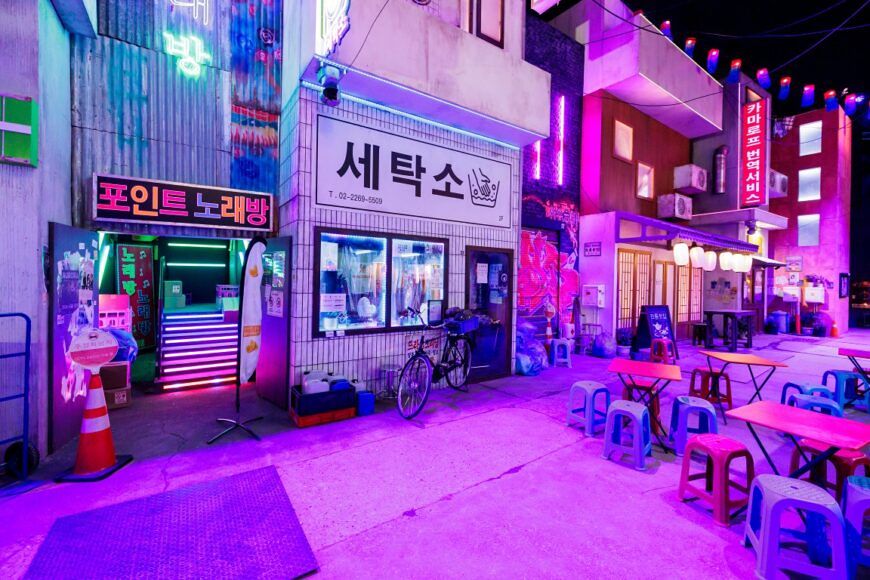
Brightly lit neon signs, Korean storefront signs reading ‘Lightning Charge’, ‘Fusion Cuisine’, and ‘Accessory Wholesale’, and the phrase ‘One-Way’ painted on gray pavement. It looks like a typical alleyway scene in South Korea, but this is actually the Shoreditch district in London, England. Last month, game developer Activision created this pop-up space in a London parking lot to promote ‘Call of Duty: Modern Warfare 4’, a new game set against a Korean backdrop. Foreigners lined up to enter a meticulously crafted space featuring karaoke rooms, unmanned parcel lockers, and PC bangs, walking through the alleys while eating hot dogs and Choco Pies.
As interest in Korea—initially sparked by K-pop—spreads to fashion, beauty, and food, everyday Korean lives are now being recreated all over the globe. Analysts note that ordinary domestic living scenery has become a novel content magnet attracting global consumers.
Opened last month at the Korean Cultural Center in Los Angeles, USA, ‘LA:ON’ is an experiential space introducing so-called ‘K-lifestyle’. It is the LA model of the ‘Global K-ZONE’ project launched by the Ministry of Culture, Sports and Tourism this year. While cultural centers previously focused on general exhibitions and events, this initiative expands into a ‘culture export base’ helping K-culture and related industries enter the local market.
On the first floor of the cultural center, a permanent exhibition titled ‘Text to Texture’ is on display. Starting from the question, ‘How does a single character become a single culture?’, it illustrates how thoughts and emotions recorded in Hangul expand into books, objects, spaces, and tastes through Hanji lighting, furniture, Korean antiques, and crafts.
Next to the permanent exhibition space on the first floor of the Korea Center, rotating pop-up exhibitions take place. Until the 14th, a ‘Text-Hip’ pop-up runs under the theme ‘The Real Face of Korea Met Through Books’. Starting on the 24th, the space transforms into a ‘K-Supermarket’, a lifestyle pop-up where visitors can experience Korean food, daily goods, modern crafts, and traditional cultural products just like browsing a neighborhood market in Korea.
The everyday lives of Koreans also served as the core concept at ‘KCON’, hosted annually in Los Angeles by CJ ENM. Held last August, ‘KCON LA 2026’ was themed around ‘K-SOUL CITY’, transforming the LA Convention Center to resemble a neighborhood in Seoul. Rather than a standard exhibition hall with rowed booths, it was designed so visitors could stroll as if wandering through a Seoul alley. Passages between zones resembled subway stations, and the food zone recreated a Korean night market atmosphere. Street food stalls and merchandise booths lined the area, where visitors sat on red plastic stools typical of Korean marketplaces to enjoy food, successfully recreating the vibe of Euljiro’s outdoor drinking spots. According to local media, approximately 142,000 people visited this ‘Seoul’ over three days.
In Paris, Korean-style grocery stores have emerged. Activision, which previously recreated a Korean alley in London, opened a Korean grocery store called ‘Chez Pape’ in a gallery in the 1st arrondissement of Paris to promote ‘Call of Duty 4’. Past shelves packed with Korean ramen and snacks lies a space set up with a traditional Korean dining table, and opening a refrigerator door reveals a secret passage leading downstairs to a PC bang filled with rows of computers. It is a reproduction of the everyday gaming spaces familiar to Korean gamers right in the heart of Paris.
Pop-ups are not the only examples. In 2024, a Korean-style truck driver restaurant named ‘Kisa’ opened in New York, USA, generating buzz with its Hangul signs, vintage CRT televisions, Korean calendars, and instant coffee vending machines. This ‘authentic local’ sensibility drew immediate lines of eager patrons. Meanwhile, ‘Otsu Coffee’, which opened its first overseas branch in Paris this year, focused heavily on replicating a domestic Korean branch by commissioning the furniture team from its Gwanghwamun location, with the trendy Einspänner remaining its signature menu item.
These spaces differ from the past because they capture the daily routines and lives of ordinary Korean people. While previous global exhibition spaces like Korean pavilions at biennials centered around traditional crafts or fine arts like white porcelain and Hanji, recent trends focus heavily on alleys, PC bangs, night markets, and supermarkets as primary content. Many are designed to transition seamlessly from simple appreciation to direct experience and subsequent purchases.
A major turning point was the 2022 exhibition ‘Hallyu! The Korean Wave’ at London’s Victoria and Albert (V&A) Museum. As the world-class institution formally treated contemporary Korean pop culture and everyday culture as legitimate exhibition subjects, it became a benchmark for subsequent Korean cultural spaces. This is why convenience stores, apartments, and PC bangs from K-dramas now serve directly as ingredients for pop-ups and exhibitions, aligning the interests of governments and corporations seeking to connect cultural experiences with consumer goods exports.
Choi Won-seok, the director who planned the LA Korean Cultural Center’s permanent exhibition and the Text Hip pop-up, noted, “What overseas audiences are really curious about right now is what is genuinely unique to Korea and what contemporary Koreans actually enjoy and care about. Products don’t sell simply because you slap a ‘K’ on them; they sell better when introduced within the cultural context and narrative where those items belong.” He added, “Just selling instant noodles isn’t enough—daily cultural elements like eating ‘Han River ramen’ must be conveyed together so people want to purchase the actual experience.”