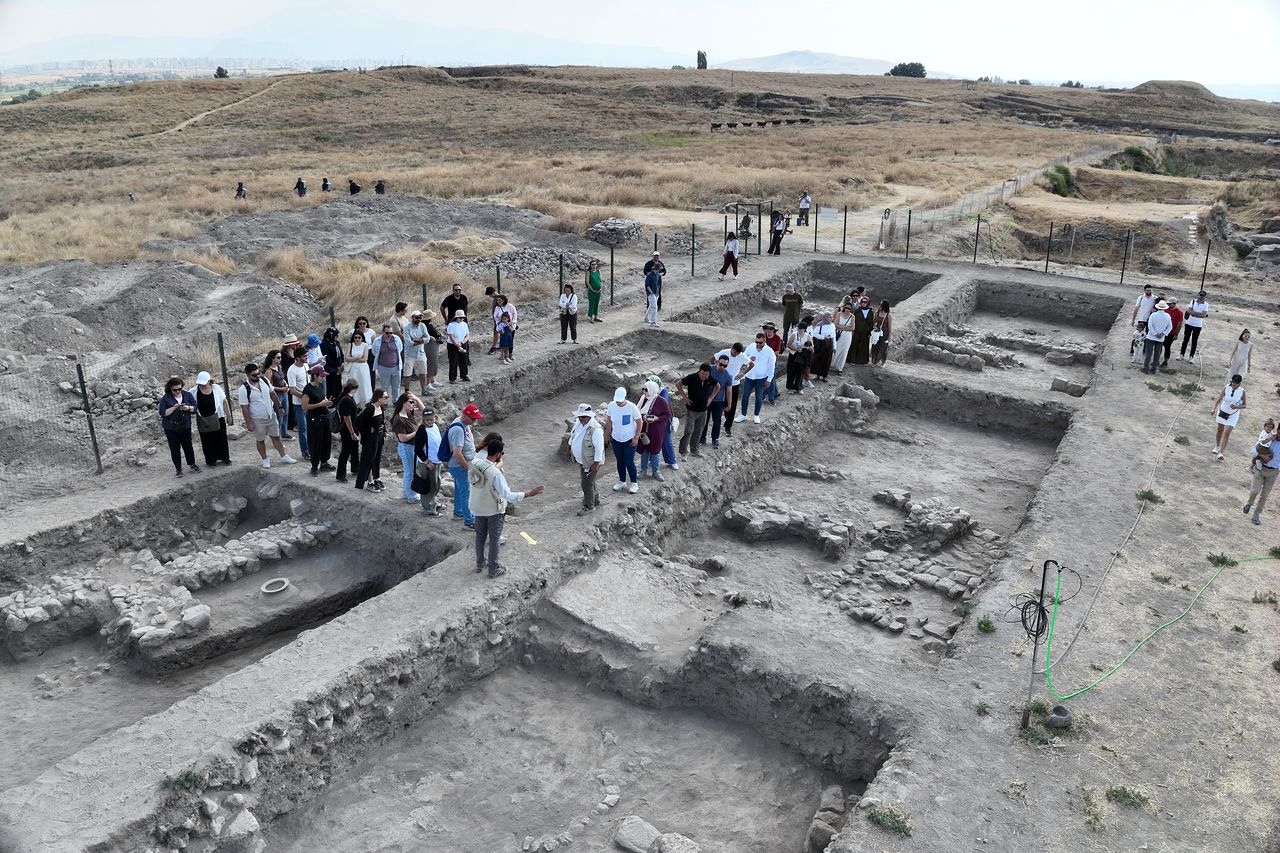
South Korean archaeologists participating in the international Kultepe excavation project in Turkey have made a remarkable discovery, unearthing Hellenistic-era mosaic structures and four distinct overlapping cultural layers.
Located roughly 7,500 kilometers from South Korea, the Kultepe archaeological site in central Turkey served as a major transportation and trade hub in ancient Anatolia. A South Korean excavation team began field surveys here in August of last year, conducting a 45-day initial phase followed by a second phase this summer.
While digging about two meters below the surface, researchers encountered unexpected remains. Amidst scattered Hellenistic-era (323–30 BC) pottery, a building foundation featuring a mosaic-decorated floor was uncovered.
In ancient civilizations of this region, mosaic structures (architectural remnants) typically signified sacred spaces associated with religious rituals. The discovery of such a building indicates that the site was a thriving major city even during the Hellenistic period. Although mentioned in related historical literature, finding physical evidence for the first time since the Kultepe excavation began in 1948 has drawn international praise as an unprecedented achievement accomplished in just over a year.
On the 27th, a joint South Korea-Turkey press briefing was held at the Koreana Hotel in Jung-gu, Seoul, to unveil these findings. Officials from the Turkish Ministry of Culture and Tourism, invited by the National Heritage Administration’s National Research Institute of Cultural Heritage, attended the event. They brought replicas of cuneiform clay tablets excavated from Kultepe.
Known as Kanesh in ancient times, Kultepe has yielded some 23,500 cuneiform clay tablets recording Assyrian merchant transactions, which are now listed on the UNESCO Memory of the World register. The Kultepe site itself was added to the tentative UNESCO World Heritage list in 2014, and experts noted that this latest discovery will help accelerate its full World Heritage inscription.
The newly identified mosaic structure measures approximately 163 centimeters east-west and 165 centimeters north-south. The foundation was prepared by leveling the ground, laying a base of crushed stone and fine soil, topping it with small river gravel, and finishing the surface with pottery shards and lime.
Joint research team members explained that considering the surrounding traces, the original scale of the complex was likely much larger, suggesting a multi-purpose functional complex stood at the location. Hellenistic pottery bearing specific markings—such as quantities or artisan names—was also recovered from the same cultural layer.
While Kultepe was initially highlighted as a center for Bronze Age civilizations such as Assyria and the Hittites, experts remark that the site is now being re-examined as proof of active Hellenistic cultural exchanges extending deep into the Anatolian interior, rather than just along the Turkish coast.
To date, excavation work at Kultepe covers only about three percent of the total site area. Researchers emphasize that the site features cultural layers stacked like a cake, spanning from the Paleolithic era through the Roman period and into modern times, raising expectations for further significant discoveries in future survey phases.
Scholars and international collaborators have lauded the South Korean team for its thorough preparation, systematic physical exploration methods, and well-trained professional personnel. Turkish cultural authorities expressed strong expectations for ongoing mutual development, combining South Korea’s digital restoration and technical prowess with Turkey’s rich heritage resources and excavation experience.
South Korea’s involvement in overseas archaeological research began in the early 2000s in regions like the Russian Maritime Province tied to Balhae history, later expanding to northern and Central Asia including Mongolia, Kazakhstan, and Uzbekistan to trace the formation and spread of ancient Korean culture. The Turkish excavation marks a new strategic turning point by expanding research cooperation into world ancient civilizations that lack direct ties to Korean history, thereby elevating the academic prestige of Korean archaeology on the global stage.