
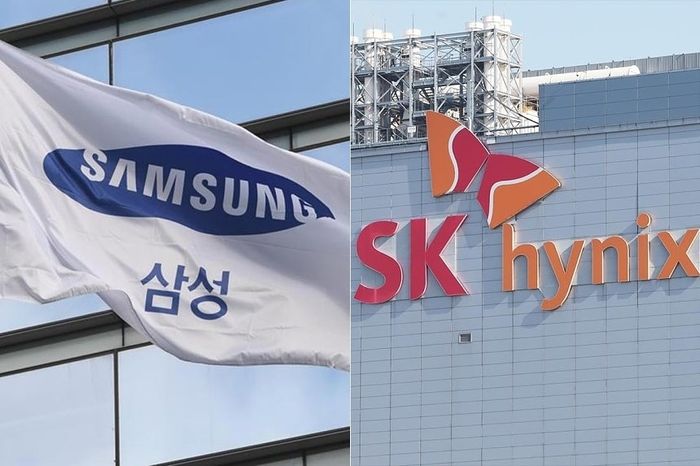
Even as Samsung Electronics and SK Hynix posted record-high performances in the third quarter, a fierce memory semiconductor LTA and reservation war is unfolding among companies scrambling to secure their memory chips. Driven by the artificial intelligence (AI) boom, a shortage of memory has triggered a surge of requests to guarantee long-term chip supplies.
According to industry sources on the 1st, both companies are expanding their Long-Term Supply Agreements (LTA) with clients. An LTA involves pre-determining supply and purchase volumes, pricing mechanisms, and deposits for memory over a set period. This benefits clients by securing necessary supplies while allowing manufacturers to predict sales volumes and streamline investment and production planning.
During its third-quarter earnings conference call on the 29th of last month, Samsung Electronics announced it has signed long-term contracts with 10 clients and is currently negotiating with 10 more. The demand for these contracts is expanding beyond AI enterprises to mobile, automotive, and network companies. Samsung stated that the spread of LTAs will greatly help establish a contract-based stable business model, adding that it is nearing its goal of allocating 60% to 70% of its total production capacity to long-term contracts by 2030.
SK Hynix has signed contracts with 14 clients, including major cloud computing providers. The contracts typically last five years, and the company is currently discussing extensions with some clients. It has already secured buyers for more than half of its total production capacity for next year and the year after through long-term agreements. Combined with ongoing negotiations, DRAM and high-bandwidth memory (HBM) production volumes are practically ‘sold out’ through 2029. SK Hynix explained that its current LTA structure reflects market price fluctuations within agreed price ranges, allowing the company to secure stable revenues while utilizing remaining capacity according to market conditions.
Additional orders continue to pour in. Samsung operates its long-term contracts by extending the contract period through annual negotiations, and stated that contract extension talks with several clients are already in the final stages. Requested volumes for these contract extensions significantly exceed expectations, the company noted. Samsung added that additional supply requests have been received for existing contract periods, prompting a review of mid-to-long-term production possibilities and various supply response strategies given the limited production capacity.
Overcapacity Concerns and Market Realities
The current market harbors concerns regarding future oversupply. These worries stem from increasing AI investment burdens on big tech companies alongside capacity expansions by Chinese competitors. Market research firms like TrendForce project that new factories will begin significantly increasing DRAM supply around 2028. This uncertainty has weighed on stock prices; despite Samsung and SK Hynix recording a massive combined third-quarter operating profit of 190.77 trillion KRW, their stock prices on October 30th remained 39.9% and 52.5% lower than their 52-week intraday highs, respectively.
To mitigate these risks, both companies plan to flexibly adjust their capacity expansion speeds. Samsung intends to secure cleanroom space first and install equipment based on demand, while SK Hynix plans to accelerate structural work for Yongin and Cheongju M17 while opening cleanrooms in phases.
Although investments are on the rise, actual supply increases are expected to take time. Samsung stated that increases in facility investments for 2027 are unlikely to substantially contribute to 2028 bit production. Due to the time required for factory construction, equipment procurement, and the complex manufacturing processes of next-generation HBM, tight supply conditions are forecasted to persist through 2028. Park Jun-young, a researcher at Hanwha Investment & Securities, projected that unlike in the past, a structure has formed where increased investment does not directly translate to expanded production, making a prolonged upward trend in memory prices highly likely.