Michelle Steel, U.S. ambassador to South Korea nominee, smoothly completed her U.S. Senate confirmation hearing on May 20, receiving bipartisan praise despite heightened political tensions between Republicans and Democrats ahead of the primary election season.
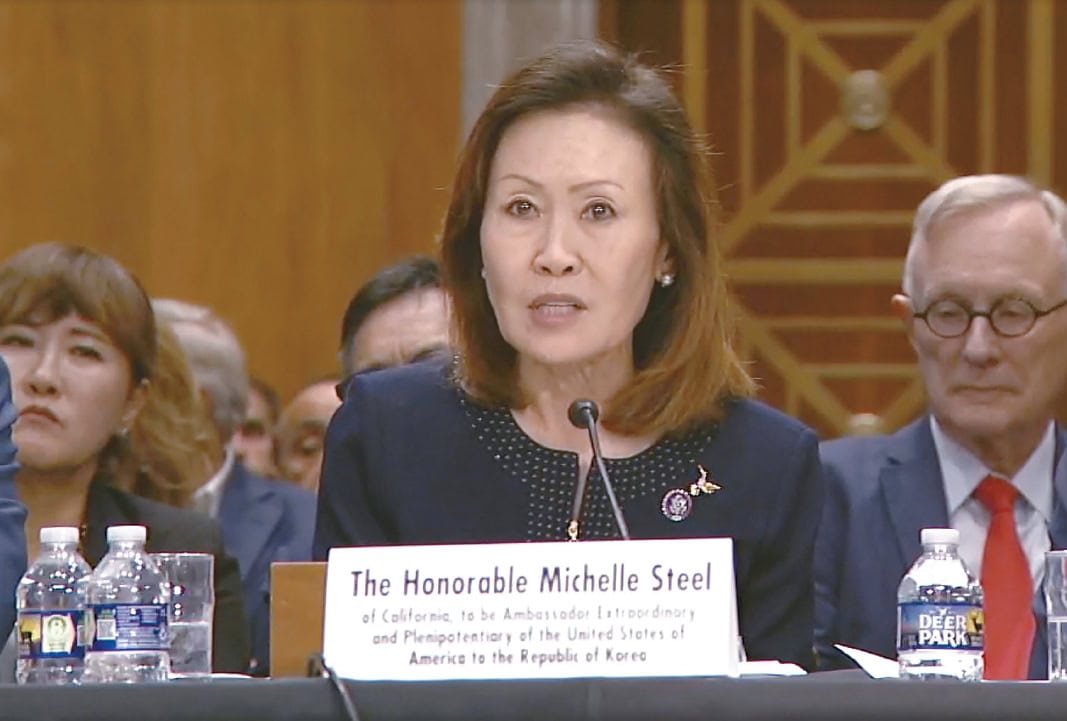
Steel pledged to strengthen the U.S.-South Korea alliance, which has endured for more than 70 years.
“The combined defense posture, reinforced by 28,500 U.S. troops stationed in South Korea and America’s extended nuclear deterrence, remains ironclad,” Steel said during the hearing. Speaking briefly in Korean, Steel said, “고생 끝에 낙이 온다,” a Korean proverb meaning, “At the end of hardship comes happiness.” She then shared the story of her parents, who escaped North Korea, met in South Korea, and later immigrated to the United States.
Steel also paid tribute to Korean War veterans. “If it were not for them, I would not have been born,” she said. “My parents came down to South Korea from different parts of North Korea, and thanks to those veterans, they were able to meet in Korea and I am here today.”
Sen. Tim Kaine, a senior Democrat from Virginia, made clear that he supported Steel’s nomination.
Kaine noted that he and Steel had previously worked together when she was a member of Congress to introduce legislation creating a national registry for Korean American divided families. “You are exactly the right person to make the issue of divided family reunions a priority,” Kaine said. “I look forward to supporting your confirmation.”
Sen. Jeanne Shaheen, a Democrat from New Hampshire and ranking member of the Senate Foreign Relations Committee, also responded positively to Steel’s remarks.
Steel had earlier said she welcomed an agreement under which South Korea would invest $350 billion in the United States and lower export barriers. However, she said it remained unclear where the funds for that investment, as well as $150 billion tied to the shipbuilding sector, would come from. “I would like to know exactly where that money is coming from,” Steel said.
Shaheen welcomed Steel’s commitment to transparency and asked whether she would share relevant information with the Foreign Relations Committee.
“If I become ambassador, I will do that,” Steel replied.
The exchange took place in a relatively friendly atmosphere.
During the hearing, senators also questioned Steel on strategic industrial investment, trade imbalances, technology controls and humanitarian issues between the United States and South Korea.
Sen. Bill Hagerty, a Republican from Tennessee, raised the issue of Korea Zinc’s critical minerals project in his state and asked Steel to make sure the investment proceeds smoothly if she is confirmed.
Steel replied that she would actively support the project if confirmed.
Hagerty also raised concerns that major U.S. technology companies may face discriminatory treatment in the Korean market compared with local companies such as Coupang or Chinese companies.
Steel said U.S. companies should receive the same fair access in South Korea that Korean companies receive in the United States.
“Just as Korean companies are treated equally in the United States, American companies should have the same market access in Korea,” Steel said. “If I am confirmed, I will make sure to address this issue.”