
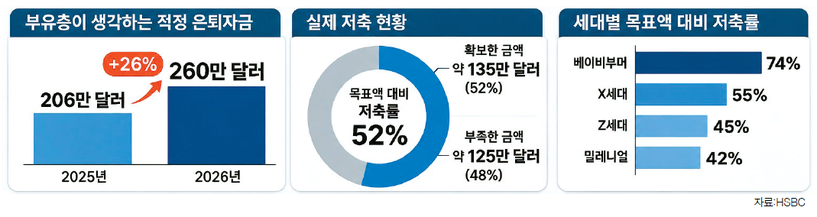
Domestic high-income earners now believe they need an average of retirement savings amounting to $2.6 million for a comfortable retirement life.
However, the actual retirement funds secured are only about half of the target amount, indicating that even high-income and high-net-worth individuals are struggling with retirement preparation.
According to a survey by financial institution HSBC, the appropriate retirement fund perceived by the affluent increased by 26% compared to the same survey a year ago, USA Today recently reported. This figure is about twice the retirement funds perceived by the general public.
In a previous survey conducted by asset management firm Schroders, the average amount general Americans answered they needed for a comfortable retirement was $1.2 million.
This trend may be a natural consequence of rising inflation and healthcare costs, but for some families, it could become a source of pressure to change their retirement plans.
For this survey, HSBC conducted an online questionnaire targeting 9,993 investors aged 21 to 69, including affluent individuals with at least $100,000 in investable assets and high-net-worth individuals with $2 million or more.
As a result of the survey, the retirement funds actually saved by respondents accounted for only an average of 52% of their target amount. Based on the target of $2.6 million, this translates to having secured approximately $1.35 million.
Behind the surge in required retirement funds lies not only inflation but also a shift in perceptions of retirement life.
According to HSBC, 70% of respondents were raising funds for other goals in addition to their retirement life. The proportion of respondents who cited retirement itself as their main financial goal was 43%, while 39% responded that they were preparing for a new start in life, such as a career transition, starting a business, or acquiring new skills. The response that it is important to provide financial support to children and elderly parents stood at 37%.
Increased life expectancy is also a factor driving up the burden of retirement funds. About 6 of 10 respondents answered that the possibility of longevity affected their financial planning. 31% stated they are increasing their savings in preparation for long-term medical and nursing care expenses.
On the other hand, responses to expand spending for current health and living standards accounted for 23%, and responses to spend money on experiences such as travel or hobbies accounted for 22%.
Experts emphasized that financial planning considering individual lifestyles, residential areas, retirement timing, health conditions, and expected income is more important than a uniform retirement target amount. They explained that since post-retirement goals and expenditure structures vary, fund plans must also be adjusted regularly.
Raquel Oden, head of US wealth management at HSBC, pointed out that the cost of maintaining a comfortable retirement life is continuing to rise even for people with substantial assets.
Experts analyze that this trend has no choice but to accelerate further in the current structure where lifespans are getting longer and related medical costs are rising.