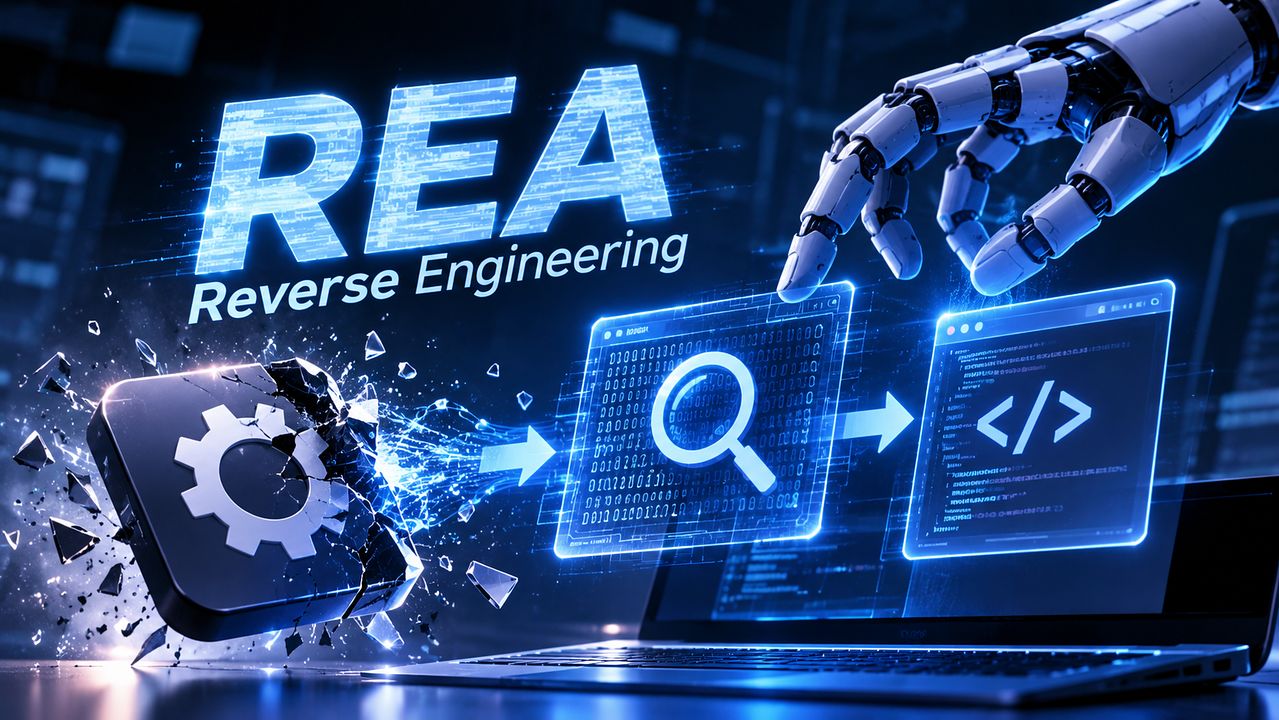
Developers often upload their program codes to platforms like GitHub to share with one another. On these sites, users can click a star icon on useful code, similar to a ‘like’ or ‘bookmark.’ In early October, a certain piece of code had fewer than 10,000 stars, but by the end of the month, it surpassed 400,000 stars.
Named REA, it stands for reverse engineering anything. It is a tool designed to help artificial intelligence (AI) analyze programs created by others and figure out how they work. Naturally, this raises questions about the legality of dissecting existing programs in this manner.
Reverse engineering is somewhat comparable to taking apart components inside an electronic device. Tearing it down reveals what technology was used and how it was applied. In fact, specialized tools for deconstructing programs and examining them have existed for a long time. Tools released by the U.S. National Security Agency are a prime example, though mastering them requires years of practice. REA implements such capabilities using AI. When a user explains what they want to know, the AI analyzes the existing software code and recreates it.
Recently, the applications of AI-driven reverse engineering have been expanding. One developer analyzed the Bluetooth signals exchanged between a smart toilet and a mobile app, subsequently creating a program to open and close the toilet lid using a laptop. Another case involved analyzing an existing smart TV app to develop a separate application that reduced the time it takes for video lists to appear from 30 seconds to 3 seconds. Projects attempting to analyze executable files of Nintendo console games like Super Mario and reconstruct their source codes have also surfaced. Lately, cases of bypassing digital rights management (DRM) on e-books or unlocking restricted features in existing programs have emerged, causing controversy.
Developers engaging in these activities argue that their goal is not to exact-copy original codes or steal protected codes from commercial software. Reverse engineering itself is not inherently illegal. In the 1990s, a U.S. federal court recognized reverse engineering as fair use when performed to obtain functional information necessary to develop software compatible with game consoles. However, this ruling was based on conditions such as legitimate purposes and difficulty in accessing functional information through other means; it did not grant a blanket authorization for all reverse analysis and copying.
In the 1980s, Compaq analyzed IBM’s programs to build computers compatible with IBM PCs. The method utilized during this process was the ‘clean room’ approach. The clean room method separates the analysis team from the new programming team. The analysis team inspects the original code solely to understand its functions and writes a manual, while the development team creates new code based strictly on the manual without ever viewing the original code. This method helps prove that the development team independently implemented the software without directly copying the original code.
The Rise of AI-Powered Software Alternatives
As tools for reverse engineering gain attention, ArtCraft—a service posing as an alternative to Adobe—has also sparked buzz. Developer Brandon Thomas created apps to replace major Adobe products such as Photoshop and Illustrator. Programs targeting Microsoft Office applications like Word, Excel, and PowerPoint soon followed. Another feature of ArtCraft is its free availability. Rather than selling the program, the developer released the source code through GitHub and other platforms. This can be highly attractive to users dissatisfied with the pricing and subscription policies of existing software.
What stands out most is the development methodology. Thomas explained that he built the programs with the assistance of AI and did not directly copy Adobe’s internal code. He stated that he observed publicly available information and external behaviors of the programs to write new code accordingly. This aligns with the clean room approach of recreating functions without direct access to original source code. Nevertheless, a developer claiming a clean room approach does not automatically resolve all implementation and copyright issues.
Furthermore, utilizing a clean room method does not instantly dictate copyright infringement status. Various factors must be examined, including not only whether the original source was accessed, but also what specific elements were recreated and whether copyrighted expressions were duplicated. In an era where AI seamlessly bridges analysis and development, figuring out how to separate and prove these processes poses a brand-new challenge. Distributing software for free also does not eliminate copyright concerns, as the acts of copying and distribution can trigger legal disputes even without commercial sales.
The market reacted swiftly. HSBC, a multinational financial institution headquartered in the UK, lowered its investment rating on Adobe from buy to hold, citing the potential impact that ArtCraft’s free alternative programs could have on Adobe, while also lowering its target price. Of course, Adobe’s stock movement cannot be attributed solely to ArtCraft. However, it is clear that the emergence of AI-powered free alternatives has begun to be recognized as a new competitive risk for legacy software companies.
The completeness of these alternative programs has yet to fully catch up with legacy software. PDF editors remain at a level where they implement only a subset of Acrobat Pro’s total features, and the developer himself admitted that matching all functions requires much more time than expected. Having a feature listed in a menu is quite different from being able to use it reliably in professional workflows.
Moreover, implementing identical features does not guarantee safe handling of personal data or total absence of bugs. In sectors where security and regulatory compliance are paramount—such as public administration and finance—such alternative programs cannot immediately replace traditional software.
Shifting Competitive Dynamics in Tech and Gaming
The competitive conditions in the software and IT development markets are undergoing a transformation. Relying solely on legacy features is no longer sufficient to attract users. The more expensive and difficult-to-cancel a subscription is, the stronger the motivation becomes to build alternatives. The value software companies must provide is also shifting, as anyone can now leverage AI to replicate features comparable to existing programs.
Changes in the gaming industry could manifest even more dramatically. Currently, revival projects for vintage games are mostly driven by fans and often exist in legal gray areas entwined with copyright issues. However, as AI lowers development costs, executing such projects directly may become more affordable. The possibility is growing that individuals will increasingly use AI to analyze functions of popular mobile games and commercial titles to create similar games. If these are distributed for free or used commercially beyond personal enjoyment, it could pose a severe threat to game developers, who must now adapt to these changes.
The hardware sector faces a similar reality. Users are increasingly leveraging AI to revive older televisions and household appliances abandoned by their manufacturers. Going forward, hardware makers that proactively disclose compatibility information are likely to gain an advantage, as the costs of hiding information to evade AI analysis will continue to rise. Completely preventing users from dismantling their devices and figuring out how they work is becoming virtually impossible. Decisions moving forward will revolve around whether to treat reverse-analysts as adversaries or to determine the extent to which their results are permitted.
Above all, the most critical shift is the rapid lowering of technical knowledge barriers. In the past, analyzing a program’s internal structure and building a similar product required specialized knowledge, extensive experience, and large teams. Today, AI analyzes existing software and replicates it with near-identical fidelity, cutting down the required time and cost. We are transitioning from an era where software was built exclusively by deep tech experts to an age where conceptualizing what to build and orchestrating AI to execute it holds greater value.