Having moved to LA just four months ago, I was a U.S. citizen but had never registered to vote before. I also had not yet been issued an ID card displaying my residential address. The only thing in my hand was a passport issued by the U.S. government.
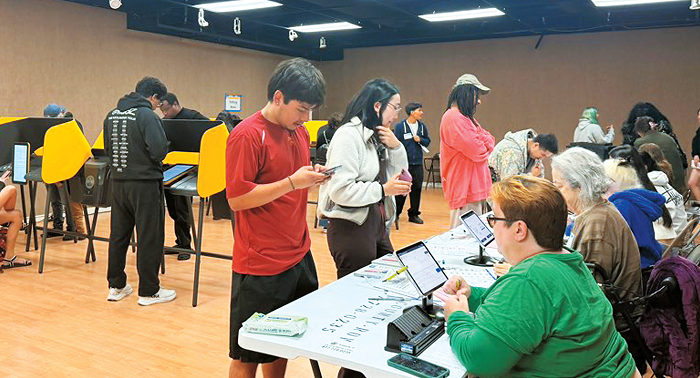
On November 3, the day of the midterm elections, I visited the polling place set up at the Korea Daily building in LA to see if I could exercise my right to vote for the first time.
Although I had participated in elections multiple times in South Korea, this was my first time here. I was secretly worried because my only identification was a passport, but the voting process turned out to be simpler than expected. This was thanks to California’s ‘Same-Day Voter Registration’ system.
Polling place staff explained that voters who register on the same day cast their ballots through a provisional voting process. Election authorities check registration information, eligibility, and duplicate voting after the vote, and if there are no issues, include the ballot in the final count.
This mechanism prevents voters from losing their voting rights due to administrative errors while simultaneously blocking duplicate voting.
Poll workers explained that provisional voting is frequently used not only by those who failed to register in advance but also by individuals whose names do not appear on the voter list due to administrative oversights.
Following the instructions, I received a pink provisional voter envelope. On the front of the envelope, I checked the boxes for U.S. citizenship status and being 18 years or older, then filled in my name, date of birth, residential address, place of birth, the last 4 digits of my Social Security Number (SSN), and signed it.
In California, voters are generally not required to present an identification card. While exceptional ID checks may be requested for some new voters, I did not need to submit a separate ID or residency proof document on this day.
The poll worker marked the envelope as ‘New Voter, No ID’ and wrote their name on it. This felt quite different from the voting landscape in Korea, where finding a designated polling station and presenting an ID is strictly required.
The convenience of completing on-site registration and voting on the same day without extensive prior preparation was notable.
According to the California Secretary of State, provisional ballots cast by same-day registrants are tallied after election authorities verify voter eligibility and check for duplicate voting. If eligibility requirements are not met or if the voter does not have voting rights for that specific district, part or all of the ballot may be excluded.
Standing in front of the electronic voting machine, no fewer than 66 items appeared on the monitor. Without reviewing the contents in advance, making selections on every single item was no easy task.
Voting was conducted via a digital touchscreen interface. Although the ballot measures consisted of somewhat complex topics, the screen provided summary explanations for each item along with lists of supporting and opposing organizations to assist voter judgment. Unlike South Korea, where voters must observe whether candidates fulfill their campaign promises long after the election, it felt refreshing to directly cast yes-or-no votes on concrete policy initiatives.
On this day, quite a few voters were spotted carefully touching the screen while glancing at notes they had prepared in advance.
The marking process was also intuitive and convenient. Once selections were completed on the screen, a paper ballot displaying the recorded choices was instantly printed. This brought back memories of Korea, where I used to blow on paper ballots to dry the ink from stamping seals to prevent them from smudging into invalid votes.
I placed the printed ballot back into the pink envelope and submitted it.
Upon completing the provisional vote, a staff member detached a confirmation slip from the envelope and handed it to me. The slip included instructions to call 30 days after election day to verify whether my vote was counted as valid.
As I walked out of the polling place, a sense of pride washed over me for directly participating in the local community’s policy-making process and taking my first step as an LA resident. Of course, the uncertainty of whether the single vote I cast would be ultimately counted as valid remained and required time to unfold.