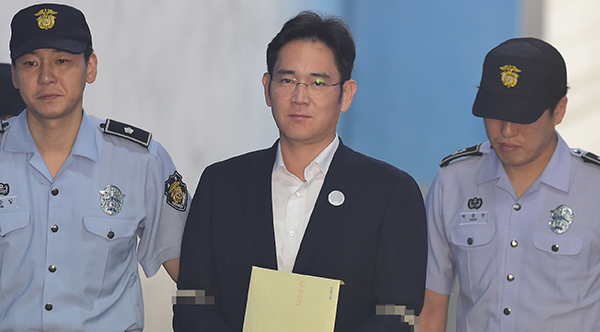
The Seoul Central District Court announced the verdict and sentence on Friday, wrapping up a four-month trial. Lee was convicted of all five charges he was indicted on, including bribery.
His sentence was the mandatory minimum.
“The essence of this case is the corrupt alliance between government and big business,” Kim Jin-dong, the presiding judge of the three-judge panel, said. “The people’s disappointment seemed irreparable because the corrupt alliance between the president and the conglomerate existed not just in the past but in our present reality.”
The 49-year-old tycoon and four former Samsung executives were indicted in February for having offered or promised bribes to former President Park and her friend Choi Soon-sil. The court ruled Friday that Lee and the four former Samsung leaders were guilty of paying bribes totaling 8.8 billion won ($7.8 million), which included Samsung’s sponsorship of equestrian training for Choi’s daughter Chung Yoo-ra.
In addition to bribery, Lee was convicted of embezzlement, illegal transfer of assets abroad, concealment of criminal profits and perjury at a National Assembly hearing.
The court also convicted Choi Gee-sung, former vice chairman of the Samsung Group — who once headed the powerful Future Strategy Office of the conglomerate — and Chang Choong-ki, a former president of that office. They were each sentenced to a four-year prison term.
Choi was the second highest executive of the Samsung Group and a mentor to Lee after Lee’s father, Lee Kun-hee, collapsed in 2014 with grave health problems. After Samsung was tarred in the presidential scandal, the Future Strategy Office, the highest decision-making body of the group, was dismantled. The office was behind the decisions that led to the indictments – and which were instrumental in the impeachment and removal of Park.
Two other Samsung leaders were convicted but not jailed. Former Samsung Electronics President Park Sang-jin received a three-year suspended prison term. Former Samsung Electronics executive Hwang Sung-soo was sentenced to a suspended prison term of two years and six months.
Samsung lawyers immediately announced they will appeal the convictions.
The trial began in April and Lee was under physical detention throughout.
The court heard closing arguments from an independent counsel, which acted as the prosecution in the trial, and Lee’s lawyers earlier this month. Independent Counsel Park Young-soo recommended the court give Lee 12 years in prison.
The independent counsel argued that Lee bribed Park through Choi in return for the president’s help in getting a state-run pension fund to exercise its voting rights to support a controversial merger in 2015, which cemented Lee’s control over Samsung.
Throughout the trial, lawyers representing Lee and the former Samsung executives said they had no choice but to support Choi because of her reputation and power, challenging the charges that the nation’s largest conglomerate bribed Park in return for political favors.
The independent counsel said Lee and Samsung leaders offered or promised 43.3 billion won ($38.4 million) in bribes. Samsung was accused of promising 21.3 billion won for Chung’s equestrian training and actually paid 7.8 billion won of the sum. Samsung also paid 1.6 billion won for a youth sports center operated by Choi’s relative and funded 20.4 billion won for two non-profit foundations that Choi practically controlled, the independent counsel said.
Judge Kim said Friday Samsung offered the bribes to Park in anticipation of her help in cementing Lee’s control of the group. He said Lee did not make a direct and specific request, but there was a tacit understanding. He also said Park was aware of Samsung’s situation and demanded its sponsorship of Chung.
“Samsung executives were steadily preparing for Lee’s succession and paid large bribes to the president, who had the ultimate authority over Korea’s economic policy, with an anticipation of her help for the management control succession scheme,” Kim said. “They also embezzled money from Samsung Electronics, illegally transferred assets abroad and concealed criminal profits.”
While convicting Lee and others for bribery, the court rejected some arguments by the independent counsel concerning the scope of bribes. The court said Samsung’s 7.2 billion won payment for Chung’s equestrian training was a bribe as well as its sponsorship of the youth sports center. It, however, did not include unpaid promised funding for Chung and contributions to the Mi-R and K-Sports foundations, worth 20.4 billion won.
Judge Kim said the accused were representative executives of the giant business group and they made a serious impact on society and the economy. He said Lee, in particular, was in a position to benefit the most from the management handover process and his influence over the crime was the largest.
“The accused, however, did not actively solicit the president’s help and give bribes,” Kim said, explaining the court’s reasoning for the mandatory minimum sentences. “They appeared to have passively accepted the president’s active demands.”
Lee became the first member of the family that controls Samsung Group to be convicted and jailed, creating an unprecedented leadership vacuum for the country’s largest conglomerate. Since its foundation in 1938, no head of the conglomerate was jailed.
His late grandfather, Samsung founder Lee Byung-chull, was investigated in 1966 for a saccharin smuggling case but never prosecuted.
Samsung Chairman Lee Kun-hee, Lee’s father, was prosecuted for bribery in 1996 and tax evasion (and breach of trust to create slush funds and illegally transfer assets to his children) in 2008. He received suspended sentences in both cases and later presidential pardons. After Chairman Lee’s heart attack in May 2014, Lee took over leadership of the conglomerate.
Lawyer Song Woo-chul, representing Lee and the other accused, said the ruling was unacceptable from a legal point of view. “All charges will be cleared in the appeals trial,” he said.
The independent counsel said it accepted the outcome and will continue to fight in the appeals trial to make sure that Lee and others will face heavier punishments.
Friday’s ruling was closely connected to the trial of Park and Choi, accused as the receivers of the bribes. In criminal law, those receiving the bribes are punished more heavily than the givers.
Park and Choi are currently undergoing a trial over corruption charges. A ruling is expected around October.
“We hope the ruling will serve as an opportunity to end the longstanding history of corrupt alliances between politicians and business, which has been an obstacle for our society’s advancement,” said Yoon Young-chan, senior presidential secretary for public relations at the Moon Jae-in Blue House. Moon was elected in May after Park was impeached and ousted over the corruption scandal.
By SER MYO-JA [ser.myoja@joongang.co.kr]