The relocation process for Hosihan (1885–1956), an independence activist who dedicated his life to the country’s liberation, has officially begun after 70 years.
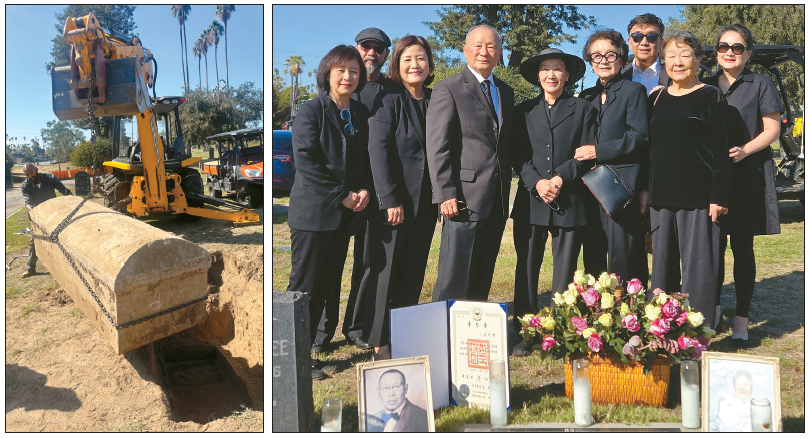
On the 27th, a grave-opening procedure for the relocation of late activist Ho and his wife Lee Jung-soon (1899–1988) took place at Rosedale Cemetery near LA Koreatown. The site visit was attended by bereaved family members, including eldest grandson Ho Yoon-jin, and Cho Sung-ho, Deputy Consul General of the Consulate General of the Republic of Korea in Los Angeles.
Following a brief service, the excavation work commenced around 10:30 AM.
Eldest grandson Ho Yoon-jin shared his thoughts, saying, “Although I have no direct memories of my grandfather, I came to learn about his deeds in detail through the reporting of The Korea Daily LA. As the eldest grandson, it is deeply meaningful to be able to escort him back to his homeland.”
Ho added, “After our generation passes, there won’t be many descendants left to visit the gravesite remaining in the US. I am glad that by moving him to Korea, more people can honor his legacy together.”
Granddaughter Jung-mi-hee stated, “Through this opportunity, I have gained a deep understanding of the life my grandfather lived, and I am very proud that he devoted himself to the independence movement during such a grim era.”
The remains of activist Ho will undergo cremation procedures on the 28th and will be temporarily stored by the cemetery. The bereaved family plans to retrieve the ashes and transport them to South Korea via Los Angeles International Airport on the 13th of next month. A welcoming ceremony will be held at Incheon International Airport on the 15th, followed by a repatriation ceremony in Seoul the next day (the 16th), before final enshrinement at the Daejeon National Cemetery.
Deputy Consul General Cho Sung-ho remarked, “This holds great significance as we are bringing back an independence activist who fought for liberation and rested in the US. We expect this repatriation to serve as an opportunity to widely illuminate the history of the independence movement by the Korean American community once again.” Activist Ho participated in the national restoration movement as a member of the San Francisco Korean Association in 1908. In 1920, he engaged in fundraising activities for the Provisional Government of the Republic of Korea, was arrested by the Japanese colonial authorities, and suffered imprisonment. Afterward, he moved to the United States and continuously supported the independence movement by funding anti-Japanese financial resources and the Liberation Army.
In recognition of these contributions, the government posthumously awarded him the Order of Merit for National Foundation, Aejok Medal, in 2021. However, the medal could not be delivered as the whereabouts of his descendants had not been confirmed until recently.
A turning point was created through the “Find Independence Patriots’ Graves” project last year, co-hosted by the Daehan Inkuominhoe Memorial Foundation and the Hwarang Youth Foundation, and sponsored by Bank of Hope. Descendants who encountered The Korea Daily’s report belatedly learned about the independence patriot commendation facts, and independence movement historical records preserved by the family were also unveiled.