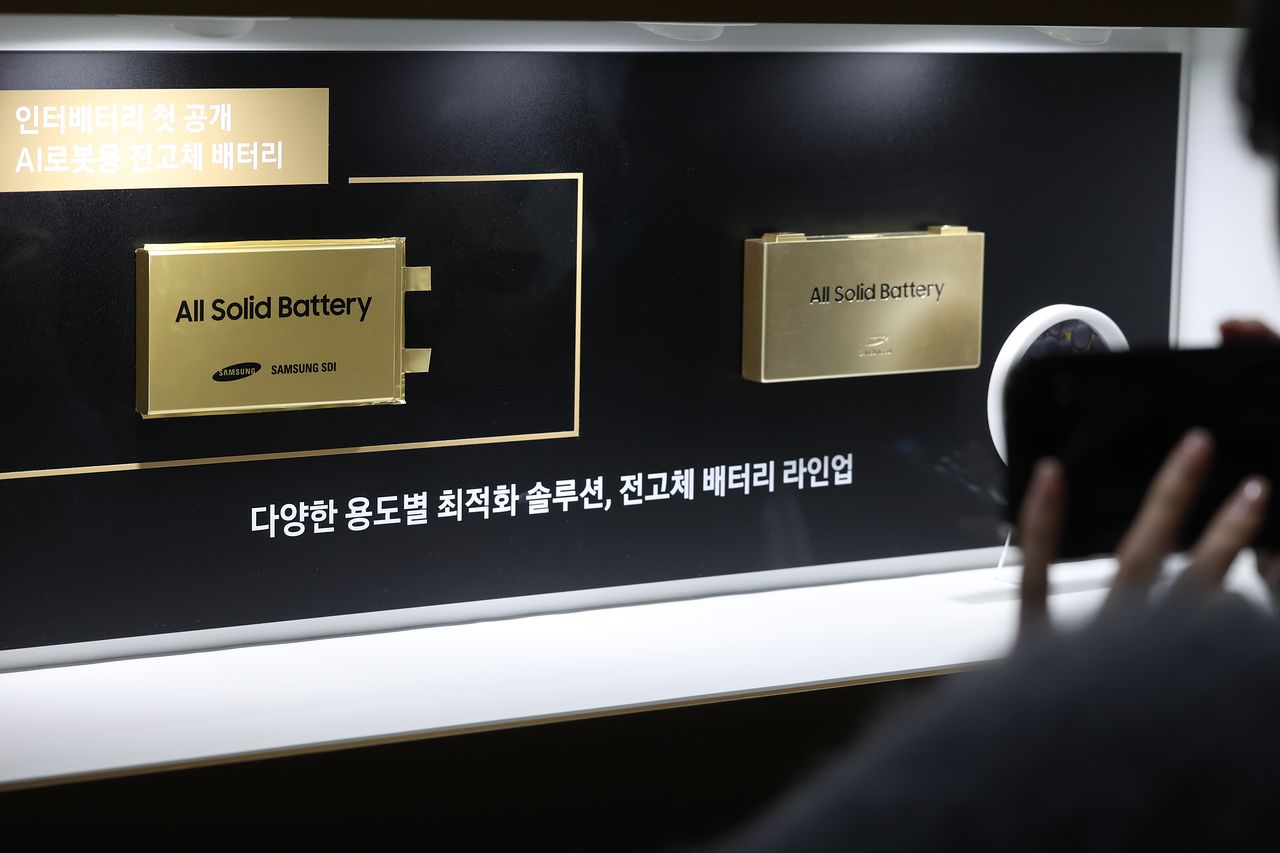
Often hailed as a ‘dream battery’ due to its near-zero explosion risk and vastly expanded electric vehicle driving range, the solid-state battery is facing a shifting industry perspective. As commercialization draws closer, skepticism regarding profitability is mounting due to high costs and mass-production limitations.
According to the battery industry, South Korea’s top three battery makers are all racing toward solid-state commercialization, but with varying degrees of urgency. Samsung SDI is currently pushing the hardest, targeting mass production by the second half of 2027. On the 6th of this month, the company signed a joint development agreement with battery material firm Ecopro BM for solid-state cathodes and solid electrolytes. A Samsung SDI official stated, “We are already supplying prototypes to clients and verifying performance. There are no changes in the demand from clients currently in discussions.”
However, large-scale mass production will not begin immediately next year. The initial target markets are humanoid robots requiring fewer batteries and ultra-luxury electric vehicles capable of absorbing high battery costs. Yet, whether meaningful profits can be generated solely from supplying small quantities of batteries for robots and EVs remains uncertain. Industry watchers believe that given Samsung SDI’s long-standing dedication to solid-state development domestically, the move is intended to preempt a new market that even China has yet to dominate.
In contrast, LG Energy Solution and SK On are adopting a more measured pace. LG Energy Solution has set its mass-production target for EV solid-state batteries in early 2029 and humanoid applications by 2030. A company official remarked, “We view solid-state batteries more as a ‘market extender’ that expands the market rather than an immediate ‘game changer’ that will replace it overnight.” This represents a more cautious stance compared to its self-published report last year, which heavily promoted solid-state technology as a future game-changer. Similarly, while SK On continues development after completing a solid-state pilot production line last year, it has scheduled commercialization for 2029 or later.
Recently, the global EV market has seen low-cost Chinese LFP (lithium iron phosphate) batteries become mainstream, even with lower performance than ternary batteries. This background fuels concerns that high-priced solid-state batteries could face market rejection. Professor Lee Ho-keun of Daeduk University noted, “The question is how many cars can actually bear the cost of solid-state batteries. This now needs to be approached as an industrial issue rather than just a technological one, which won’t be easy in the short term.”
Technological hurdles must also be cleared. Issues such as poor adhesion between solid materials, cracks during charging and discharging, and low production yields persist. An industry insider noted, “Making things in a laboratory and mass-producing them in a factory are entirely different challenges.”
Skepticism is also surfacing in China. Ni Jun, Chief Manufacturing Officer (CMO) of CATL, the world’s largest battery company, stated last month, “The possibility of short-term commercialization for solid-state batteries is very low. Large-scale commercialization will take at least five years.” Chinese battery giants like CATL and BYD have likewise targeted commercialization around 2030.
Nevertheless, experts emphasize that South Korea must claim the solid-state battery market first. Professor Park Chul-wan of Seojeong University stressed, “We have been talking about solid-state for decades; now is the time to prove the technology with actual products.” Professor Lee Sang-young of Yonsei University added, “Before China establishes solid-state standards and occupies the market, South Korea must create the benchmarks first and secure an early lead.” This implies finding a breakthrough in the solid-state sector through an “upgrading” strategy powered by technological prowess, escaping China’s onslaught of cheap battery supplies.
Professor Kim Pil-soo of Daelim University pointed out, “Mass production is difficult, but the directional path of solid-state technology is correct. Domestic batteries struggling with price competition ultimately have no choice but to compete with high-value-added products.”