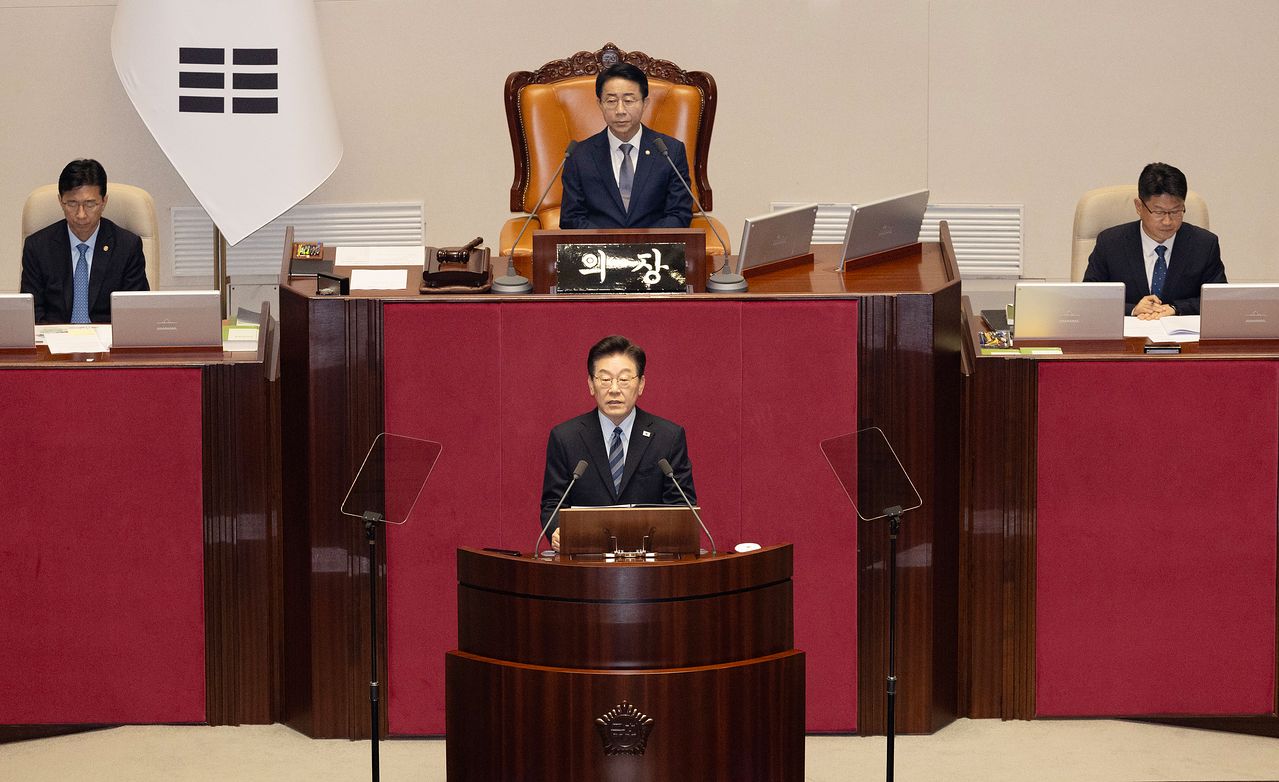
President Lee Jae-myung named the 2027 budget plan a ‘growth-expansion budget’ during his policy speech at the National Assembly on the 2nd, emphasizing the justification for aggressive fiscal spending. He explained that this funding is essential to boost growth potential, increase support for artificial intelligence (AI) and future growth engines, and address widespread K-shaped polarization. However, considerable criticism has followed. Critics argue that a temporary increase in tax revenue driven by semiconductor specialties should not translate into excessive spending, pointing out the need for flexible fiscal management to prepare for unpredictable economic downturns.
President Lee diagnosed the current state of the South Korean economy as a ‘clear V-shaped recovery’ during his address. He noted that potential growth rate projections are rebounding for two consecutive years for the first time in about 40 years, the growth rate reached 3.8% in the first half of this year alone, and annual exports reaching $1 trillion are within sight. Opinions, however, are divided. While the realization of a 3% growth rate for the first time in five years since 2021 has broken a sluggish trend, it is premature to classify this as a structural rebound. In reality, it is closer to a temporary boom leaning heavily on a single semiconductor item. Indeed, the proportion of semiconductors in total exports (cumulative from January to October) rose to 42.7%, expanding 19.3 percentage points from 23.4% in the same period last year.
Reliance on price increases rather than volume is another alarming factor. In the third quarter of this year, the semiconductor export value index surged 223.1% year-on-year, while the volume index rose by 15.6%. Amid global fears of an AI peak, highlighted by the Intel stock crash, any decline in price increases will inevitably deal a blow to exports. An anonymous professor pointed out, ‘While the process of the KOSPI rising to the 9,000 range was filled with cheers, we must remember how painful the four-month plunge to the 5,000 range was. It is more accurate to view recent surging tax revenues and growth rebounds as bubbles, making preparation for an inevitable downturn far more critical.’
The government’s 2027 budget plan is a record high in both scale (820.9 trillion won) and total expenditure growth rate (12.8%). President Lee repeatedly emphasized the necessity of expanding fiscal spending, stating that based on an incomparably elevated national status and drastically expanded economic power, he will concentrate investments on future growth engines and narrowing gaps, ensuring that the opportunities and fruits of growth are shared equally by all.
He also stressed that the foundational strength of public finances will grow sturdier, noting that the managed fiscal deficit relative to Gross Domestic Product (GDP) will hit its most favorable level in 20 years, while the national debt-to-GDP ratio will drop from 51.6% to 48.3%. Although government bonds will be issued, he claimed they will mostly be used to repay existing bonds, resulting in virtually no net increase in government debt.
However, the total planned issuance of treasury bonds next year under the budget stands at 222.8 trillion won, with the net increase—excluding maturity redemptions and refinancing—reaching at least the 90 trillion won range. National debt is not decreasing. Consequently, national debt next year will increase by 106 trillion won compared to this year’s main budget. Furthermore, improvements in the national debt ratio stem from rising growth rates rather than a reduction in debt. The National Assembly Budget Office recently pointed out that interpreting this from the perspective of fiscal sustainability requires caution.
According to the ‘Third Long-Term Fiscal Outlook,’ if current policies are maintained, South Korea’s national debt-to-GDP ratio will soar to 71.5% in 2035, 97.4% in 2045, and 126.3% in 2055. This background fuels criticism that while the government plans to set up a separate fiscal reservoir (Future Response Fund) to absorb extra tax revenues expected over the next few years, it remains lukewarm about reducing national debt.
Indeed, the Future Response Fund is projected to be a major battleground between ruling and opposition parties during budget deliberation. While President Lee evaluated it as a ‘strategic investment platform supporting the rebound of potential growth and an innovative fiscal stabilization device,’ the opposition has vowed to use the entire 104 trillion won of surplus resources within the fund to reduce treasury bond issuance. Calls within and outside the National Assembly are growing strong to explicitly incorporate parliamentary checks into the fund legislation bill.
President Lee remarked, ‘The time has come to answer the desperate appeals of citizens who say the national economy is improving while their own household budgets remain strained, and to answer this heavy question of what good growth is if individual lives do not improve.’ Despite the president’s diagnosis, concerns persist that policy responses remain inadequate against mounting structural challenges like industrial polarization, youth unemployment, and inequality. Yang Jun-seok, an economics professor at Catholic University, stated, ‘With little apparent will for pension and labor structural reforms and a lack of concrete plans on how to utilize fiscal resources, failing to focus on enhancing corporate and regional productivity could plunge us into greater difficulties in a few years.’ Source data points directly to the core debates shaping South Korea budget policies moving forward.