Just three months after the South Korean government excluded finished electric vehicles from its domestic production tax credit target, the policy is back under review. This renewed discussion is driven by growing concerns that the ‘invasion’ of Chinese electric vehicles could undermine South Korea’s domestic manufacturing foundation.
Deputy Prime Minister and Minister of Economy and Finance Lee Hyung-il visited the Hyundai Motor-Kia Technical Center in Hwaseong, Gyeonggi Province, on the 2nd to hold a meeting. Responding to requests from corporations to introduce a production tax credit for electric vehicles, Deputy Prime Minister Lee stated, “The government will actively participate in the National Assembly’s deliberation process and discuss the matter in depth.”
The domestic production tax credit is a system that reduces taxes based on the performance of producing and selling strategic industry products within South Korea. President Lee Jae-myung also visited Hyundai Motor’s Asan plant in February of last year, when he served as party leader, to propose the introduction of this incentive.
In the tax law amendment announced last August, the government included six major sectors—such as semiconductors and secondary batteries—in the tax credit eligibility, but excluded electric vehicles. The initial reasoning was to prioritize support for core parts and materials with vulnerable production bases while simultaneously boosting the competitiveness of finished vehicles through secondary battery support.
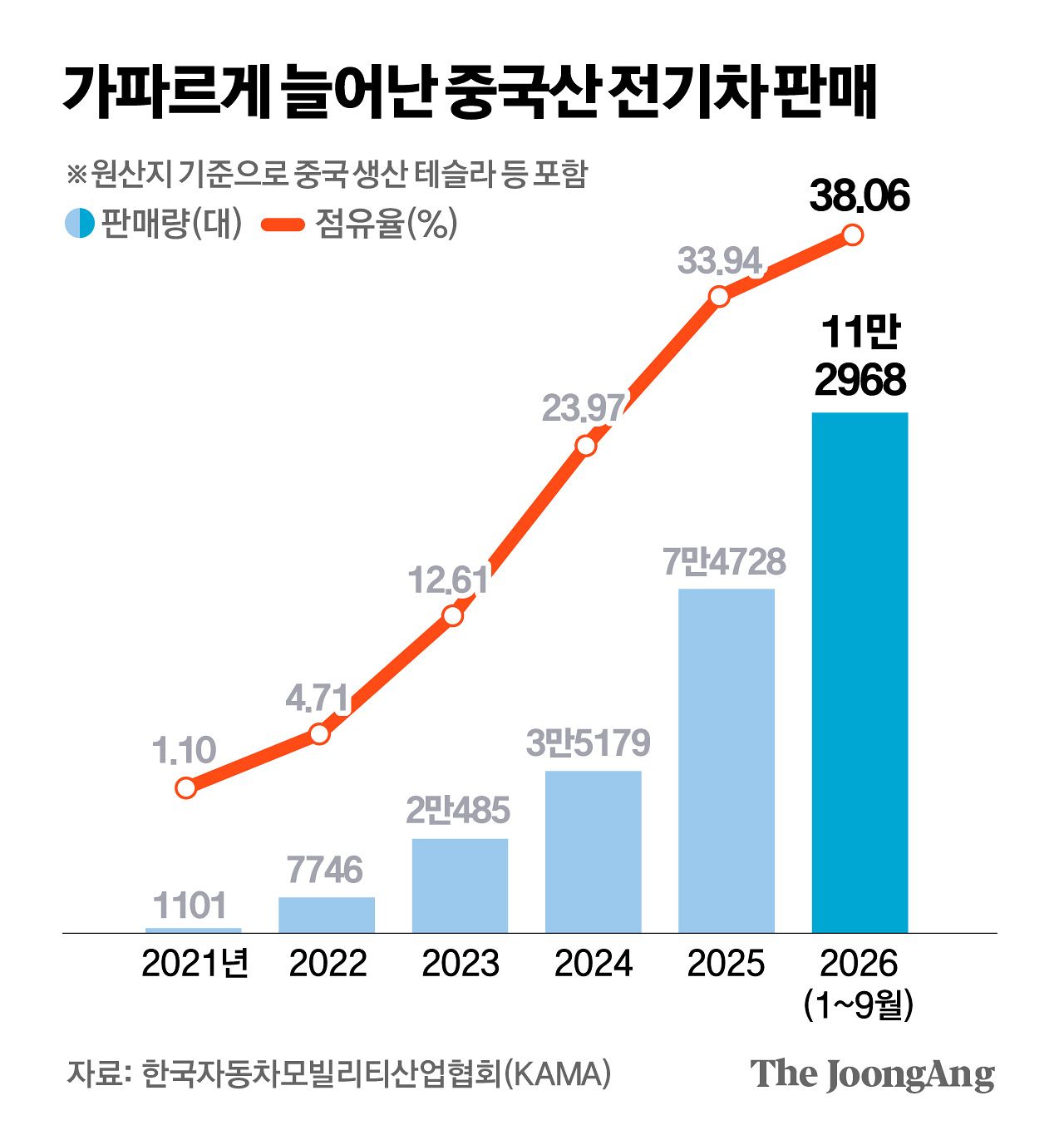
The situation shifted as the offensive from Chinese products intensified. According to the Korea Automobile Mobility Association (KAMA), the proportion of Chinese electric vehicles among new registrations (296,801 units) from January to September reached 38.1% (112,968 units), marking a 6.5 percentage point increase compared to the same period last year. For electric passenger cars specifically, Chinese models accounted for 43.5% while domestic models fell below the majority for the first time at 48.7%. This outcome aligns with the expanded sales of Tesla and BYD manufactured at the Shanghai plant in China.
South Korea’s lower trade barriers compared to major nations also played a role. The United States imposes a 127.5% tariff on Chinese electric passenger cars, while the European Union imposes a baseline 10% tariff plus up to an additional 35.3% tariff depending on the manufacturer. In contrast, South Korea only levies a basic 8% tariff without additional duties. In July of this year, the government selected purchase subsidy recipients by evaluating after-sales service (AS) and contributions to the domestic supply chain, successfully excluding BYD from subsidy targets. However, subsidies continue to be paid for Tesla vehicles produced in China.
Cho Chul, a distinguished professor at the Korea Institute for Future Strategy, remarked, “If domestic electric vehicle production declines, battery demand will also decrease, rendering the tax credit meaningless,” adding, “If the current situation persists, one or two domestic plants could face closures upon the complete transition to electric vehicles.”
The National Assembly is also pursuing legislation related to the electric vehicle production tax credit. Ruling and opposition lawmakers, including Lee 언주 (Eon-ju) and Yoon Han-hong, have separately proposed relevant bills. The Ministry of Economy and Finance has yet to finalize its stance, and variables such as trade conflicts remain. A Ministry official stated, “We will actively participate in the National Assembly’s discussions.” The Strategy and Finance Committee of the National Assembly initiated deliberations on the tax law amendment on the same day.