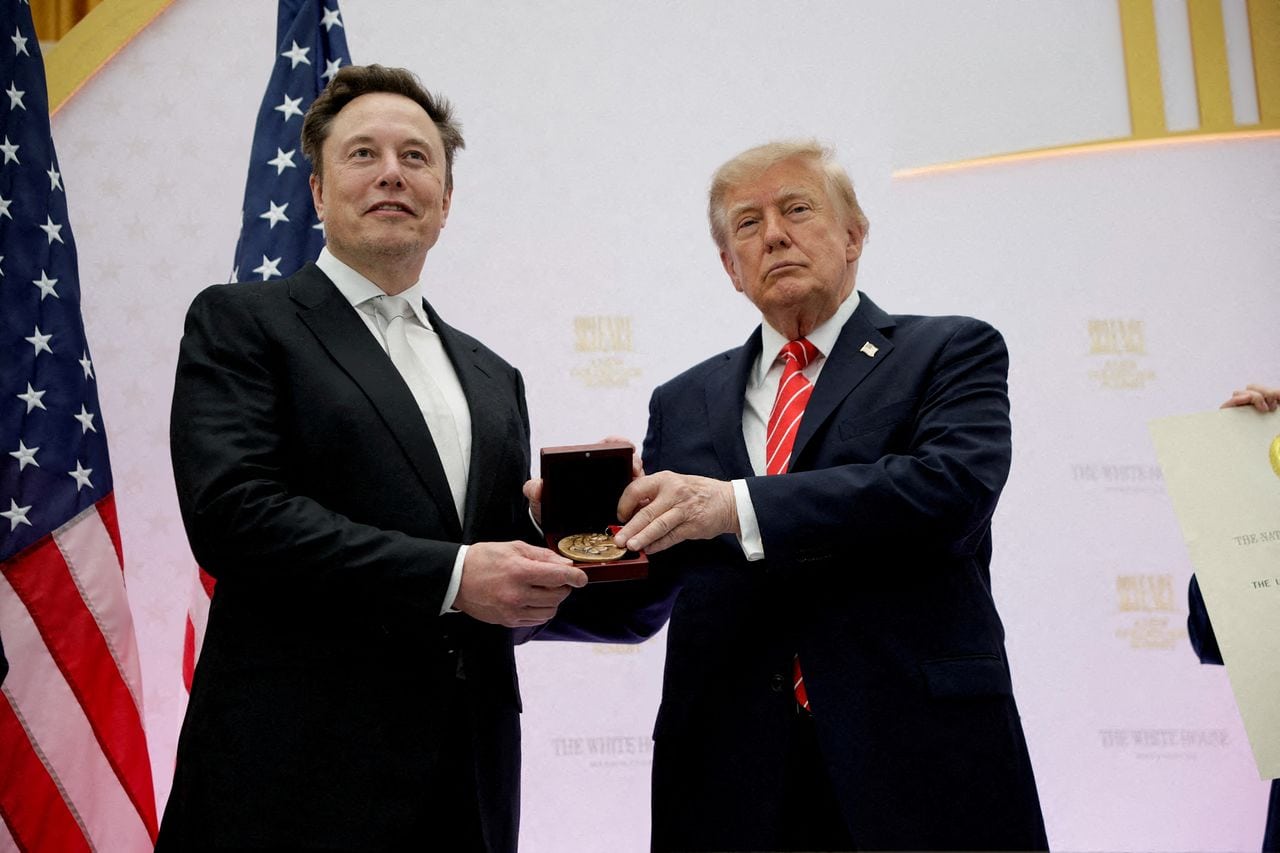
 U.S. President Donald Trump awards the National Medal of Science to Tesla and SpaceX CEO Elon Musk at the Donald J. Trump Institute for Peace in Washington, D.C., on the 8th (local time). Reuters=Yonhap News
Elon Musk, the Chief Executive Officer of SpaceX, announced that he will distribute one share of SpaceX stock to every child in the United States. This is a groundbreaking pledge amounting to a staggering 15 trillion won (approximately $11 billion). However, specific distribution plans have not yet been disclosed, leaving a question mark over whether the promise will actually be fulfilled.
On the 19th (local time), Musk posted on the social media platform X (formerly Twitter), stating, SpaceX stock will be given to every child in the United States next year, and this will be the first of many things to come.
According to the Wall Street Journal (WSJ), SpaceX shares closed at $147.96 on that day. To provide one share each to approximately 73 million children under the age of 18 estimated by the U.S. Census Bureau, about $11 billion (approx. 15 trillion won) is required. Musk’s net worth exceeds $900 billion (approx. 1,200 trillion won). Bloomberg estimated that even if this gift takes place, Musk’s voting power stake in SpaceX would only drop by 0.1 percentage points, from 82% to 81.9%.
The Role of Trump Accounts and Government Regulations
The stock distribution is expected to utilize Trump Accounts, an investment account for children introduced by the U.S. government. U.S. President Donald Trump also took to social media on the same day, saying, I appreciate Elon’s incredible generosity, and adding that this is exactly what was envisioned when creating Trump Accounts.
Last month, the U.S. Department of the Treasury established regulations allowing the donation of stocks to children of specific ages or regions. Donors can receive tax benefits upon meeting certain requirements. In principle, donated stocks cannot be sold for five years. In an editorial, the WSJ evaluated the move positively, stating, Musk is practicing capitalism by granting beneficiaries ownership and control.
Skepticism and Past Unfulfilled Promises
This announcement came shortly after AI company Anthropic stated it would contribute 5% of its stock to a public foundation. In response to Anthropic’s announcement, Musk suggested that they should distribute the stock directly to the public.
Musk does have a precedent for massive donations. In 2021, he donated Tesla stock worth about $5.7 billion (approx. 7.6 trillion won) to charity. In the same year, when the UN World Food Programme (WFP) requested $6 billion to help 42 million people facing starvation, he promised to support them if it could be proven that the amount would solve the crisis. However, the WSJ reported that it remains unconfirmed whether the WFP actually received funds from Musk.
The key issue is whether the promise will be truly fulfilled. In 2018, Musk claimed he had secured funding to take Tesla private, which turned out to be false and landed him in legal trouble. This time as well, specific distribution schedules and methods have not been disclosed. Mark Gongloff, a Bloomberg Opinion columnist, raised the possibility that Musk made the promise without sufficient preparation, provoked by Anthropic’s donation announcement, and criticized that no one knows how children will receive these stocks, and they probably won’t even need to know.