“A nation’s future hinges on how it secures and utilizes talent.”
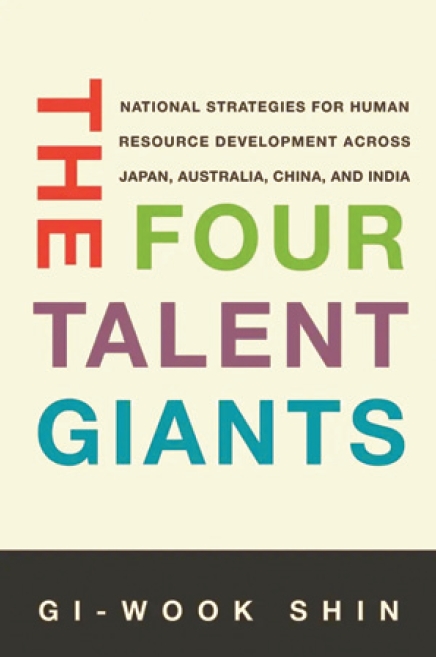
That is the core message of The Four Talent Giants, a new book by Gi-Wook Shin, director of the Asia-Pacific Research Center (APARC) at Stanford University. In the book, Shin analyzes the talent development strategies of Japan, Australia, China, and India, presenting the concept of a “talent portfolio” as a critical component of national competitiveness.
“Each country has built its talent base in different ways, shaped by its cultural, institutional settings and strategic goals,” Shin said. “These differences have had direct consequences for their economic trajectories.”
In an interview conducted on July 11, Shin discussed his Talent Portfolio Theory, the four types of talent strategies, and the unique challenges faced by South Korea.
Q: What prompted the development of your Talent Portfolio Theory?
“As I examined the sources behind the rise of China, Japan, India, and Australia, I noticed that each country was following a distinct talent strategy. I approached this from the perspective of financial investment. Think about how we diversify stock portfolios based on market trends or industry sectors—it’s no different with talent. A nation’s competitiveness depends on how strategically it assembles and leverages both domestic and international human capital.”
Q: How does this differ from conventional approaches?
“I’ve categorized talent strategies into four types. Brain Train refers to developing talent domestically. Brain Gain involves attracting top talent from abroad. Brain Circulation is about encouraging nationals to build experience overseas and then return. Finally, Brain Linkage focuses on collaborating with diaspora talent living abroad.”
Q: Among the four countries, which one’s talent strategy stands out?
“India is the one to watch. The rise of Indian talent in Silicon Valley is remarkable. Among foreign professors at Stanford’s engineering and business schools, Indians represent the largest group. Korea should actively pursue deeper networks with Indian professionals.”
Q: Why wasn’t Korea included in this book?
“I previously published a separate book solely on Korea’s talent strategy. For this volume, I chose countries that each represent a clear archetype: Japan for Brain Train, Australia for Brain Gain, China for Brain Circulation, and India for Brain Linkage.”
Q: What are Korea’s shortcomings in talent development?
“Korea tends to emphasize substitution rather than complementarity. With a lack of diverse talent, fresh ideas struggle to emerge. Investment in educational infrastructure is also insufficient. Low faculty salaries and deeply entrenched bureaucratic systems make it difficult to attract and nurture top talent.”
Q: How can this be improved?
“To be competitive in the global talent market, Korea’s government and academic institutions must improve faculty compensation and expand research funding. Immigration policies should be loosened, and efforts to attract more international students must be strengthened to diversify the talent pool.”
Q: Why are Korean students abroad reluctant to return home?
“In the past, it was about economic disparity. Today, it’s more about quality of life. In the 1960s and ’70s, students didn’t want to return because of the lower living standards in Korea. Now, younger generations prioritize life satisfaction over high salaries, and that makes them hesitant to come back.”
Q: Korea also struggles to attract skilled foreign professionals.
“Part of the problem is political pressure to protect domestic jobs, which makes the government hesitant. Settling in Korea is also difficult for foreigners. Racial discrimination continues to be a significant barrier.”
Q: What about the criticism that talent strategies can exacerbate inequality?
“For the poorest and developing nations, investing in human capital may feel like a burden—but it’s a necessary one. Even through international support, countries must prioritize higher education and overseas study for their own people. Korea, Taiwan, and China serve as strong examples of this.”
Q: What’s the most important principle in deploying talent effectively?
“Don’t limit the talent pool to your own citizens. Nations must think globally—secure a diverse set of talent and put it to use.”
Q: What kind of talent will be most needed in the future?
“Not just people with strong skills, but those with open minds, transnational networks, and the ability to collaborate and integrate across borders. These are the talents that matter in a global society.”

Gi-Wook Shin to Step Down as APARC Director After 20 Years
After two decades as director of Stanford’s APARC, Gi-Wook Shin will step down in August. He plans to continue teaching as a professor of Korean Studies and will lead the Stanford Next Asia Policy Lab, a project focused on integrated research covering Asia’s social, political, economic, and cultural changes.
About Gi-Wook Shin
Gi-Wook Shin earned his sociology degree from Yonsei University and moved to the United States in 1983, completing both his master’s and PhD in sociology at the University of Washington. He began his academic career at the University of Iowa in 1991, later taught at UCLA, and has been a faculty member at Stanford University since 2001. He has served as director of APARC since 2005, and founded Stanford’s Korean Studies Program, contributing significantly to the development of Korean studies.
BY KYEONGJUN KIM [kim.kyeongjun1@koreadaily.com]