As artificial intelligence (AI) raises concerns about job security, vocational schools in Southern California are seeing renewed interest—especially among Korean Americans seeking career stability and preparation for retirement through specialized training.
Jinsu Oh, 40, has worked as a graphic designer in Orange County for the past 10 years. This fall, he will begin studying at a community college. “As my children grow up, having a stable job and preparing for old age became important,” he said. “My wife, who is a nurse, recommended learning a skilled trade. After completing the prerequisites, I was accepted into a nursing program.”
Oh chose nursing because of its stability and long-term career potential. Healthcare employers in Southern California, especially hospitals, are actively hiring due to a shortage of skilled staff—and the pay is often higher than in other sectors.
“My wife worked at a logistics company. After earning her nursing license, her starting salary was close to $100,000,” Oh said. “Once I decided to learn a new skill, the medical field stood out to me.”
Brian Lee, a photographer for nearly 20 years, recently ranked among the top five sales performers at his company’s solar panel installation division. He spent two years during the pandemic learning electrical skills at a technical school.
“I was able to gain certifications and practical knowledge at the vocational school,” he said. “Thanks to that, I now work in a growing industry and receive strong compensation.”
Vocational school staff say gaining certifications in targeted fields can support both job placement and starting a business.
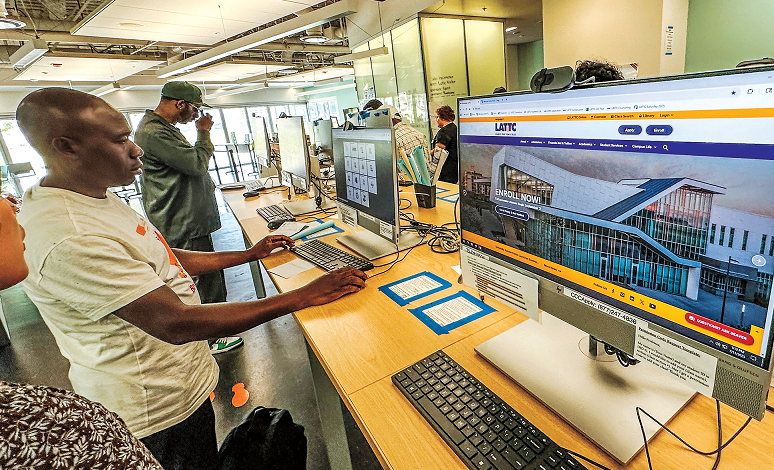
One of the most prominent public trade schools in the Los Angeles area is Los Angeles Trade-Technical College (LATTC). It offers training in hands-on fields like electrical work, automotive repair, chemistry, accounting, computer science, labor relations, plumbing, solar installation and maintenance, skincare, and cosmetology. For California residents, tuition is approximately $46 per unit. According to LATTC, any California high school graduate or resident may apply, regardless of immigration status.
Eunja Eom, director of the Korean American Vocational Education Center, which offers free instruction in apparel manufacturing, said, “If you learn skills that meet industry demand, you become more competitive.” She added, “There are plenty of vocational programs and resources available for low-income residents in the LA area.”
Interest in vocational training is also growing at the high school level. The Los Angeles Times reported on July 15 that many local schools offer technical training programs that allow students to learn skills like construction, welding, plumbing, and solar panel installation during summer break—helping them enter the workforce directly.
At La Mirada High School, the welding program has become so popular that it now has a waitlist of 100 students. One graduate reportedly earns an annual salary of $150,000 after completing the program.
The report noted that while vocational education once lost popularity due to a focus on college admissions, that trend is now reversing.
Brent Tuttle, a instructor at La Mirada High School, told the Los Angeles Times, “Jobs that require hands-on skills are not easily replaced by AI or automation. Going forward, those with skilled trades or expertise in healthcare will enjoy greater job security.”
BY HYOUNGJAE KIM [kim.ian@koreadaily.com]