The United States remains open to dialogue with North Korea but is also committed to the regime’s denuclearization and the maintenance of the U.S. nuclear umbrella over South Korea, U.S. officials said Tuesday.
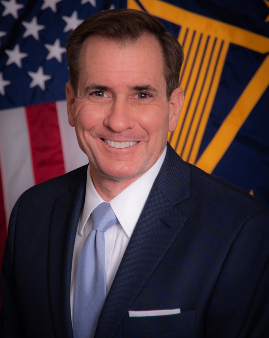
Speaking at an online press briefing, National Security Council (NSC) coordinator for strategic communications John Kirby stated Washington’s goal is “the complete and verifiable denuclearization of the Korean Peninsula” and said the U.S. government “believes that there’s still a diplomatic path forward” to that goal.
Kirby’s remarks came after North Korean leader Kim Jong-un dismissed the necessity of dialogue with either South Korea or the United States in comments reported Monday by Pyongyang’s state-controlled Korean Central News Agency (KCNA).
Referring to denuclearization and Pyongyang’s refusal to negotiate with Washington, Kirby said, “We have said we would be willing to sit down with Kim Jong-un without preconditions to negotiate that kind of outcome, but he has not responded to that offer, except to say that he has only continued his provocations, continued his missile launches, continued to try to pursue his nuclear ambitions, and all that’s doing is causing greater insecurity and instability.”
North Korea and the United States have not held denuclearization talks since the 2019 summit between Kim and U.S. President Donald Trump collapsed with no agreement.
North Korea staged seven ballistic missile launch events between Sept. 25 and Oct. 9, including an intermediate-range ballistic missile (IRBM) that flew over Japan and a short-range ballistic missile (SRBM) launched underwater from a reservoir.
Photos of the recent missile launches show that Kim was in attendance at several.
Pyongyang is also said to have completed all preparations to conduct what would be its seventh nuclear test, according to Seoul’s spy agency.
The National Intelligence Service told South Korean lawmakers in a recent parliamentary briefing that the North may conduct its seventh nuclear test after the Chinese Communist Party concludes its annual National Congress.
Kirby also said the United States is focused on bolstering its bilateral and trilateral cooperation with South Korea and Japan.
When asked if the United States would redeploy tactical nuclear weapons to South Korea if North Korea conducts a fresh nuclear test, the NSC spokesman declined to answer.
State Department spokesman Ned Price said U.S. President Joe Biden remains committed to maintaining the extension of the U.S. nuclear deterrent to South Korea when asked a similar question at a Tuesday press briefing.
“[President Biden] affirmed that commitment to the ROK, using the full range of U.S. defense capabilities, including nuclear, conventional and missile defense capabilities,” Price said, referring to South Korea by the acronym for its official name, Republic of Korea.
Meanwhile, North Korean ambassador to the United Nations Kim Song blamed tensions on the Korean Peninsula on the U.S. deployment of strategic assets to the region at a speech in New York on Tuesday and suggested Washington should abandon its own nuclear weapons before pressing Pyongyang to do the same.
“The main objective of our self-defense capabilities is to prevent war by forcing the enemy to give up their aggression,” Kim said.
“In order to realize the complete abandonment of nuclear weapons, the United States must take the lead in dismantling nuclear weapons and refrain from extending nuclear umbrellas.”
While the recent flurry of missiles fired by the North mostly consisted of short-range missiles, the North is believed to be working to develop an intercontinental ballistic missile (ICBM) capable of striking the mainland United States to deter Washington from intervening in a hypothetical second conflict on the Korean Peninsula.
BY MICHAEL LEE [lee.junhyuk@joongang.co.kr]