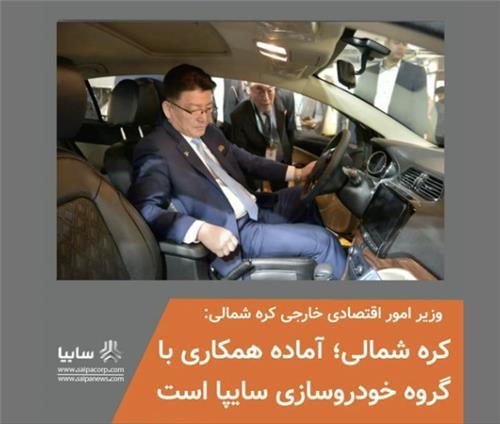
North Korea expressed interest in cooperation with Iranian automaker Saipa during a recent trip by an official delegation from Pyongyang to Tehran, according to a social media post uploaded by the company on Tuesday.
Yun Jong-ho, North Korea’s external economic relations minister, was quoted in a post on Saipa’s Instagram account that the two countries could “cooperate in the automotive industry given favorable bilateral political ties.”
According to Saipa, Yun made the remark during a visit to the company’s booth at a trade show in Tehran during the North Korean delegation’s 10-day visit to Iran, which ended on Thursday, according to the North’s state-controlled media.
The trip was the first to be publicized by the North’s state media since 2019, when Pak Chol-min, then the vice chairman of the North’s rubber-stamp legislature, visited Iran after the collapse of the Hanoi summit between North Korean leader Kim Jong-un and then-U.S. President Donald Trump.
Saipa, Iran’s second-largest automaker, formed a relationship with South Korea’s Kia Motors in the early 1990s and produced localized versions of the Kia Rio from 2005 to 2012 and the Kia Pride from 1993 to 2020.
Little data is published about the North’s automotive industry, but only a handful of citizens own cars as the regime emphasizes the production of military and industrial-use vehicles over passenger cars.
The regime has two automakers, Sungri Motor Plant and Pyeonghwa Motors, which mostly produce unauthorized derivations of foreign cars or reproductions under license.
Pyeonghwa Motors was set up as a joint venture by the South Korean-based Unification Church in the early 2000s, but the church divested completely from the company in 2013.
Chung Yu-seok, a researcher at Seoul’s Korea Institute for National Unification, said industrial cooperation between the North and Iran is likely intended to “highlight the ineffectiveness of sanctions imposed by the Western-oriented international community” but would probably be “limited in both economic scale and technology.”
While declining to comment directly on news reports regarding the North’s interest in automotive industry cooperation with Iran, an official at South Korea’s Unification Ministry told reporters on condition of anonymity that any substantive economic cooperation with the North would violate international sanctions targeting the regime’s illicit weapons programs.
“All forms of joint ventures, as well as the establishment, maintenance and operation of cooperative entities with North Korea, are banned under United Nations sanctions resolutions,” the official said, adding it is “highly likely” that “any meaningful cooperation with the North likely breaches United Nations Security Council sanctions.”
Resolution 2375, which the Security Council passed in response to the North’s sixth nuclear test in September 2017, bans all countries from establishing all joint ventures or cooperative entities in the North and prohibits the expansion of existing joint ventures with North Korean entities or individuals.
BY MICHAEL LEE [lee.junhyuk@joongang.co.kr]