The Snack Trap: How Costco Free Samples Hack Your Shopping Brain
You walked in for paper towels and bulk trash bags. You walked out with a $200 receipt, a massive box of frozen dumplings, and a sudden commitment to daily protein shakes. Sound familiar? If you’ve ever fallen victim to an impulse buy after a tiny paper cup of food, you aren’t alone. The legendary Costco free samples aren’t just a friendly customer perk—they are one of the most brilliant psychological marketing traps in modern retail history.
The Science of the Free Bite: Reciprocity and Sensory Memory
Why does a single bite of sausage convince us to open our wallets? According to behavioral economists, it boils down to two factors: social obligation and reduced purchasing risk.
-
The Reciprocity Rule: Duke University professor Dan Ariely notes that humans are hardwired to return favors. When a friendly worker hands you a free warm snack, your brain feels a subtle obligation to “pay it back”—which usually manifests as tossing the $15 box into your cart.
-
The Taste Memory Effect: Honor Taal, a behavioral economist visiting the University of Maryland, points out that tasting a product creates an immediate sensory memory. It instantly eliminates the fear of wasting money on something unknown, drastically lowering your hesitation to buy.
Neil Saunders, Managing Director of Retail at GlobalData, puts it bluntly: consumers who sample in-store are infinitely more likely to convert. “At the end of the day, it’s a high-ROI sales vehicle disguised as hospitality,” Saunders notes.
From Shopping Strategy to Suburbian Sport
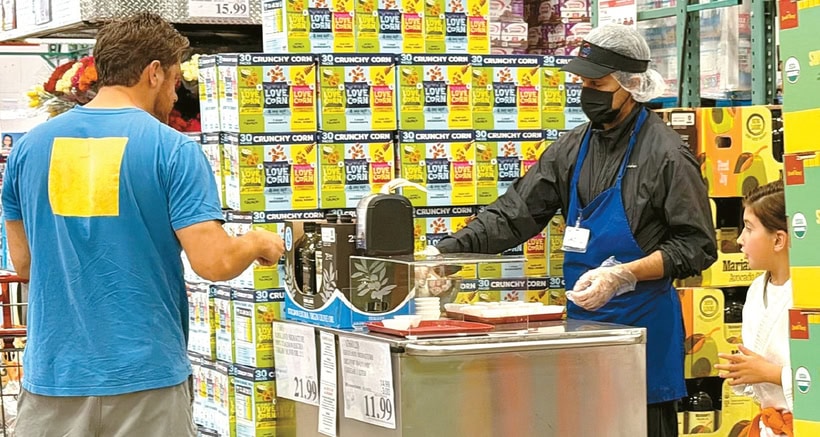
For millions of members, chasing Costco free samples has evolved into a weekend cultural tradition. Shoppers happily lap the warehouse perimeter, treating the food stations like a buffet.
“I only went in for water and paper towels,” admits LA resident Hyewon Park. “Then I hit the sample stations. I ended up leaving with frozen dumplings, protein shakes, and snacks I had zero intention of buying. I regularly spend $50 to $100 more than planned just because I tasted something good.”
The Chaos in the Aisles (and Why It Works Anyway)
Of course, free food brings its own brand of chaos. Cart traffic jams, sample-line cutters, and abandoned paper cups left on random display shelves are a constant headache for warehouse staff. Yet despite the occasional retail anarchy, experts agree that the program is central to Costco’s subscription model. By giving away small bites, Costco builds massive brand loyalty, drives high volume, and maintains the exact sales momentum required to keep their overall prices so low.
Next time you reach for that tiny pretzel stick, just remember: that “free” bite might just cost you $50 at the register. But hey, at least the dumplings taste great.