Non-Korean companies are increasingly putting Korean letters on packaging to appear tied to Korea, a trend of Hangul branding misuse that is confusing shoppers and risking damage to authentic brands. Some products look like they come from verified Korean firms, yet the sellers import goods labeled only as “Korean-made” without clear manufacturing details, or sell items with no actual connection to Korea.
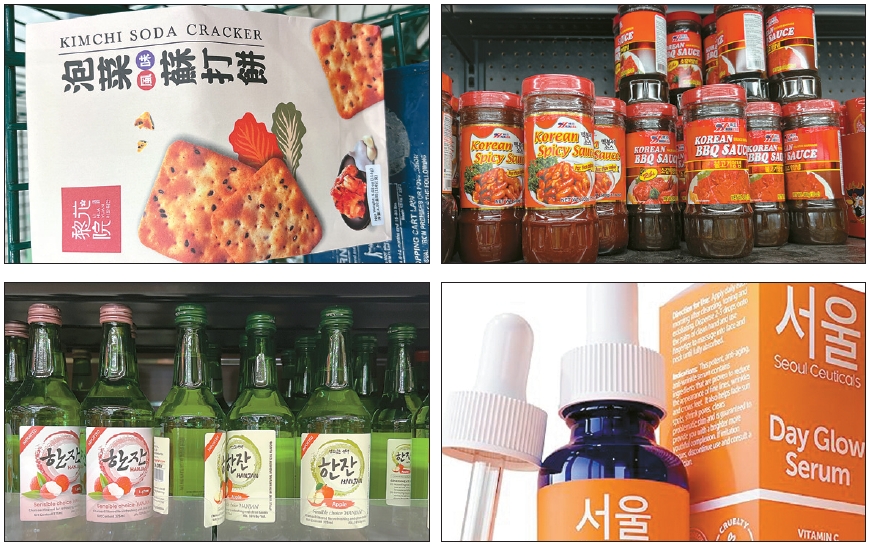
In Southern California’s Chinese-owned markets such as 99 Ranch Market and 168 Market, a “Kimchi Soda Cracker” uses Chinese, English, and Hangul together. The brand name “Li Hua Yuan” is also written in Hangul as “리화위안.” Records show the seller and distributor is Yang-Zhen Enterprise, whose headquarters and factory are in Taiwan.
Similar patterns appear in sauces now driving K-food exports. Products labeled as Korean “tteokbokki sauce” or “bulgogi marinade” list distributor Han Asia—easy to mistake for a Korean firm at a glance. The parent is Walong Marketing, a Chinese-owned company that imports Chinese products or distributes private-label foods.
Soju shelves show the same tactic. A fruit-flavored soju branded “Hanjan,” marked as Korean-made, is distributed by Aiko, a non-Korean-owned liquor company founded by a Ukrainian entrepreneur and CEO.
Shoppers notice the ambiguity. One customer said, “I thought it was a Korean company’s product just from the Korean writing,” adding that most people would not realize otherwise “unless they look closely.”
Online, K-beauty listings echo the trend. A highly rated serum labeled “Seoul” is made by Seoul Ceutical, headquartered in Florida and founded by Amy Romero and Craig Romero. The company’s website says key ingredients are sourced from Korea, but all products are manufactured in the United States.
Experts warn the look-alike labeling can mislead consumers and undermine real Korean brands. Jong-geum Lee, secretary-general of the Korean Food Globalization Association, said, “Korean shoppers can often tell the difference, but non-Koreans may struggle. Products marked only as ‘Korean-made’ without clear origin or factory information raise concerns about proper quality assurance.”
BY HOONSIK WOO [woo.hoonsik@koreadaily.com]