In a TV debate held on September 10, Vice President Kamala Harris and former President Donald Trump, who will face off in the upcoming November election, engaged in a heated exchange of views.
The two candidates clashed over various issues, including economic policy, the Ukraine war, and immigration, while also showing differing responses on North Korean leader Kim Jong-un.
During the debate, Harris criticized Trump’s close relationship with North Korean leader Kim Jong-un, stating, “It is well known he exchanged love letters with Kim Jong-un. Donald Trump is weak and wrong on national security and foreign policy. It is well known that he admires dictators, and wants to be a dictator on day one according to himself.”
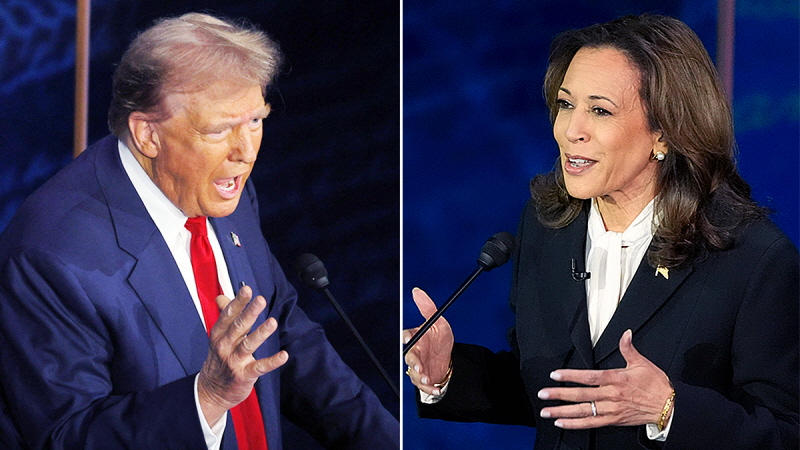
She further added, “It is absolutely well known that these dictators and autocrats are rooting for you to be president again because they’re so clear, they can manipulate you with flattery and favors. And that is why so many military leaders who you have worked with have told me you are a disgrace.”
Trump countered by citing Hungarian Prime Minister Viktor Orbán, claiming that world leaders are eager for his return to the presidency.
“China was afraid. And I don’t like to use the word afraid but I’m just quoting him [Orbán],” Trump said. “China was afraid of him. North Korea was afraid of him. Look at what’s going on with North Korea, by the way.”
Trump went on to say that Orban told him Russia also feared him, asserting that he was the most respected and feared leader in the world.
Despite mentioning North Korea as a threat, neither candidate brought up the term “denuclearization.”
Recently, concerns have been raised about the removal of the goal of North Korea’s denuclearization from both the Democratic and Republican party platforms, where it had previously been included.
These developments have sparked concerns that future U.S. policy on North Korea might shift from pursuing denuclearization to focusing on arms control and threat reduction. There is apprehension that North Korea, which seeks de facto recognition as a nuclear-armed state, might gain such recognition with U.S. acquiescence.
Meanwhile, voters who watched the presidential debate broadly agree that Harris outperformed Trump, according to a CNN poll conducted by SSRS.
Debate watchers favored Harris over Trump by 63% to 37% for her performance onstage in Philadelphia. Before the debate, the same voters were evenly divided on who would perform better, with 50% expecting Harris to excel and 50% expecting Trump to.
After the debate, 96% of Harris supporters believed she had outperformed, while 69% of Trump supporters said he had a better night.
Harris’ favorability among voters who watched the debate rose from 39% to 45%, while Trump’s favorability dropped from 41% to 39% after he took the stage.
BY YOUNGNAM KIM [kim.youngnam@koreadaily.com]