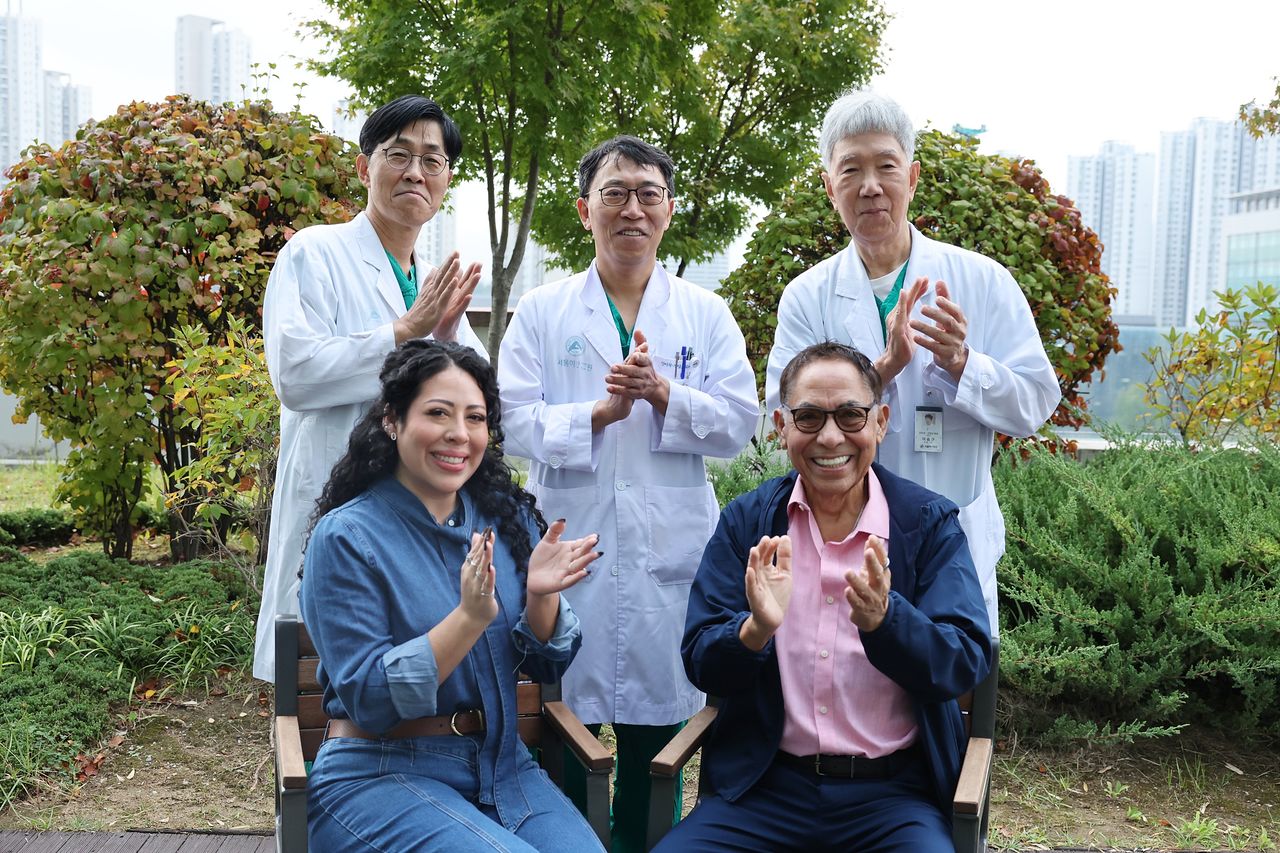
A 69-year-old Peruvian philanthropist suffering from end-stage cirrhosis has successfully regained his health after undergoing a living-donor liver transplant in South Korea. Asan Medical Center announced that Marco Antonio Quiroz, who received the transplant in August, has fully recovered and is scheduled to return to the United States.
Quiroz, who divides his time between the U.S. and Peru as a real estate developer, has long used his business proceeds to support nursing home elderly, low-income families, and ill children in Peru. He first discovered he had a liver condition in 2008 after gallbladder removal surgery revealed fatty liver disease. At the time, his doctor advised him it was not yet severe, so he lived without undergoing specific treatment.
However, by September of last year, abdominal swelling led him back to the hospital, where doctors diagnosed him with ascites and progressing liver fibrosis. By February of this year, fluid buildup in his lungs caused severe breathing difficulties, and he was officially diagnosed with cirrhosis. With his kidney function also at risk, a liver transplant became urgently necessary.
Quiroz learned that waiting for a deceased-donor liver in the U.S. would take over a year, as deceased-donor transplants are far more common there than living-donor procedures. Seeking alternative options, he discovered South Korea’s advanced living-donor capabilities, researched hospital success rates, and traveled roughly 10,000 kilometers to Korea with his family in late May.
Daughter’s Selfless Donation at Asan Medical Center
Following comprehensive medical evaluations, his 30-year-old daughter, Kimberly Lucia Quiroz, was chosen as the donor. Medical staff carefully evaluated her willingness, overall health, and physical build to confirm she could safely donate the necessary portion of her liver to her father.
On August 14, father and daughter underwent simultaneous surgeries. Professor Song Gi-won of the Department of Liver Transplantation and Hepato-Biliary Surgery resected the right lobe of the daughter’s liver, while Professor Lee Seung-gyu and Professor Moon Deok-bok successfully transplanted it into the father. The daughter’s procedure utilized an advanced technique that limits abdominal incisions to under 10 centimeters.
Overcoming Complex Vascular Challenges
The 17-hour surgery was exceptionally demanding. Complexly tangled blood vessels surrounding Quiroz’s liver and hardened tissue enveloping the inferior vena cava posed a high risk of massive hemorrhage or circulatory failure during extraction. Medical staff successfully navigated the challenge by first constructing a bypass route for blood flow before separating the diseased liver and implanting the new organ.
The daughter was discharged just 8 days post-surgery, while the father followed in his third week. Professor Moon Deok-bok noted that meticulous preparation, including the creation of a preliminary portal-vena cava bypass route, was key to successfully completing the complex operation.
Reflecting on his recovery, Quiroz expressed deep gratitude and renewed purpose, stating that his native Peru still holds many impoverished individuals who need his help, and he feels profoundly happy to have been given the opportunity to continue his charitable work.