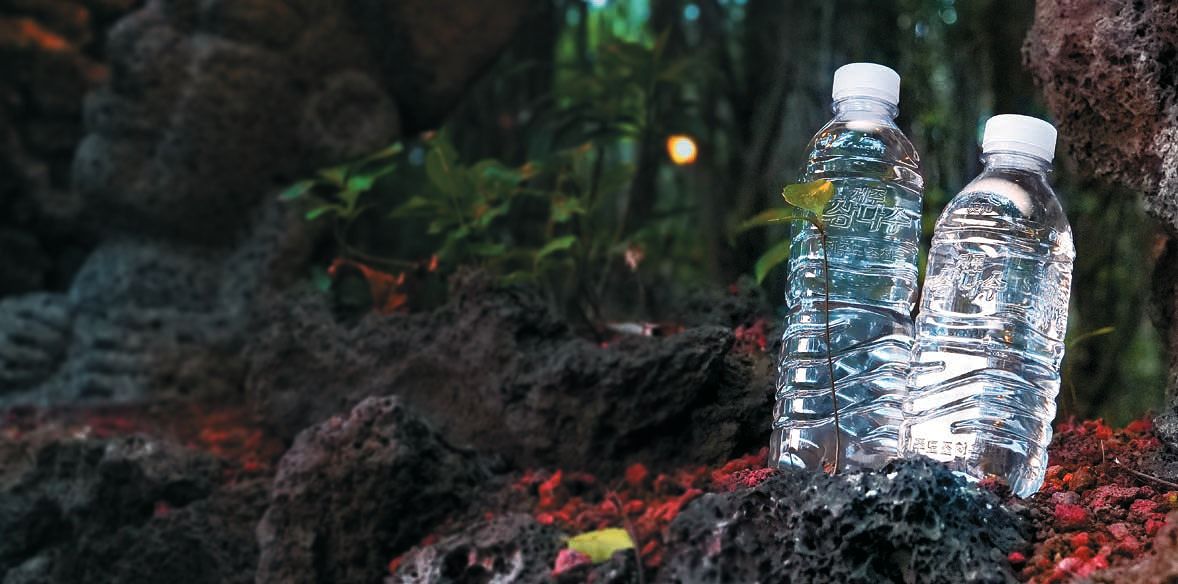
The pure groundwater nurtured by the volcanic island of Jeju over a long period is heading beyond South Korea and into the global market. Jeju Samdasoo, which has grown based on clean water resources created by Hallasan’s volcanic bedrock, is accelerating its entry into the global market with quality competitiveness and eco-friendly production technology.
The Jeju Samdasoo Development Corporation announced on the 25th that it is accelerating its overseas market expansion, having already proven its brand competitiveness domestically. The markets Jeju Samdasoo is focusing on the most are the United States and China. In the US, it made its first export of 40 tons to the New York and New Jersey regions.
The Jeju Samdasoo Development Corporation plans to expand its touchpoints with local consumers through H Mart in the US and online distribution networks in China. In June of this year, it opened an official brand pavilion on JD.com, a major online distribution platform in China, and began local sales.
In addition to the US and China, Jeju Samdasoo has set a goal to raise its export volume to 100,000 tons within the next three years through the expansion of global distribution networks. To achieve this, it is also pursuing business innovations such as strengthening online sales competitiveness, expanding overseas distribution partnerships, and building smart production facilities.
Global Strategy and Leadership
Since taking office in September, Jeju Samdasoo Development Corporation President Kim Do-young has presented ‘The Second Founding’ as a management direction, promoting global business expansion and management innovation. Based on about 27 years of experience in sales, distribution, and new businesses at private companies, his vision is to upgrade domestic distribution networks and pioneer overseas markets.
The quality competitiveness of Jeju Samdasoo stems from Jeju’s unique geological environment. Rainwater that seeps into high-altitude areas above 1,450 meters on Mt. Halla moves along volcanic bedrock for a long time, forming groundwater through natural filtration processes, which is then extracted from a single water source.
Recently, scientific analysis results showing that this natural filtration process takes about 31 years have reinforced its quality competitiveness. The Jeju Samdasoo Development Corporation, through a joint research team with Korea University last year, recalculated the average residence time of Jeju groundwater, previously estimated at about 18 years, to 31 years.
Strict Quality Control and Eco-Friendly Innovations
The Jeju Samdasoo Development Corporation operates the Water Research Institute, a nationally certified drinking water quality testing agency, conducting more than 20,000 water quality tests annually. It also systematically manages water resources through artificial intelligence (AI)-based groundwater level prediction and real-time monitoring.
Jeju Samdasoo is also focusing on eco-friendly production innovations. Following the introduction of the label-free product ‘Jeju Samdasoo Green’ in 2021, the company reduced the container weight of all product lines by an average of about 12% last year. This year, it further lowered plastic usage by reducing the container weight of the 330mL product by about 14%.
In September, the corporation established solar power generation facilities at the second water intake source, laying the foundation to produce about 260,000 kWh of renewable energy electricity annually. Through the L6 eco-friendly smart factory scheduled for completion in 2027, it plans to combine cutting-edge automation technology with label-free and recycled PET (r-PET) production foundations to enhance both production efficiency and eco-friendly manufacturing competitiveness.