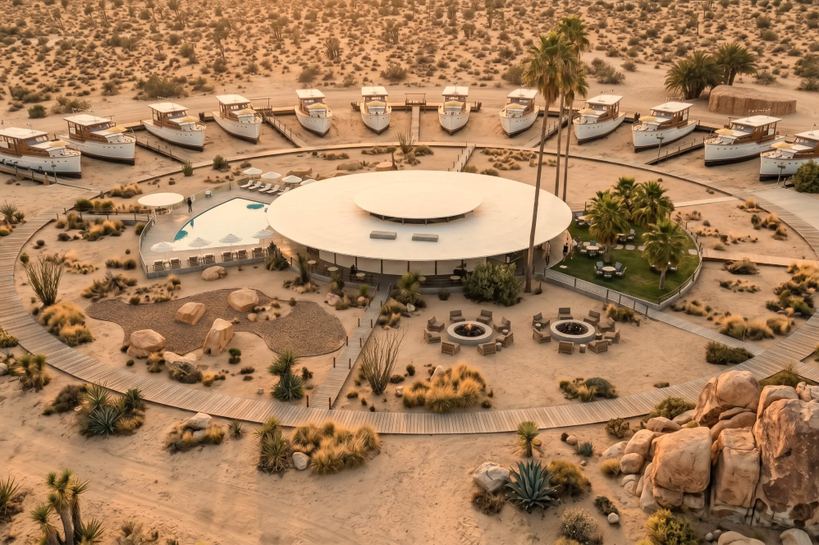
A unique desert hotel featuring landlocked yachts is slated to be built right in the middle of the Joshua Tree desert in California. The radical concept places rooms equipped with yacht decks, hulls, and portholes not in the sea or a marina, but on the dusty desert ground.
Lucky Find Hospitality, a boutique hotel development and operating company, announced plans to create the marine-themed hotel named Joshua Tree yacht hotel, officially called the ‘Compass Yacht Club’. Guests will stay in accommodations designed like real yachts while taking in expansive desert and mountain views. The company stated that construction is less than a year away.
The hotel rooms will consist of 30 two-story luxury yachts and 28 boathouses. All 58 accommodations will be arranged in a circle surrounding a central clubhouse, which will house a restaurant, bar, and swimming pool. The hotel site is located about a five-minute drive from the entrance of Joshua Tree National Park.
Nick Avanessoff, managing director at Lucky Find Hospitality, explained that falling asleep on a yacht and waking up to the desert’s mountain scenery is the hotel’s greatest charm. He noted that guests can sleep on a yacht, wake up facing the mountains in the desert, and reach one of America’s most beautiful national parks within minutes. Although it might sound a bit eccentric, that is exactly why he loves the project.
Overcoming Desert Regulatory and Environmental Challenges
This project, which seemingly combines two incompatible elements like the ocean and the desert, is moving forward after years of preparation and obstacles. Rigel Bitterman, CEO of Lucky Find Hospitality, shared that this project is much more than creating a unique accommodation—it holds deeply personal significance for him.
Born in Idyllwild, California, and raised around yacht life in San Diego, Bitterman frequently visited Joshua Tree National Park during his childhood to camp and rock climb. His experience growing up on the water and a lifelong interest in marine design naturally evolved into the concept of building a yacht hotel in the desert.
He has previously helped launch around 40 boutique hotel projects worldwide. Lucky Find Hospitality purchased a 23-acre parcel directly across the highway from AutoCamp in Joshua Tree back in 2023. Afterward, they began earnest preparations for hotel development, though the unique terrain, ecosystem, and cultural environment of the high desert proved challenging.
Bitterman noted the surprising length of time required to get anything moving in that location. Although the land was already zoned for commercial use when purchased, a portion of the site fell within a flood hazard zone designated by the Federal Emergency Management Agency (FEMA), requiring coordination with both local governments and federal agencies for permits and approvals.
Sustainable Design and Community Pushback
Developing with the desert’s limited water resources and natural environment in mind was another crucial task. The company stated it is investing extra time and effort to minimize environmental impact and build the hotel sustainably. Plans include minimizing water usage during operations and utilizing sustainable building materials for construction.
To reduce environmental damage, the yacht rooms will not be built on-site; instead, they will be completed in external facilities and transported for installation. Once manufacturing is finished, large cranes will lower the yachts directly onto the desert floor, anchoring them permanently in the middle of the desert unlike traditional seafaring vessels.
Another major hurdle during the project’s progression was pushback from local residents. The Joshua Tree area traditionally harbors a critical view of new development projects. Residents who value the natural environment and local community character have raised concerns that outside capital-driven development might alter the area’s traditional identity.
Bitterman has held quarterly town hall meetings to communicate with residents and build understanding around the project. While the company uses these sessions to share progress and listen to community concerns, the meetings have reportedly been far from smooth, with Bitterman admitting they face harsh rebukes from residents every time.
Community Reactions and Future Outlook
During a community information session held last December, one resident criticized the project as the epitome of gentrification, a phenomenon where incoming external capital and development displace existing residents or alter the neighborhood’s character. Another resident argued that a maritime yacht theme did not fit the desert landscape and jokingly suggested changing the hotel concept to a spaceship, which would better match the aesthetic of Joshua Tree.
This unexpected suggestion gained enthusiastic support among meeting attendees, with Bitterman recalling that everyone in the room started chanting "spaceship, spaceship."
Despite local resistance and various permitting hurdles, company management remains optimistic that the project will proceed as scheduled. Bitterman projected that final conditional use permits will be approved by the end of this year, allowing both hotel guests and the general public to access portions of the site.
The company targets breaking ground in 2027 and opening the hotel by the end of 2030. However, because the project schedule has already faced multiple delays, actual construction and opening timelines may vary depending on permitting and development progress.
Lucky Find Hospitality has finalized modular yacht hotel room designs with design partner Rad Labs. Once permitting is fully completed, the company plans to move forward by manufacturing the rooms off-site and installing them locally.
Over the past decade, Lucky Find Hospitality has participated in launching boutique hotel projects utilizing yurts, treehouses, glamping tents, and Airstream camping trailers. Developing unconventional hotels that offer distinct accommodation experiences in nature remains the company’s core business focus.
Bitterman reflected that among all the projects he has pursued, the Compass Yacht Club is the most radical and difficult, yet the one closest to his heart. He concluded that the project incorporates his childhood background of growing up on boats and being fascinated by marine design, noting that while all their projects are small and unique, they have never had another opportunity to bring such a special idea to life.