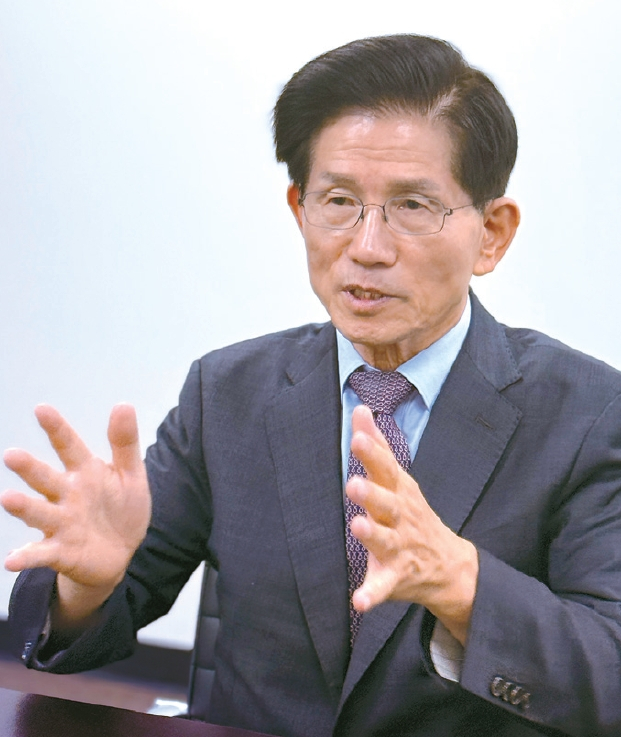
Kim Moon-su is unpretentious. The fact that he wore black rubber shoes during his college days at Seoul National University illustrates his down-to-earth character. At the same time, he is unyielding. Standing at the center of fierce labor movements, he went to prison several times and endured harsh torture, yet never betrayed his colleagues’ hideouts. This militant politician, Kim, is consequently direct in his speech. Visiting Los Angeles to attend a patriotic lecture hosted by the Freedom Democracy Research Institute at the Aroma Center on October 27 at 5 PM, he sat down on October 21 to frankly discuss the current state of ROK-U.S. relations and other pressing issues.
-Today, U.S. Ambassador to South Korea Michelle Steel stated that the ROK-U.S. alliance is experiencing ‘turbulent currents.’
“Historically, ROK-U.S. relations have never been this distant. In the past, during the Park Chung-hee administration, there was friction over Carter’s U.S. troop withdrawal policy, but back then, North Korea did not possess nuclear weapons. Now, doesn’t North Korea have nuclear weapons? The North Korea-China-Russia trilateral axis is currently forging close ties based on nuclear capabilities, yet the Lee Jae-myung administration is walking down the wrong path. It is increasingly falling into a black hole.”
-Why is it falling into a black hole?
“What is the basic axis driving the world today? Isn’t it the hegemonic competition between the U.S. and China? The Lee Jae-myung administration completely fails to grasp this. Instead, it is only making moves and remarks that please North Korea and China. How pleased must Xi Jinping and Kim Jong-un be? The shaking of ROK-U.S. relations is directly linked to the security situation on the Korean Peninsula. Many people are feeling anxious. The Lee Jae-myung administration has tripped up its steps as it grows distant from the United States. Who bears the cost of that damage?”
-The U.S. is facing midterm elections. What impact will they have on South Korea?
“From our perspective, President Trump is currently drawing a clear line against China. Simply put, he is dividing the free democratic camp and the communist camp. Isn’t this an opportunity for the Republic of Korea? Yet, the Lee Jae-myung administration fails to seize this as an opportunity, instead talking about wartime operational control (OPCON) transfer and autonomous diplomacy in ways that easily cause misunderstandings in the U.S. Under these circumstances, if Trump’s Republican Party loses the midterm elections, I believe things will become even more complicated for South Korea.”
-Why is the Korea-US alliance important?
“We base our alliance on the ROK-U.S. partnership across all areas, including diplomacy, economy, and culture. Wasn’t the driving force behind our prosperity and stability over the past 70 years thanks to the ROK-U.S. alliance? Furthermore, the Lee Jae-myung administration claims that North Korea’s nuclear weapons are not for offensive use, which is absolute nonsense. They lack an accurate understanding of the importance of the ROK-U.S. alliance, widen the distance with the U.S. without viable countermeasures, and talk about getting along well with China and North Korea. Can that truly work out well?”
-What constitutes South Korea’s current crisis?
“Broadly speaking, there are three crises. The most serious problems are the North Korean nuclear threat and the security crisis caused by the OPCON transition, the destruction of the rule of law due to criminals coming to power, and the despair youth feel because of the social establishment.”
-You have been communicating frequently with young people since the presidential election.
“Those in their late 40s to early 60s should be regarded as the establishment. The activist faction holds the majority, and they have seasoned experience, political energy, and technique, along with good organization. The problem is that it is time for them to step down, yet they refuse to do so. In reality, they are a gang of thieves forming a cartel. Young people have no organizations and are not a voting bloc that holds political clout, leaving them without anyone to represent their voices. That is why I am creating platforms like youth dialogue sessions to meet with them primarily through education.”