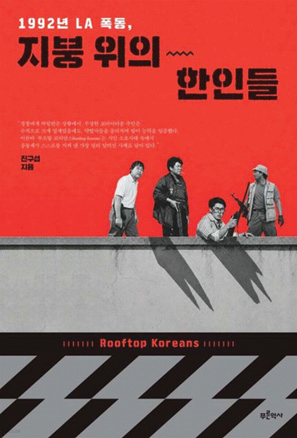
Professor Emeritus Koo-Sub Jin of McPherson College has released his new book, LA Riots Rooftop Koreans, as if lifting a lifelong burden from his heart.
The Truth Behind Rooftop Koreans
The title ‘Rooftop Koreans’ is drawn from a iconic photograph that symbolizes the 1992 LA Riots. The individuals in the photo are neither police officers nor protesters. They are Korean Americans who climbed onto building roofs with guns to protect their own stores. At the time, the media called them ‘Rooftop Koreans.’
The author meticulously investigates the errors and incompetence of the Los Angeles Police Department as if solving a mystery. He reconstructs the events before and after the riots minute by minute and traces the actions of the police. He expresses deep regret that even if only a fraction of the 1,790 police officers gathered at the ‘Emergency Field Command Post’ during the first six hours of the riot had been deployed to the violence scene just about two miles away, the spread of the riots could have been halted immediately.
Challenging Historical Distortions
As a researcher of racial issues, the author has another reason to recall the events of 34 years ago. Distortions regarding the LA Riots are occurring amidst universal oblivion.
At some point, the mainstream media’s tone in reflecting on the incident solidified into a direction that substituted the LA Riots into a conflict between Korean Americans and African Americans. The author points out that a historical reversal, or ‘switcheroo,’ is taking place where the Korean American community is portrayed as the cause of the riots and Korean immigrants are perceived as perpetrators rather than victims.
Amidst this, false information about the LA Riots is reportedly circulating as if it were fact on the internet in South Korea. Furthermore, a dichotomous view is prevalent within some circles of the diaspora community, viewing themselves as good and other groups as evil. He emphasized that restoration and playback work are necessary to correct our errors.
Immigrant Survival and Identity
The book comprehensively reconstructs why Korean immigrants, harboring the American Dream, had no choice but to open stores in predominantly Black neighborhoods, and how conflicts accumulated between the Black and Korean communities through the Rodney King incident and the ‘Soon Ja Du incident’ (the Latasha Harlins shooting).
This book can also be read as an account showing how Korean immigrants survived, clashed, and forged their identities within the multiracial society of the United States.