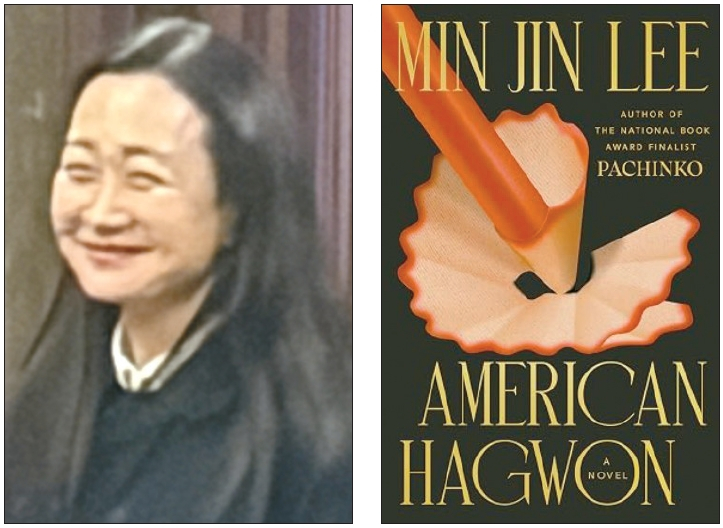
Best-selling author Min Jin Lee held a book launch talk for her new novel, Min Jin Lee American Academy, on the 13th at the First Congregational Church of LA, drawing an audience of over 700 attendees.
Alongside actress Jamie Chung and director Lee Isaac Chung of the film ‘Minari’, she discussed immigration, education, and the meaning of family. As the third installment in her four-part series exploring the lives of Koreans and the Korean diaspora following ‘Free Food for Millionaires’ and ‘Pachinko’, ‘American Academy’ marks her first new release in about 10 years since ‘Pachinko’ in 2017.
Prior to the publication event, an interview was conducted with author Min Jin Lee.
Regarding the background of her diaspora quartet and the starting point of the immigrant experience through ‘American Academy’, she explained, “It started from the question, ‘Why do misfortunes happen to good people?’ ‘Free Food for Millionaires’ dealt with capitalism and generational conflict, while ‘Pachinko’ covered colonial history. The new novel ‘American Academy’ aims to shed light on the historical context of Korean educational zeal. The shock experienced by the assetless middle class during the 1997 IMF foreign exchange crisis led to another diaspora. Through this book, I wanted to provide a legitimate context for Korean behavior.”
When asked about the values explored through the Go family as their success formula collapses, she stated, “I wanted to show the gap between ‘lived experience’ and ‘faith in upward mobility.’ The parents in the novel graduated from prestigious universities but lacked assets, leaving them helpless in the face of the IMF shock and ultimately reverting to the individual survival tactic of children’s education. This process demands desperate sacrifices and bonds, such as giving up one’s studies for a younger sibling. Beyond the success formula, I wanted to question the sacrifice and communal values that sustain a family amid crisis.”
Addressing why the culture of evaluating parents’ sacrifices through children’s success and the fever for education persist, she noted, “Evaluating parental sacrifice through a child’s success is harmful. Viewing education as an investment and return causes families to collapse. This belief persists due to Confucian traditions and the emotional need to prove oneself, reminiscent of ‘The Tale of Hong Gil-dong.’ However, before dismissing educational zeal as an obsession, we must ask the structural reasons why people feel helpless and rely solely on education as a survival tactic. Understanding it as a survival strategy helps heal intergenerational wounds.”