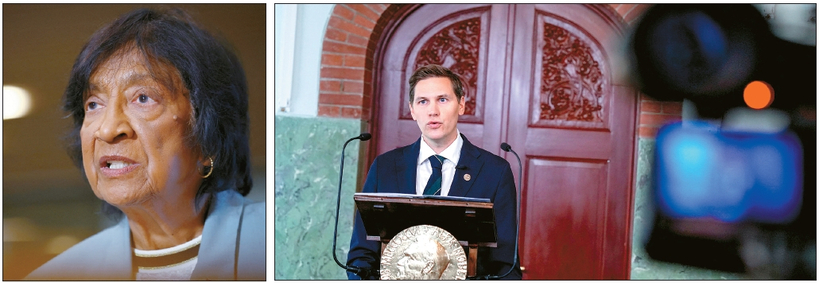
The Nobel Peace Prize is notoriously susceptible to political winds, and the controversy surrounding the 2026 laureate vividly reminds the world of this reality.
This year’s recipient is Navi Pillay, an 85-year-old jurist from South Africa. Having served as the UN High Commissioner for Human Rights, a judge on the International Criminal Court (ICC), and president of the International Criminal Tribunal for Rwanda, her selection was officially attributed to her fight against South Africa’s apartheid and her contributions to punishing war crimes, crimes against humanity, and genocide through international law.
While the overarching rationale sounds commendable, evaluations diverge sharply on the details, particularly among American conservatives and pro-Israel factions who question her qualifications.
The skepticism stems from allegations of partisan bias. Critics argue she has been overly stringent regarding Israel while showing leniency toward Hamas. They point out that while she categorized Israel’s military operations in Gaza as genocide, she applied excessively rigorous evidence thresholds to allegations of sexual violence committed by Hamas against Israeli civilians.
Her track record during her tenure at the United Nations has also come under scrutiny. Critics contend that she focused disproportionately on criticizing Israel rather than addressing human rights abuses in China, North Korea, and Russia. According to the conservative magazine National Review, during her tenure as UN High Commissioner from 2008 to 2014, the UN Human Rights Council adopted 39 resolutions condemning Israel, compared to only 6 for North Korea and 4 for Iran. Resolutions targeting China, Russia, Cuba, Qatar, Turkey, and Pakistan stood at zero.
Serious allegations have also surfaced. Citing former UN human rights staffer Emma Reilly, National Review reported that under Pillay’s watch, the UN handed over a list of 50 Chinese dissidents to Beijing authorities. Reilly claimed that some individuals on that list were subsequently detained, tortured, or died, though Pillay’s direct involvement remains unverified.
Pillay was already at the center of controversy prior to winning the Nobel prize due to her leadership of the UN Independent International Commission of Inquiry from 2021 to 2025. Last September, the commission concluded that Israel committed genocide in the Gaza Strip, asserting that four of the five acts defined by the 1948 Genocide Convention had occurred.
Genocide is a grave legal term with strict criteria. It requires proving a specific intent to destroy, in whole or in part, a national, ethnic, racial, or religious group—known as ‘genocidal intent’. In the 2007 International Court of Justice (ICJ) ruling on the Bosnia case, it was established that inferring genocidal intent requires it to be the only reasonable inference. Critics argue that Pillay’s commission weakened this standard by relying heavily on circumstantial evidence to establish genocidal intent.
Israel has strongly denied these claims, whereas the Norwegian Nobel Committee heavily praised Pillay’s investigative work as a key reason for her award. This starkly contrasts praise for defending international law with fierce criticism that international law is being politically exploited.
In an op-ed published on October 13 in the online magazine Quillette, University of Florida professor Norman Goda pointed out that Pillay’s investigative methods and evidence utilization were biased, arguing that her data sources relied too heavily on Palestinian entities and anti-Israel NGOs.
Controversy over evidence standards also arose regarding Hamas’s sexual violence. In a June 2024 report, the commission led by Pillay acknowledged that sexual violence occurred in multiple locations in a consistent pattern during the October 7, 2023 attacks. However, it also noted limitations, stating it could not secure forensic evidence, directly interview survivors, or independently verify certain specific allegations.
Critics argue this represents a double standard: emphasizing a lack of evidence for Hamas’s sexual violence while broadly accepting indirect and circumstantial evidence to judge Israel’s genocidal intent.
While the Nobel Committee selected Pillay for upholding the international legal order, detractors argue that her legal interpretations could undermine the credibility of international law. Conversely, supporters maintain she demonstrated that even major powers and militaries are not exempt from judgment under international law, fueling politically charged debates.
This dual structure stems from Alfred Nobel’s 1895 will, created when Sweden and Norway were united under a single monarch. Although the two countries dissolved their union in 1905, the authority to award the peace prize remained with Norway.
The selection process also differs. While scientific Nobel prizes focus on verifying discoveries and research achievements, the peace prize evaluates political actions and their meanings. Furthermore, candidates are judged not only on past accomplishments but also on ongoing peace efforts and future potential.
Consequently, controversy is frequent. The joint award given in 1973 to Henry Kissinger and Le Duc Tho for negotiating the Vietnam War ceasefire is a prime figure in this history. Critics fiercely questioned awarding a peace prize to Kissinger, a key architect of the war, while Le Duc Tho refused the prize on the grounds that true peace had not been achieved.
Barack Obama’s 2009 award faced similar criticism, coming less than nine months into his presidency and sparking debate over whether it was granted prematurely based on expectations rather than concrete achievements. Meanwhile, Mahatma Gandhi, renowned for his nonviolent resistance, was repeatedly nominated but never won.
While the Nobel Peace Prize ostensibly honors contributions to global peace, the evaluations themselves often serve as the starting point for intense political controversy. This year’s award to Pillay once again challenges whether the benchmark for such recognition remains truly impartial.