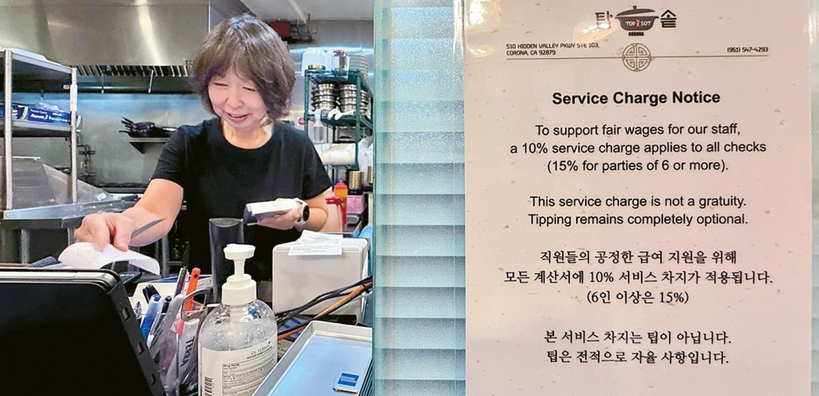
In Southern California, where an 18% to 20% tip has essentially become the standard when dining out, a restaurant introducing a new approach of a ‘10% service charge, tipping optional’ is catching attention.
The Korean restaurant Tapsot Corona branch automatically charges a 10% service charge on the food bill instead of demanding separate tips from customers. The receipt also guides customers that ‘additional tips are not necessary, and this is entirely optional.’
Customer reactions are beyond positive. Amid the recent trend where restaurants frequently present self-tipping options of 18%, 20%, and 22%, customers appreciate only paying 10% without worrying about extra tips. Compared to the typical recent 20% tip, this cuts the tipping burden down to about half.
The restaurant stated that customers visit not only from around Corona but also from distant areas like Irvine. Customers cite the biggest advantage as not having to worry or feel pressured about how much tip to leave when paying.
David Kim, the owner of the Tapsot Corona branch, pointed to the recently overly high tipping burden as the background for introducing this system.
Kim said, ‘Even as someone running a restaurant, there are times when continuously paying a 20% tip feels burdensome,’ adding, ‘The intention is to eliminate the atmosphere where expensive tipping feels forced while receiving service costs at a reasonable level.’
Employees are also satisfied. Instead of server earnings fluctuating greatly based on high or low sales, this method guarantees a steady wage. Income coming from the 10% service charge is utilized entirely for employee compensation, according to the explanation.
Kim added, ‘The money coming in through the service charge is used to pay the wages of not just servers, but also food runners and the kitchen, and we clearly guide customers on this as well,’ noting, ‘If guests receive good service and are specially satisfied wanting to give more, they can give an extra tip freely, but that is entirely up to the guest.’
Restaurant owners looking to introduce such a system need to closely review relevant laws in advance. Because service charges are completely different from general tips under tax and labor laws, clear notice and wage processing—just like the Tapsot Corona branch—are important.
Mandatory service charges are subject to sales tax. When this amount is paid to employees, it is considered wages rather than tips, making it subject to income tax and social security tax.
The California government states that restaurants and bars can charge a separate service charge provided they clearly and conspicuously disclose the fact that there is a mandatory fee and its cost where prices are displayed, such as on the menu.
Kim said, ‘Right around our restaurant, places are slowly emerging that receive a fixed service charge instead of tips to reduce the burden on guests,’ adding, ‘Rather than tipping continuing to rise like now, I hope tipping culture changes in a direction that guests, employees, and restaurants can all agree on.’