Seven months into President Donald Trump’s second term, the world is in turmoil. The global free trade system, once anchored by Washington, is rattled by Trump’s steep tariff barriers. U.S. allies are pressed to pour hundreds of billions of dollars into the American economy.
The United States faces a series of urgent challenges: the war in Ukraine, conflict in the Middle East, China’s challenge to U.S. hegemony, and ongoing provocations from North Korea. The key question is whether Trump’s “America First” foreign policy has the vision and strategy to address these crises—and how the U.S. will reshape the international order.
A new volume, Rethinking World and the United States, edited by Chung-in Moon, Distinguished Professor Emeritus at Yonsei University, seeks to explore that question. Published in English with support from the Pacific Century Institute (PCI), the book compiles the 2023 James Laney Lecture Series at Yonsei, which Moon led as Laney Chair Professor.
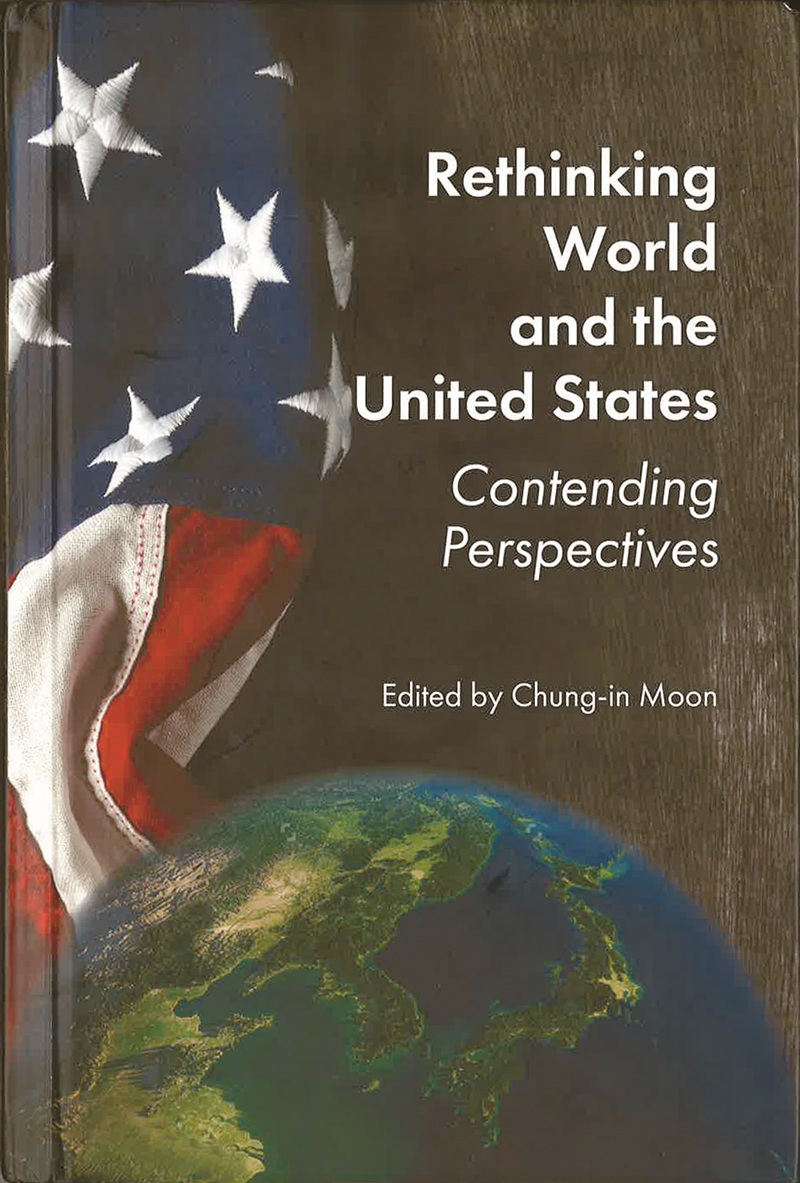
The lineup of contributors is impressive, featuring leading scholars and experts: Charles Kupchan of Georgetown University, Walter Russell Mead of the Wall Street Journal, G. John Ikenberry of Princeton University, former Assistant Secretary of State Susan Thornton, Karl Eikenberry of Tsinghua University, Robert Carlin of Stanford University, nuclear scientist Siegfried Hecker, and former Assistant Secretary of State Robert Gallucci, among others.
Though the book does not confine itself to Trump’s second-term policies, its opening chapter examines the meaning of “America First.” Trump, the authors argue, shows little regard for traditional American values of democracy, human rights, and the rule of law, focusing instead on national self-interest above all else.
Most lecturers converge on one point: China is the central challenge. Whether Washington opts for coexistence within a managed framework, or seeks to contain Beijing’s rise, will shape the future of the international order.
On the Korean Peninsula, the debate circles back to North Korea’s nuclear ambition.
Analysts Carlin and Hecker note that North Korea once sought normalization with Washington from the early 1990s, but abandoned that goal after the failed 2019 Hanoi summit. Pyongyang has since drawn closer to Russia and China. In 2023, it declared South Korea a “hostile state at war” and adopted an openly aggressive nuclear doctrine.
How should Seoul respond? Carlin argues, simply, that “diplomacy is the only solution.” Hecker proposes a phased approach, beginning with a freeze on nuclear activities and progressing step by step toward full denuclearization. Neither sees an easy or immediate fix.
Security strategy, of course, is often filtered through partisan and ideological lenses. Not all readers will agree with the perspectives in this book. Yet Rethinking World and the United States offers a timely prompt for South Koreans to reflect on their nation’s options amid global upheaval.
The publication of the book and the lecture series was supported by Pacific Century Institute (PCI).
By Mooyoung Lee [lee.mooyoung@koreadaily.com]
Notice: With PCI’s support, the Korea Daily will provide free copies of the book to the first 30 interested readers (one per person). To apply, send your name, address, and phone number by email to jservice@koreadaily.com. Confirmed recipients may pick up their copy at the Korea Daily office (690 Wilshire Pl, Los Angeles, CA 90005). For U.S. residents, shipping is available for a $20 delivery fee.