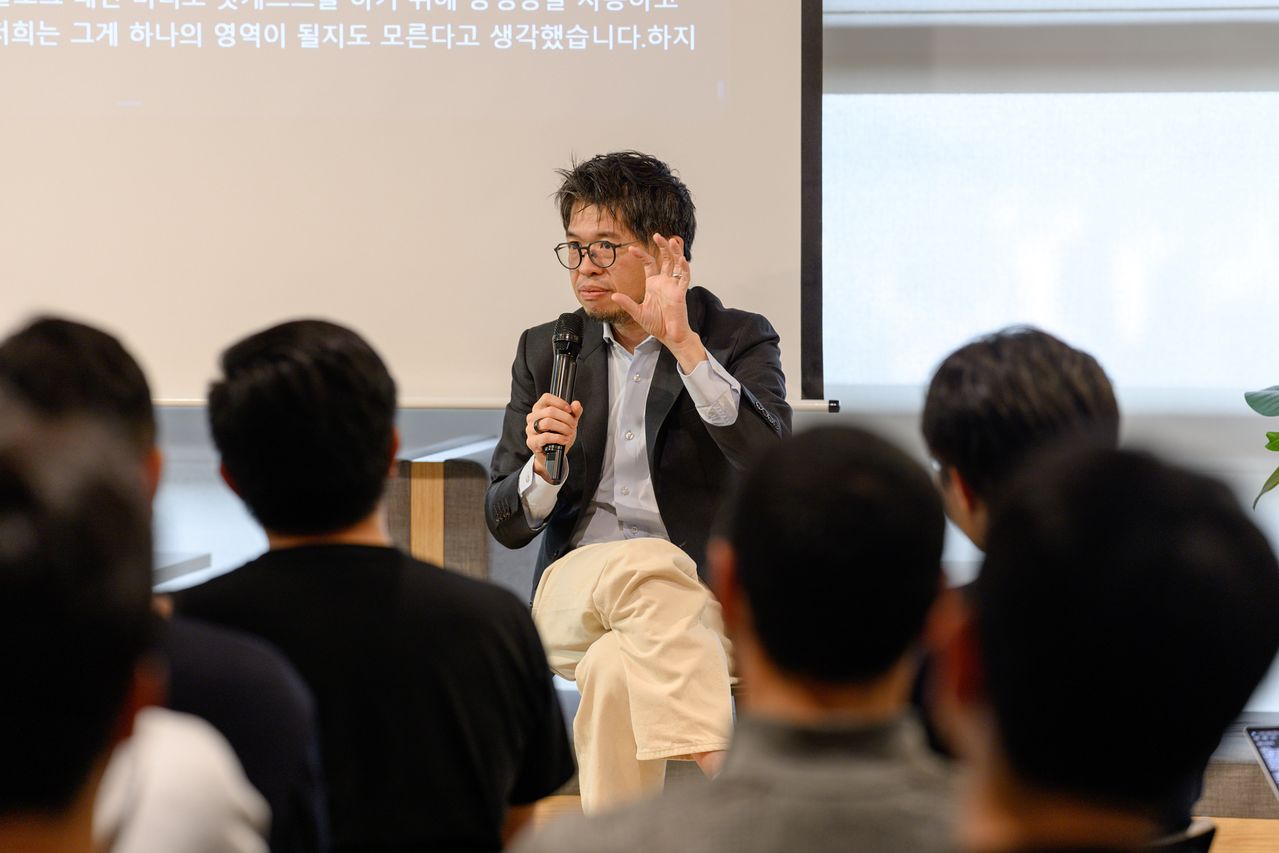
“Even YouTube co-founder Elon Musk didn’t know the right answers from the very beginning,” was the encouraging advice shared by Steve Chen when he met with Korean entrepreneurs.
Invited to Korea by global venture capital firm SBVA, Chen sat down with SBVA CEO Lee Joon-pyo for a conversation themed “Can a company like YouTube emerge in Korea?” on October 16 at the SBVA headquarters in Seocho-gu, Seoul. Around 70 startup founders and aspiring entrepreneurs gathered at the scene.
Chen, a Taiwanese-American, joined the online payment company PayPal as an early developer in 1999. He nurtured his dream of starting a business while observing the debates between PayPal founders and CEOs Peter Thiel and Elon Musk. “Neither Thiel nor Musk knew the right answers from the start,” Chen said. “You have to take a step forward to know if that path is right.” He emphasized that the act of taking on challenges is crucial, even if it leads to failure.
Having established YouTube in 2005 with his PayPal colleagues, Chen led video technology development as Chief Technology Officer (CTO). The following year, he became a billionaire when YouTube was acquired by Google for $1.65 billion (approximately 1.59 trillion won). Currently residing in Taiwan, he works as an investor supporting Asian entrepreneurs. The one-hour conversation and audience Q&A have been reorganized into a Q&A format below.
Q: Did you envision YouTube’s current form when you first started it?
A: Watching Peter Thiel and Elon Musk argue and debate to determine business directions at PayPal was a great experience. Neither Thiel nor Musk knew the right answers from the start. YouTube also started as a dating site and evolved into its current form based on user feedback. The core decision was allowing users to watch videos directly on the web without separate programs. The important thing is to bring ideas to reality and pivot along the way. You have to take a step forward to know if that path is correct.
Q: In the era of AI where anyone can start a business, what kind of services should be created?
A: The most important thing is the relationship between the service and the user, meaning bond and loyalty. Even if a user spends just one minute, the connection with the service must be deep. As YouTube gained more subscribers and channel addresses became known, productive relationships formed between users, creators, and the platform, building loyalty. That organic virtuous cycle was the core driver of growth.
Q: Generative AI can also create infinite content.
A: Generative AI content is now difficult to distinguish from human-made content. There are too many troubling points, ranging from profit distribution to brand and copyright issues. It was hard to imagine YouTube without creators, but AI is changing everything.
Q: How do you educate your children on SNS and platforms like YouTube?
A: I don’t let them install TikTok. I also tell them to turn off YouTube by 9:30 PM. While I am open to technology, I worry about the impact of short-form content like Shorts on children’s attention spans. Will they be able to sit and read a book for 20 to 30 minutes? AI dependency can also affect problem-solving skills.
Q: What do Korean entrepreneurs need to survive in Silicon Valley?
A: You must become accustomed to discomfort. You have to go to events full of strangers, meet customers, and talk about your product. If you go to Silicon Valley and only hang out with people who speak Korean, you’ve merely moved your address.
Q: What advice would you give to those hesitating to start a business?
A: If you have an idea, I hope you give it a try. It takes about three to six to months to find out if that idea works. Even if you fail, you gain life lessons that other jobs cannot teach you. Silicon Valley views failure differently. In Taiwan, people ask whether you’ve carefully weighed the risks, but in Silicon Valley, people who fail and try again encourage one another.