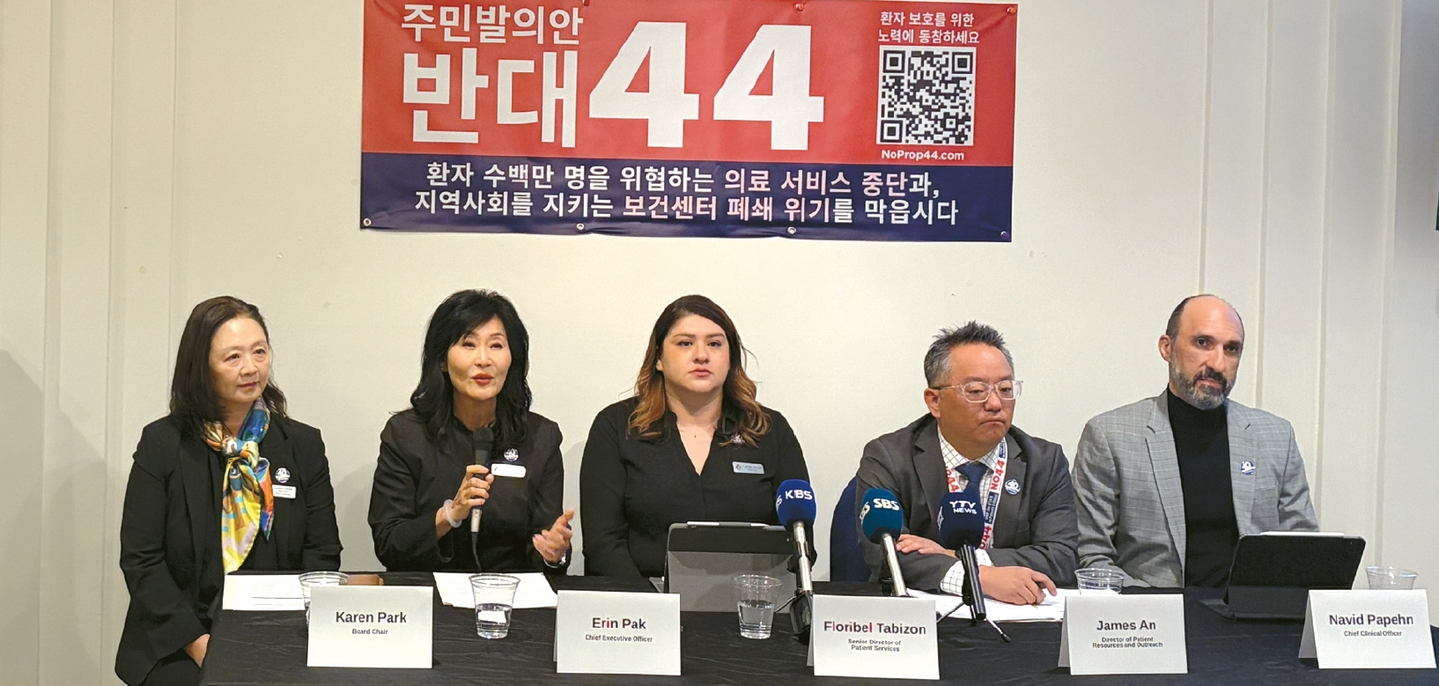
Neighborhood Care Clinic (Director Erin Park) held a media briefing at Yonggung in Koreatown on the 14th, expressing opposition to Proposition 44, which would require community clinics in California to use 90% of their revenue for patient care services.
In the November 3 midterm election, major ballot measures (propositions) will be put to a vote that will affect the tax burden and medical services of Koreans in California. The Korea Daily supports Propositions 41 and 42 and opposes Propositions 40 and 44 among the 14 propositions on the ballot. The grounds for judgment on each ballot measure are summarized below.
▶ Proposition 40 — Oppose
This ballot measure, dubbed the ‘billionaire tax,’ would impose a one-time 5% tax on assets for California residents with a net worth of $1 billion or more as of January this year, with 90% of tax revenues going to the healthcare sector. However, relying on temporary tax revenues to cover recurring medical expenses without a long-term funding plan makes it difficult to guarantee the stability of healthcare financing.
The California Legislative Analyst’s Office (LAO) analyzed that the actual collection scale is also uncertain. In particular, it raised the possibility that income tax revenue could decrease by up to $1 billion annually due to the migration of some wealthy individuals to other states. Disputes over asset valuations, such as equity in unlisted companies, and collection costs expected to reach tens of millions of dollars annually for several years are also burdens. While sympathizing with the purpose of expanding medical financing, the judgment is that securing a stable and sustainable financial resource must take precedence over a one-time tax.
▶ Proposition 41 — Support
The core of Proposition 41 is to verify whether the budget of existing public works is being used properly before collecting new taxes. The ballot measure stipulates that if 25% of the signatures required for a resident ballot measure to establish a special tax or raise taxes are secured, the California State Auditor shall conduct an independent audit of the project.
The audit includes not only financial management practices but also ways to reduce annual project costs by 10%. Audit results are released in the official voter guide and regular audits must be conducted every four years even after taxes are introduced. It also restricts new special taxes from bypassing existing state spending cap regulations. The LAO analyzed that while initial audit costs amount to several million dollars annually, audit recommendations can lead to budget savings and service improvements.
▶ Proposition 42 — Support
Proposition 42 prohibits imposing new taxes on asset ownership itself, rather than actual income or realized investment gains. Currently, California does not tax the mere holding of stocks or investment accounts, but taxes income and realized investment gains generated through them.
However, if taxes are imposed on assets that have not yet been cashed out, taxpayers may be forced to dispose of held assets to raise taxes. In particular, equity in unlisted companies with unclear market prices is concerned about leading to disputes surrounding asset valuation. For these reasons, we support this ballot measure, which bans new taxes on asset holdings themselves.
▶ Proposition 44 — Oppose
Proposition 44 mandates non-profit community clinics to spend at least 90% of their annual revenue on medical services and imposes fines for shortfalls if they fall short of the criteria. However, uniform spending criteria that do not consider the different operating conditions of each clinic could rather shrink medical services. There are about 2,000 medical clinics for low-income and uninsured people in California. Private non-profit clinics currently use about 80% of their revenue on medical services on average. Operating a medical institution requires not only direct treatment but also essential indirect costs such as computer systems, facility management, and insurance claims.
Failing to consider these operational realities and uniformly increasing the ratio of medical service spending could reduce operations or even put some clinics at risk of closure. While the purpose of investing more budget in patient care is valid, excessively rigid spending regulations could rather weaken the local medical network that low-income people depend on.