[Studio486] is a corner introducing photo stories captured through the feet of JoongAng Ilbo photojournalists. JoongAng Ilbo is located at 48-6 Sangamsan-ro.
“The beauty of gold leaf comes not from the amount of gold, but from the patterns and negative space.”
Thin gold leaf gently settled onto silk under the fingertips of Kim Gi-ho, the 5th Master of Geumbak. When stroked carefully with a fingertip, the pattern carved into the wooden block revealed itself in vivid golden light. Even a slight variation in the concentration of paste or the pressure applied changes the grain of light. It is a delicate process that machines cannot replace.
Gold leaf craft begins with making the ‘gold plate,’ a wooden block used to carve patterns. The surface of a fine-grained, hard pear wood block is painted red, and the design is drawn with ink. Then, carving knives are used to scoop out the red areas, leaving only the black lines to be stamped with gold leaf. The red color helps distinguish between areas to carve and areas to keep, increasing work accuracy.
Adhesive paste is applied to the completed gold plate, and thin sheets of pure gold leaf are placed on top. After stamping this onto silk and rubbing it with fingertips to make it adhere, the golden pattern is complete. This process is called ‘bugeum.’ During the Joseon Dynasty, artisans performing this work were called ‘bugeumjang,’ but today they are known as ‘geumbakjang.’
Traditionally, adhesives used were agulue made by boiling cattle leather or bones, and fish maw glue made from croaker swim bladders. While fish maw glue offers excellent elasticity and adhesive strength, it dries so fast that it hardens in about 5 seconds, making it difficult to adjust the concentration. Today, modified pastes are also used depending on the task.
Master Kim compared gold leaf craft to ‘hardware’ and ‘software.’ If the technology of controlling paste concentration and thickness to precisely attach gold leaf is the hardware, the design of planning and arranging patterns to complete the overall composition of the artwork is the software.
“What and how to express matters more than the technique of attaching gold leaf. I think design and carving account for 90% of the work.”
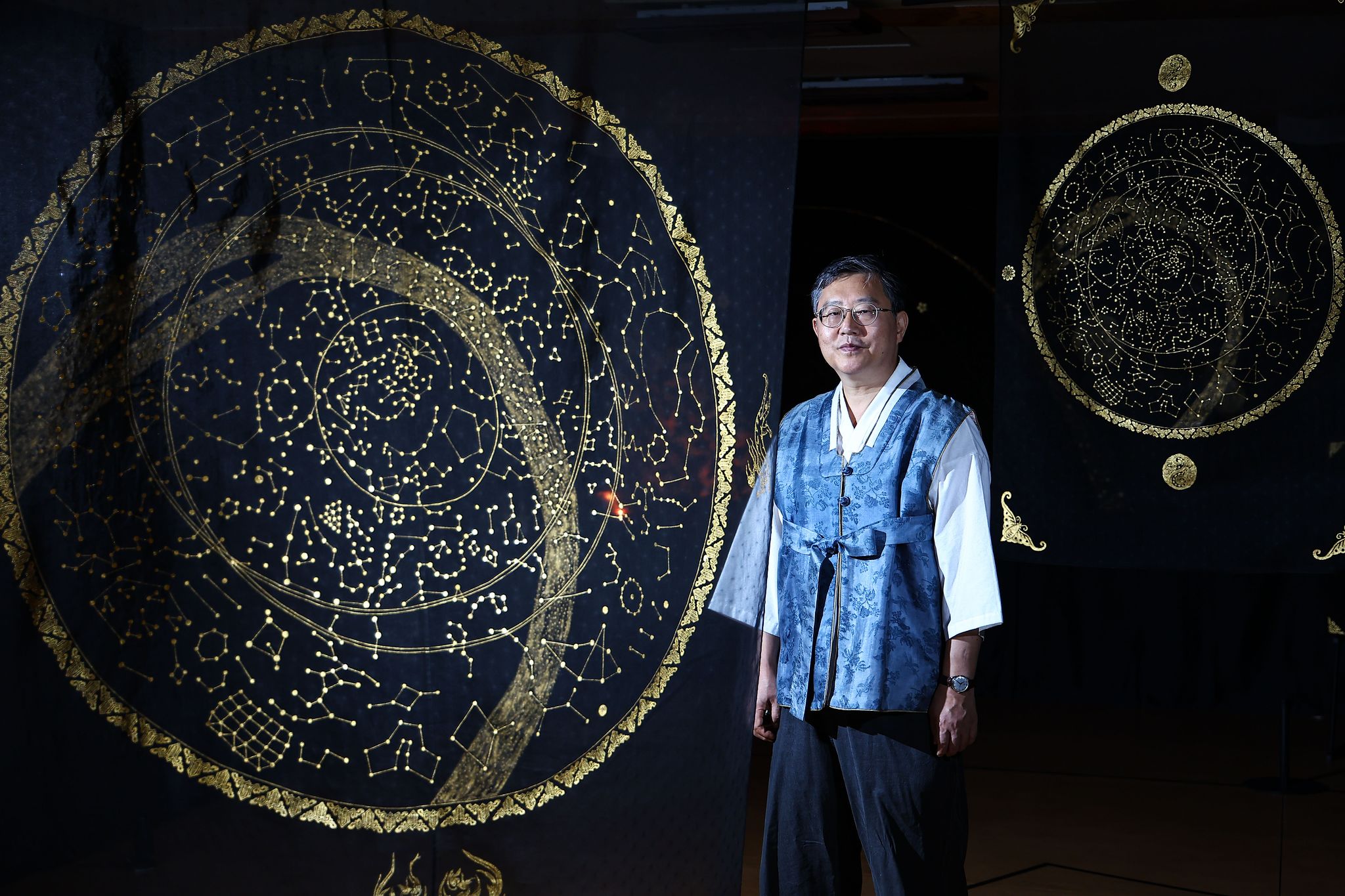
The color of gold is singular, but expression is infinite. Gloss and dimensionality vary depending on line thickness, negative space, and pressing pressure. When producing the ‘Cheon-sang-yeol-cha-bun-ya-ji-do’ (Chart of the Constellations), gold powder with less luster was deliberately used to express the Milky Way. Shading and depth were created with a single golden hue.
Master Kim owns over 500 types of gold plates. While simple patterns can be made in a single day, complex ones take nearly a year from conception to completion. A single dragon pattern once took two months to carve. The flower-and-su-bok pattern symbolizes longevity and good fortune, bats symbolize good fortune, peonies symbolize wealth and honor, and butterflies symbolize happiness. Even with the same gold plate, the impression of the work changes completely depending on the combination and arrangement of patterns.
Traditional patterns are reborn in his hands in new forms. The Four Guardian Deities from Goguryeo tomb murals, the Heavenly Horse from Cheonmachong, Goryeo Buddhist paintings, and the phoenixes from Joseon royal costumes were re-designed specifically for gold leaf. Recently, he also created a magpie-and-tiger pattern inspired by the modern ‘K-Pop Demon Hunters.’
Initially carved only in relief, he added intaglio plates on the spot when the golden light felt too heavy. A 180cm bojagi (wrapping cloth) crossing both pattern types to add depth was also showcased in a New York exhibition.
Gold leaf was originally a royal court culture used to decorate wedding and ceremonial attire for queens, princesses, and princesses of the second rank. After the disappearance of the royal court, it spread to commoners through wedding and first-birthday celebrations. Today, its scope extends beyond hanbok to neckties, scarves, jewelry boxes, and folding screens. Gold leaf is also utilized in diplomatic gifts and corporate collaboration pieces.
Master Kim was a robotics engineer at Samsung Electronics from 1993 to 1997. However, the sensitivity he developed from childhood by cutting pear wood and washing gold plates beside his father ultimately led him back to the family legacy.
“Science and art are no different. They are the same in that they seek new things and constantly experiment.”
Now, his son, who majored in animation, is learning the craft as the 6th successor. Master Kim states that while old methods must be strictly maintained for traditional attire like hanbok, creative freedom should be pursued in new fields. He also expressed aspirations to challenge himself in ‘spatial art,’ decorating a room like a universe in the future.
The exhibition ‘Golden Star, Meeting the Universe,’ highlighting Master Kim’s work and artistic value, is being held at ‘Mugewon’ in Jongno-gu, Seoul, from September 10 to November 1.
A thin sheet of gold leaf gains light and stories at the fingertips of an artisan. The ancient technique that embroidered royal garments is heading toward new materials and spaces across five generations. A golden glow that honors tradition without staying confined within it is now passing into the fingertips of the 6th generation.