Seventy-five years after the Korean War began, the remaining Korean American veterans face isolation, with their ranks thinning and public memory fading fast.
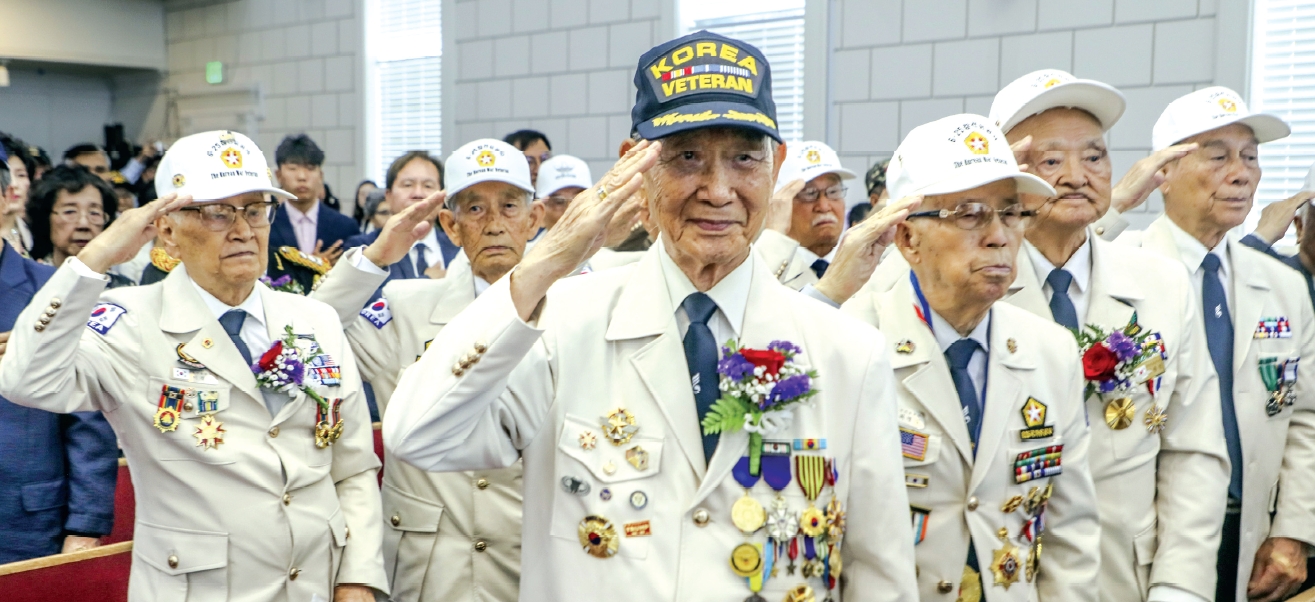
In 2019, there were more than 1,200 Korean War veterans of Korean descent in Southern California, according to community sources. Today, that number has dropped to around 150. Over the past five years, the pace of decline has accelerated due to aging. Currently, three to five veterans pass away every month.
The somber reality was on full display at the “75th Anniversary Korean War Commemoration” held on June 21 at Saehan Church in Los Angeles. Hosted by the Korean War Veterans Association (President Jae-Hak Lee), the ROKA Association (President Man-Kyu Choi), and the Korean War Commemoration Committee, the event aimed to honor the last surviving veterans.
Only 16 Korean veterans were in attendance—down from more than 20 last year. Their presence, once a proud symbol, is now a quiet reminder of a dwindling legacy.
“It’s heartbreaking,” said Lt. Col. Ji-Won Kang of the Republic of Korea Army, currently stationed in the U.S. “These veterans should be invited and honored. Instead, they’re the ones calling people and organizing the event themselves. That says a lot about the absence of proper support.”
For many, even attending is no longer an option. Most are over 90 years old. Some lack transportation. They simply give up on coming.
The event space felt emptier still. Though invitations were sent to major Korean American organizations, including the Korean American Federation of Los Angeles and the Korean American Chamber of Commerce of Los Angeles, few representatives appeared.
“The Korean War has become a forgotten story, even in our own community,” said Man-Kyu Choi, president of the ROKA Association. “The Korean organizations have turned their backs. No one tells the story. No one remembers. So of course, no one cares.”
“At this rate,” he warned, “the Korean War really will become the forgotten war.”
Jae-Hak Lee, who served as a student soldier and now leads the veterans association, shared a personal frustration.
“In the U.S., people have said to me on the street, ‘Thank you for your service.’ But from fellow Koreans? Not once.”
“I don’t expect thanks,” he added. “But I fought for my country. And sometimes, it feels like that means nothing. That hurts.”
The South Korean government provides a one-time or annual honor allowance of about ₩450,000 (approximately $325 USD) to overseas Korean War veterans. But without a Korean address, most are disqualified from additional local government support, which can reach ₩600,000. They are also excluded from veterans’ hospital care and other medical benefits in Korea.
A combination of government indifference, disengagement by Korean American organizations, lack of intergenerational education, and growing social distance has accelerated the speed at which these veterans are being forgotten.
“I still remember the day I crossed the border in 1952,” said Young-Geun Kang, now 90. “The rain poured down. Nearly all my comrades were killed.”
Tears welled up in his eyes. “I’m old now. And we don’t have many of these gatherings left. We need care. We need to be seen.”
The treatment of Korean American veterans remains alarmingly poor. Just as we pledge never to forget the Korean War, we must also ensure that its veterans—especially those who live among us—do not become forgotten heroes.
That responsibility is ours. And time is running out.
BY HANKIL KANG [kang.hankil@koreadaily.com]