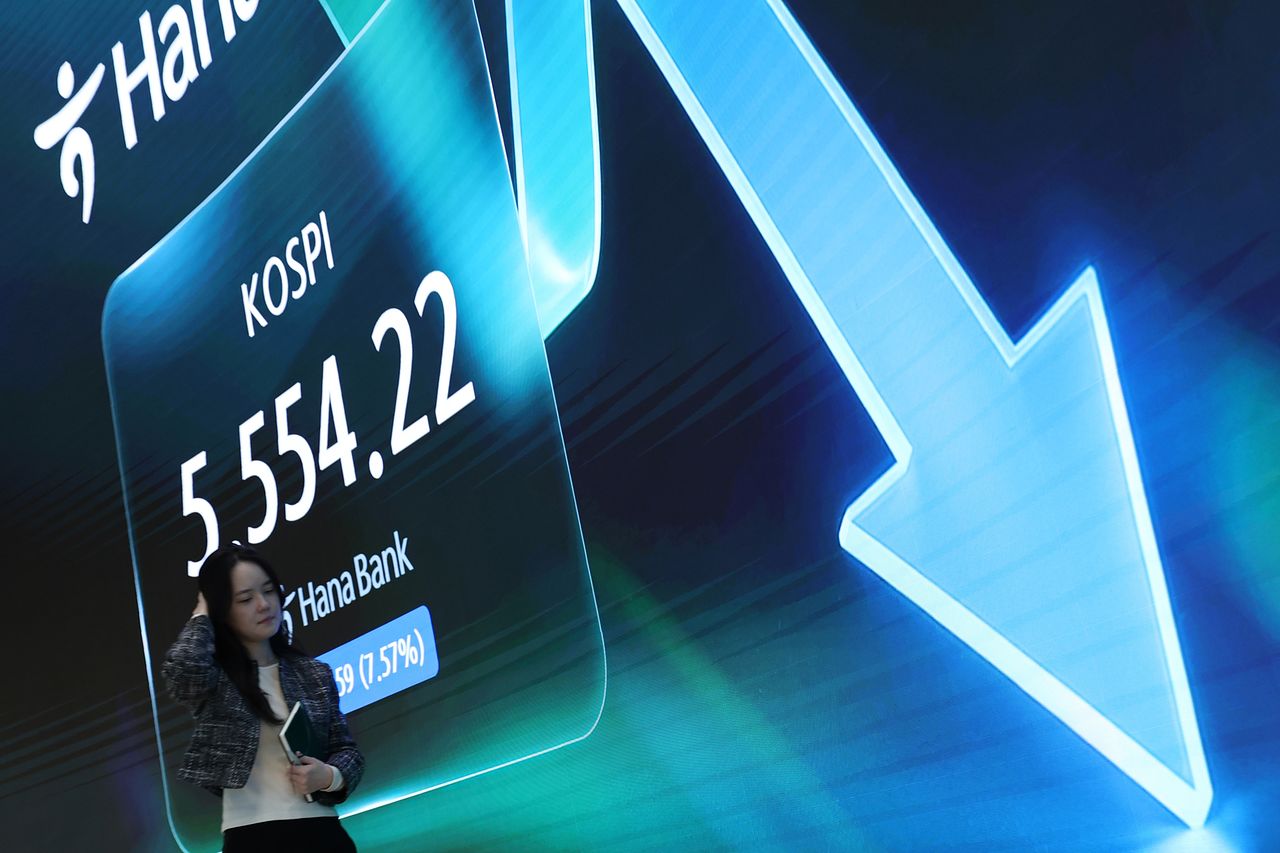
The South Korean stock market experienced a severe downturn as Kospi drop pressures intensified, sending the benchmark index tumbling for seven consecutive sessions to close at the 5500 level. During this prolonged slump, the index has plummeted by 21%, wiping out approximately 1.19 quadrillion won in market capitalization—a staggering figure equivalent to 1.6 times the South Korean government’s annual budget.
According to the Korea Exchange, the Kospi finished the trading day down 7.57% at 5,554.22. This marks the lowest closing level in over six months, dating back to April 7 when it sat at 5,494.78. During intra-day trading, the losses deepened to as much as 9.29%, briefly dragging the index down into the 5400 territory. The Kosdaq index also suffered a steep decline, plunging 7.65% to close at 760.82. Both major indices triggered circuit breakers, temporarily halting all trading for 20 minutes after dropping by more than 8%. This marks the 10th time circuit breakers have been activated this year.
Foreign Sell-Offs and Semiconductor Heavyweights Hit Hard
Foreign investors acted as the primary catalyst for the sell-off, offloading a massive 3.66 trillion won in equities on the main bourse. While institutional and retail investors stepped in to net-buy 1.68 trillion won and 1.32 trillion won respectively, their efforts were insufficient to halt the downward momentum.
The panic selling was heavily concentrated among semiconductor blue chips. Samsung Electronics plummeted 9.48% to close at 210,000 won, briefly touching an intra-day low of 204,500 won and threatening to fall below the psychological ‘200,000-won Samsung’ threshold. SK Hynix similarly nosedived 11.06% to finish at 1,262,000 won, after sinking as low as 1,238,000 won during the session.
The current 7-day losing streak marks the first time the market has dropped continuously without a single rebound day in roughly two years, since September 2024. Market analysts note that the psychological impact on investors feels significantly worse than the previous sharp correction in late July, when the index fell 17.2% over three consecutive sessions, leaving many uncertain about where the market bottom truly lies.
Macroeconomic Headwinds and Lacking Rebound Catalysts
A cascade of negative news has heavily weighed on investor sentiment. Concerns mounted over Chinese memory chipmaker CXMT advancing on domestic semiconductor technology, alongside plunging bond prices for U.S. AI cloud firm CoreWeave, which reignited skepticism regarding debt-financed artificial intelligence investments. Additionally, hotter-than-expected U.S. consumer price index (CPI) figures for September fueled renewed fears of prolonged high interest rates.
Financial authorities have characterized the market reaction as excessive. During an emergency meeting convened with related institutions and market experts, officials from the Financial Services Commission noted that while market volatility has expanded, the velocity of the decline and the supply-demand dynamics reflect an overreaction. They emphasized that key domestic industries such as semiconductors, defense, and shipbuilding continue to post solid earnings with robust economic fundamentals, urging caution against the spread of excessive anxiety and herd behavior.