Office worker Mr. Lee, 35, has been steadily purchasing semiconductor stocks since the first half of this year. The funds used were 50 million won borrowed through a credit loan. Facing a market slump this month, his valuation losses have exceeded 10 million won. Mr. Lee said, “Even if I wanted to buy more to average down, I have no ammunition left,” adding, “The Kospi needs to hit 7,500 for me to break even, and I’m worried about how to survive until my loan matures next June.”
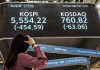
As the Kospi plunges day after day, anxiety among retail investors is mounting. Especially for ‘debt-investing’ ants who borrowed money to invest, the risks extend far beyond simple loss expansion into the danger of ‘margin calls.’ Fears are even rising that a ‘margin call’ domino effect is becoming a reality.
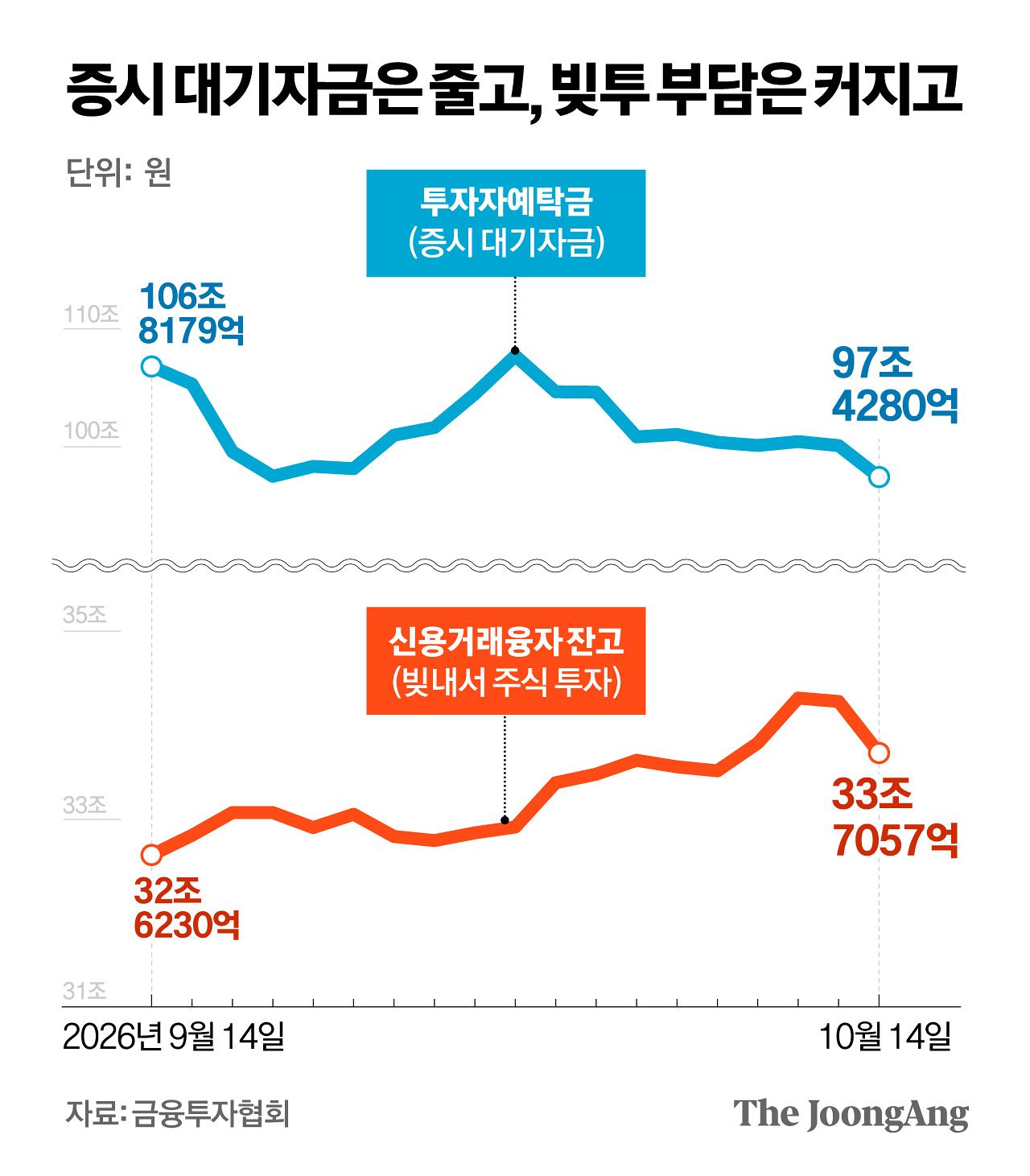
According to the Korea Financial Investment Association on the 15th, the credit transaction loan balance stood at 33.7057 trillion won as of the 14th. This is an increase of about 6.7 trillion won in just over two months from the 27 trillion won range in early August. Credit financing involves borrowing money from securities firms to buy stocks; while it can generate profits when the market rises, losses are multiplied during a downturn.
The problem is that if stock prices plummet and collateral value drops below a certain level, investors can be hit with demands for additional collateral or face forced liquidation of their holdings. On the 14th, the forced liquidation amount for unsettled transactions (where a portion of the purchase price is paid later) reached 89,336 million won, recording the highest scale since July 31st. Compared to 6.359 billion won on the 8th, this is a 14-fold increase. This is interpreted as a surge in margin calls driven by the widening market drop. Professor Lee Min-hwan of Inha University’s Department of Finance and Management pointed out, “If a vicious cycle of forced selling volumes driven by margin calls continues, the downward trend in stock prices could be prolonged.”
Undertransaction unsettled amounts, an ultra-short-term ‘debt-investment’ indicator, are also on the rise. As of the 14th, unsettled consignments stood at 1.3575 trillion won, increasing for four consecutive trading days since the 7th of this month (931.6 billion won). Consignment unsettled amounts refer to funds that investors failed to pay in full by the settlement date after purchasing stocks. The ratio of margin call amounts to unsettled balances jumped from 0.7% to 7.2% in just three trading days.
General retail investors are falling into a similar panic as the continuous market slump expands account losses to unmanageable levels. Among investors who were turning a profit this year, many have given up their gains and fallen back into principal loss territory.
A 30-year-old investor living in Seongdong-gu, Seoul, said, “I had been actively trading back and forth recently, but since a couple of days ago, losses have reached 10%, preventing me from even selling,” and added, “The amount lost over the past few days alone exceeds 10 million won.” A 40-year-old office worker who took out a bank loan to invest in domestic semiconductor stocks said, “The losses have grown so large that they are hard to cover with the loan,” and added, “I would love to average down if I could, but my funds have bottomed out.”
Major securities communities have also been flooded with posts lamenting huge losses and worrying about further crashes. One investor wrote, “I lost 100 million won. Give me back my money, foreigners.” A retail investor focused on Samsung Electronics self-deprecatingly noted, “Samsung Electronics won’t go bankrupt. The one going bankrupt is me.” Pleas such as, “I bought this to supplement my retirement living funds, but suffered a 17% loss. Buying more is terrifying,” also emerged. Outraged posts directed at the government were also uploaded, asking, “If stocks are like this, shouldn’t the government do something?” and “Are you running the stock market just to drain individual blood?”
So-called ‘Seohak ants’ (Korean retail investors investing overseas), who turned away from the domestic market to eye the U.S. stock market, are also left in despair. On the 14th (local time) in New York, the Direxion Daily Semiconductor Bull 3X Shares (SOXL), heavily backed by Seohak ants, plummeted 13.35% from the previous trading day to close at $110.54, marking its largest drop in a month.
The waiting buying momentum supporting the stock market is also weakening. Investor deposits, which serve as standby funds for stock purchases, dropped to 97.428 trillion won on the 14th, down 2.6703 trillion won from the previous day and falling below the 100 trillion won mark. Compared to the peak in June (139.6948 trillion won), this represents a decrease of about 42 trillion won. Hwang Seung-taek, head of research at Hana Securities, stated, “As the buying base to absorb foreign selling concentrated on large-cap semiconductor stocks weakens, downward pressure is amplifying.”