Samsung Electronics has opened the era of a 100-trillion-won quarterly operating profit for the first time among global big tech companies. Driven by a surge in demand for artificial intelligence (AI) chips and the continued ‘sell-out’ streak of high-bandwidth memory (HBM), the company outpaced Nvidia and Apple to maintain the top spot in tech corporate earnings for the second consecutive quarter.
However, the market reaction was cold. Although its cumulative operating profit for the first three quarters of this year (254 trillion won) is roughly 40% higher than that of SK Hynix, the scale of its shareholder returns remained at a similar level. The failure to reveal concrete execution plans for the remaining 55 trillion to 75 trillion won out of a maximum 110 trillion won in shareholder return resources also acted as a negative factor.
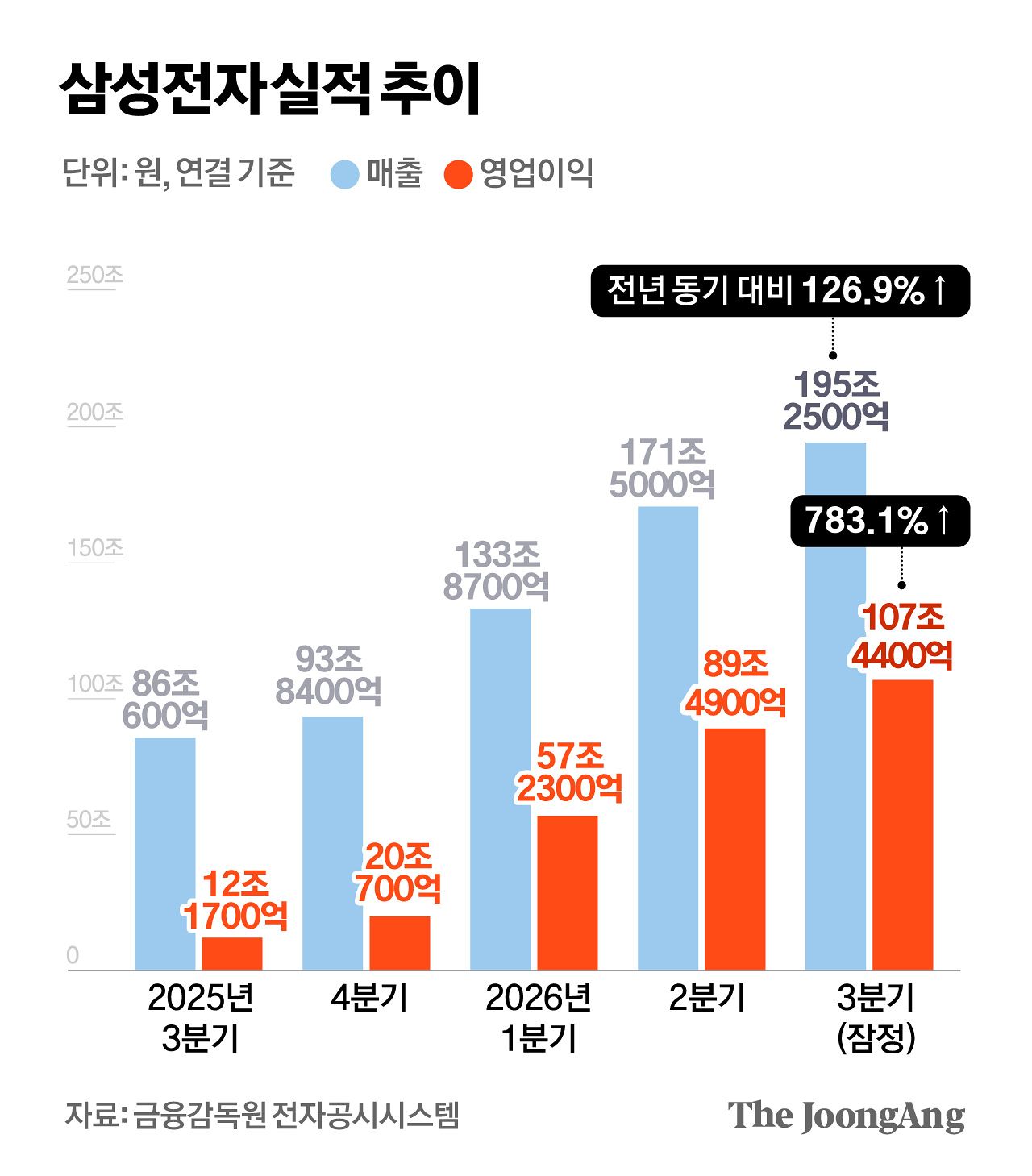
Samsung Electronics announced on the 29th that it recorded consolidated third-quarter revenue of 195.25 trillion won and an operating profit of 107.44 trillion won. Compared to the same period last year, revenue surged by 126.9% and operating profit by 783.1%. This means the company earned approximately 1.17 trillion won every single day over the three-month period.
The primary contributor was the Device Solutions (DS) division. The DS division’s third-party operating profit skyrocketed 99.5% year-on-year to 106.5 trillion won, translating to an hourly profit rate of 800 million won per minute. Sales of high-value-added 6th-generation HBM4 products exploded by more than three times compared to the previous quarter, accounting for 60% of total HBM sales, while rising generic memory prices further boosted profitability. Excluding deficit-ridden businesses like foundry and system LSI (semiconductor design), the profit margin for the memory business is estimated at 77%, comparable to SK Hynix’s 80%.
Future demand has also been secured through long-term supply agreements (LTAs). Kim Jae-jun, executive vice president of the Memory Business Division, stated, “HBM supply and demand will remain tight through 2028. Next year’s HBM supply volume is already sold out at target prices, and continuous requests for additional supply are coming in from major clients.” As long-term contract demand spreads beyond AI servers to mobile, automotive, and network sectors, the company plans to prioritize 60% to 70% of its production volume for multi-year contract customers through 2030. Kim added that the company has currently signed multi-year supply contracts with 10 global large-scale clients and is in additional negotiations with 10 others. Mass production of the next-generation 7th-generation HBM4E is scheduled for the first half of next year.
Meanwhile, the Device eXperience (DX) division posted an operating loss of 800 billion won, continuing its deficit for the second consecutive quarter. In particular, the Mobile eXperience (MX) business, responsible for smartphones, suffered a 600-billion-won loss despite an 11% increase in revenue driven by new product launches. The burden of rising generic DRAM prices used in smartphones squeezed profitability. This represents the ‘paradox of memory,’ where the DS division’s stellar performance coincides with the profitability deterioration of the MX division under the same roof. The Visual Display (VD) and Digital Appliances (DA) divisions also recorded an operating loss of 200 billion won due to rising logistics costs.
On this day, Samsung Electronics resolved to execute a cash dividend worth 30 trillion won (4,601 won per share) for the third quarter. This is part of its plan to allocate 50% of its free cash flow (FCF) to shareholder returns over the three-year period starting in 2024. The total shareholder return scale earmarked for this year is between 90 trillion and 110 trillion won.
Despite the record-breaking performance and shareholder return announcements, stock prices failed to rally. In regular trading, Samsung Electronics closed down 4.13% at 232,000 won per day. The stock plummeted around 10 a.m. when the conference call began, plunging as much as 6% during the intraday session.
The drop occurred because the company postponed the disclosure of detailed execution plans for the remaining shareholder return resources (55 trillion to 75 trillion won) to the end of January next year, failing to deliver the additional treasury stock purchase and cancellation plans the market had anticipated. Lee Kyung-min, an analyst at Daewoo Securities, analyzed that investor sentiment shrank due to the lack of specific shareholder return plans.
The ‘jinx’ in which Samsung Electronics’ stock price falls on its earnings announcement days repeated this time, following January, April, and July of this year. It is the result of soaring expectations for shareholder returns matching the elevated height of earnings expectations. Conversely, SK Hynix, which surged 10% the previous day after announcing a massive additional shareholder return policy, climbed another 2.62% to close at 1,526,000 won.